Body-Check · a Dr. Water check-up
Hi. I’m Dr. Water 🐬. I’m a doctor — the kind who keeps working adults healthy (occupational and preventive medicine).
I need to confess something up front: “ZA WARUDO! Toki yo tomare!” — The World! Time, stop! — is, to me, the single most thrilling three seconds in all of manga. So this is not a takedown. This is a love letter that happens to come with a stethoscope.
Because the moment DIO freezes time and walks, unbothered, through a world of frozen knives and frozen people, a doctor’s brain asks a very specific question: what would a real human body actually do inside a stopped second? Could you even notice it? Could you breathe? Could you move a single muscle? And — the one that keeps me up at night — what happens to the person left frozen when time starts again?
So today, not as a review but as a story about your body, I’ll check four steps of the time-stop miracle. Short version up front: the feeling that time can stretch in a crisis has a real, well-studied kernel of truth — but “get up and walk around inside a frozen world” is where biology quietly says absolutely not.
📺 Want to read it the legit way? JoJo’s Bizarre Adventure is available through Shueisha’s official channels (availability varies by Part/region — link to whatever’s official where you are).
The house rules
I’m not here to judge the series. I’m here to ask, “if a human body were in a stopped second, what would really happen?” — and back every medical claim with a paper.
Q1 | Could you even perceive stopped time? — the “slow-motion” you feel in danger is real, but it isn’t what you think.
Let’s start with the part that feels closest to true, because almost everyone has felt a version of it. You’ve heard people say that in a car crash or a fall, “everything went into slow motion.” DIO’s power looks like the ultimate version of that: perception so fast that the rest of the world freezes. So is that real?
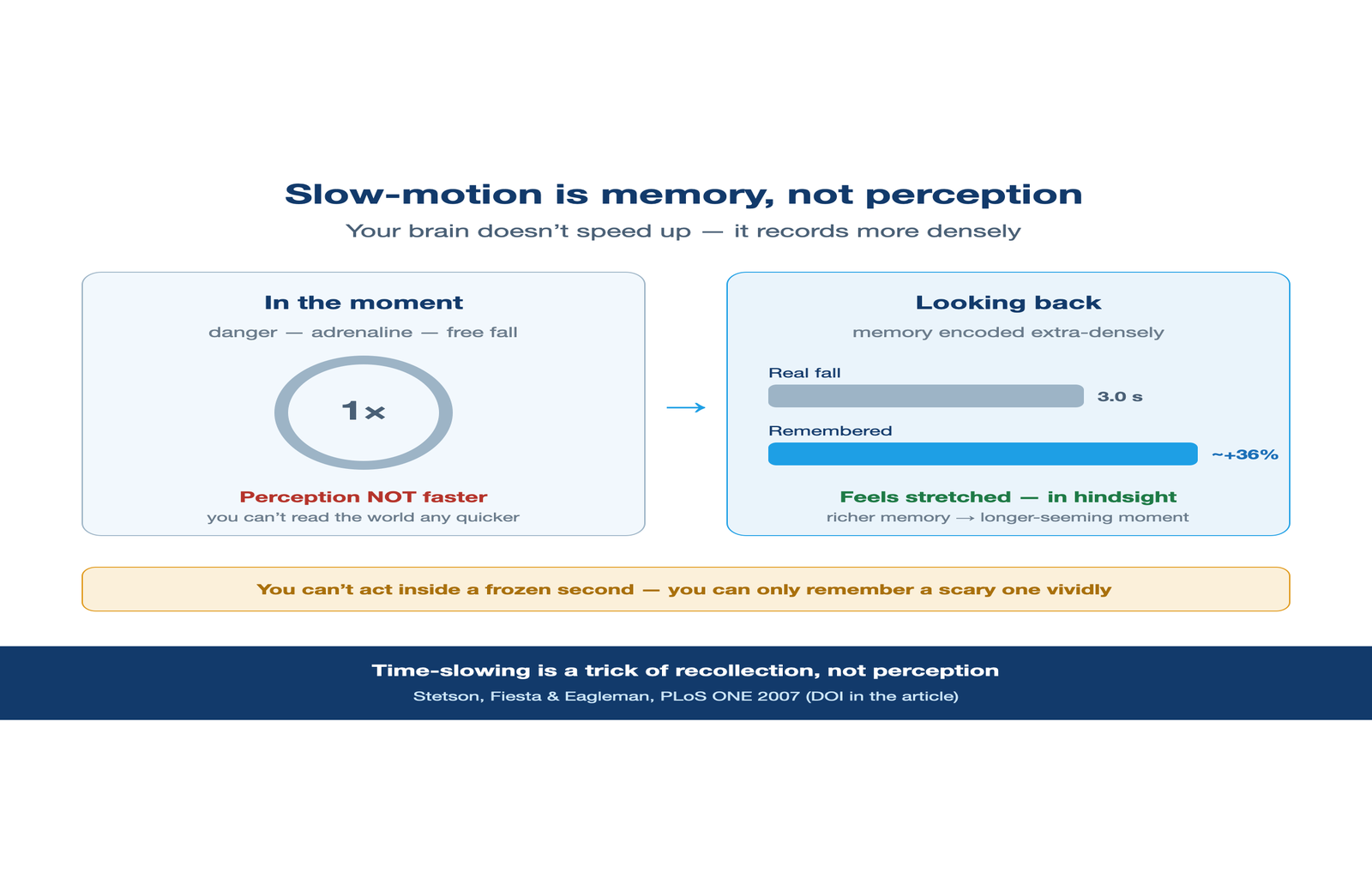
Here’s the beautiful, humbling answer from actual research. Scientists tested this directly by dropping volunteers backwards off a 150-foot tower into a safety net — a genuinely terrifying, adrenaline-soaked free fall — while measuring whether their eyes and brain could actually read information faster during the fall. The result: no. People did not gain super-fast perception. But afterward, they estimated their own fall as having lasted about a third longer than it really did (Stetson, Fiesta & Eagleman, PLoS ONE 2007).
Read that again, because it’s gorgeous: the slow-motion feeling is not your brain speeding up in the moment. It’s your brain laying down memories more densely during a frightening event, so that when you look back, the moment feels stretched. Time-slowing is a trick of recollection, not perception.
Which means DIO’s premise — perceiving and acting inside a frozen instant — isn’t an exaggeration of a real ability. The real “slow motion” is a memory effect that happens after the danger, when your body is safe again. In the actual dangerous moment, you are not moving faster than everyone else. You just remember it richly.
Takeaway ①: The “time slowed down” feeling in a crisis is real — but it’s your memory getting denser, not your body getting faster. You can’t act inside a frozen second; you can only remember a scary one vividly.
 Dr. Water
That “time slowed down” feeling in a crisis is real — but it’s your memory getting denser, not your body getting faster. You can’t act inside a frozen second, only remember a scary one vividly. 🐬
Q2 | Inside a truly frozen world, could you breathe or stay conscious? — this is where physics quietly turns cruel.
Okay, but suppose we grant the fantasy: somehow you keep moving while the world is frozen. Great — except now every part of your survival depends on things that also just stopped.
Here’s the clean way to think about it. There are only two ways the fiction can work, and it has to pick one.
Option A — everything really stops, including you. If time is truly frozen, then your metabolism is frozen too: your brain isn’t burning any oxygen, so it doesn’t matter that no blood is flowing. Nothing bad happens to you — but you also can’t move, think, or act, because you’re one of the frozen things. This is a perfectly safe world to be a statue in. It’s a terrible world to be a hero in.
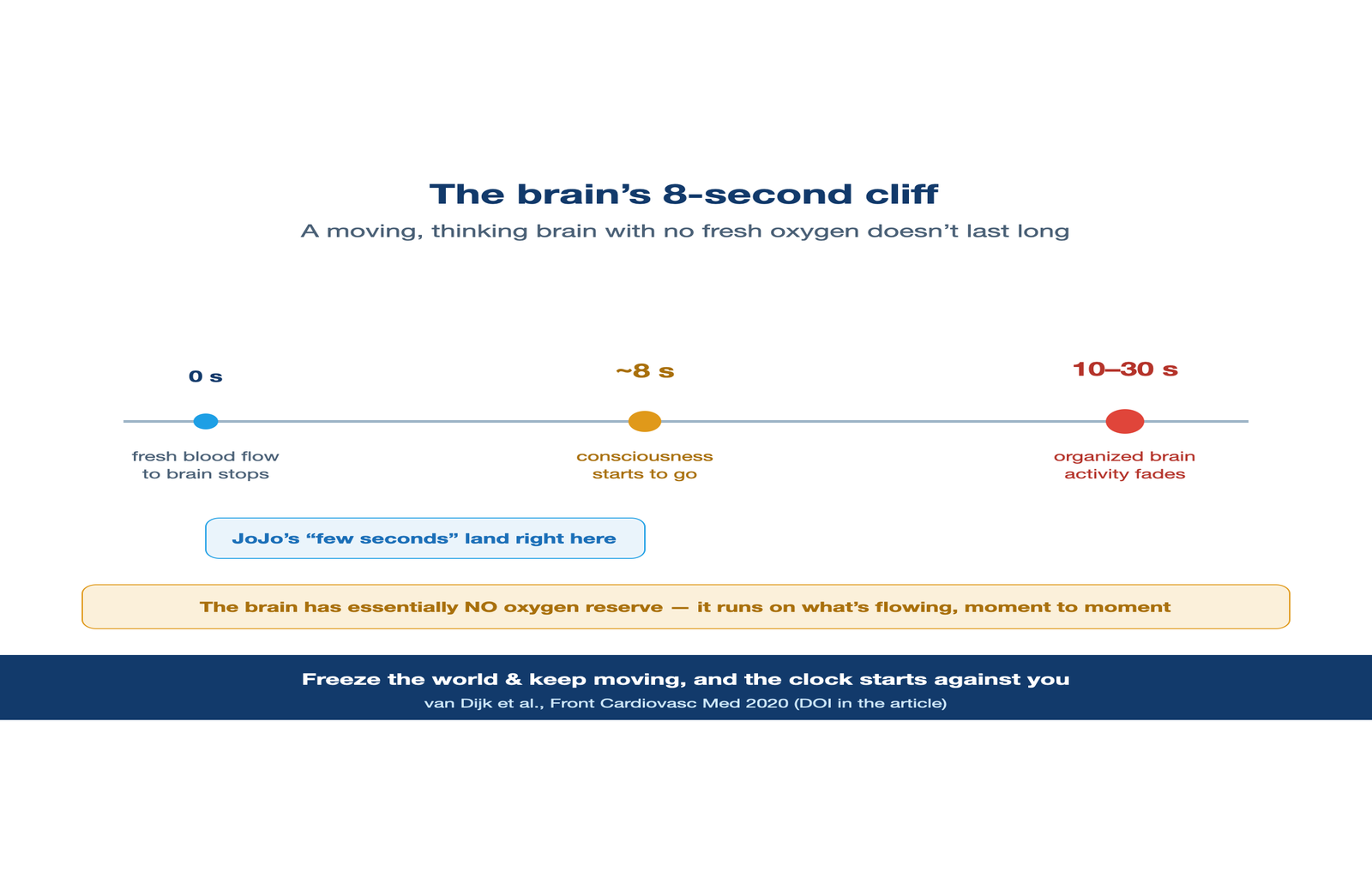
Option B — the world stops but you keep running. This is what DIO actually does: he moves, sees, thinks. But a moving, thinking brain is burning oxygen in real time — and in a frozen world, nothing is resupplying it. The air molecules aren’t moving, so a breath is inert; the blood in a paused world isn’t circulating fresh oxygen up to the brain. And your brain is the most oxygen-hungry organ you own, with essentially no reserve. When fresh blood flow to the brain stops, loss of consciousness begins within roughly 8 seconds, and organized brain activity fades within about 10–30 seconds (van Dijk et al., Frontiers in Cardiovascular Medicine 2020).
So the fiction is caught in a beautiful bind. Freeze everything (Option A) and you’re safe but frozen. Keep yourself running (Option B) and the clock starts: a brain cut off from fresh oxygen has only a handful of seconds before the lights go out. And here’s the eerie part — the “a few seconds” that JoJo characters get to move in stopped time lands right at the edge of that real physiological limit. The series didn’t pick that duration at random; it’s almost exactly how long a real brain could keep working on no new oxygen. The true magic isn’t the walking around — it’s whatever keeps the hero’s brain fed while the world is switched off.
Takeaway ②: The fiction has to choose: freeze everything (safe, but you can’t move) or keep yourself running (you move — but a brain with no fresh oxygen fails in ~8 seconds). The “few seconds” of frozen time isn’t arbitrary; it’s uncannily close to how long a real brain lasts when the supply is cut. The magic is in feeding the brain at all.
Dr. WaterThe story has to choose: freeze everything and you’re safe but can’t move, or keep running and your oxygen-starved brain fails in about 8 seconds. That “few seconds” of stopped time sits eerily close to a real limit. 🐬
Q3 | The frozen victims — and the pose you’d have to hold. — being paused is the safe part; standing still is the dangerous one.
Now flip the camera. Most people in a JoJo time-stop aren’t the one moving — they’re the ones frozen mid-step, knives hanging in the air. What happens to them?
Here’s the reassuring bit, and it’s the same principle I love in a lot of “suspended” fiction: if a body is truly paused — no metabolism, no clock, nothing ticking — then when time restarts, nothing has been lost. A genuinely frozen instant is, biologically, the safest possible state, because zero time has passed for that body. The victims who simply resume are the one part of the fantasy that, granting the premise, actually holds together.
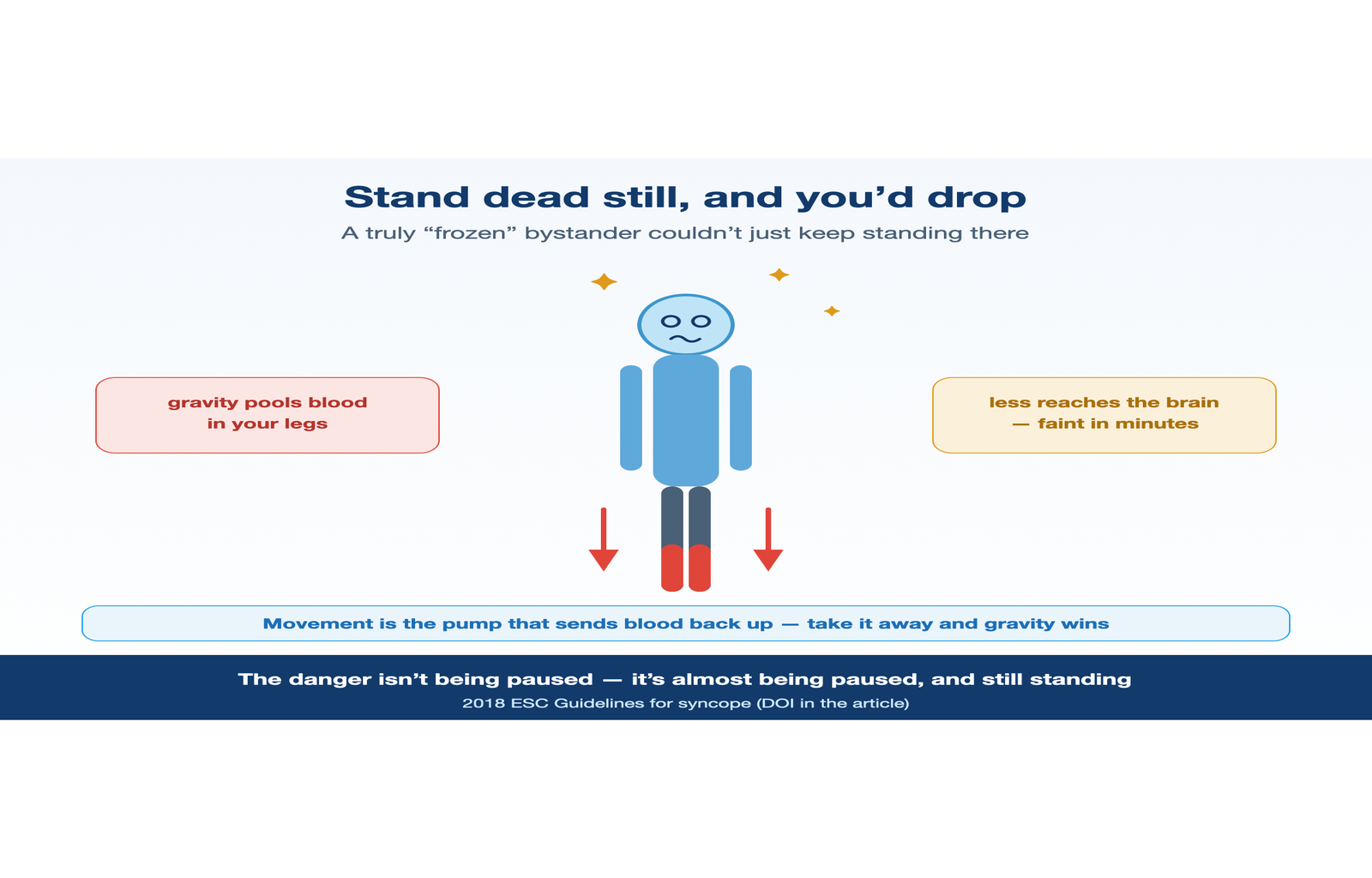
The danger isn’t in being paused — it’s in almost being paused. Consider what a real body does when it just holds still, upright, without moving, the way a frozen figure would appear to. Standing motionless makes blood pool in the veins of the legs under gravity; central blood volume drops, and within minutes a perfectly healthy person can feel lightheaded and faint. It’s a classic occupational and military problem — the soldier who locks their knees at attention and crumples on the parade ground, where “prolonged standing” is a well-recognized trigger for fainting (Brignole et al., European Heart Journal 2018). Movement is what pumps blood back up; take it away and gravity wins.
So the honest medical picture is almost the reverse of the drama. A body that is genuinely stopped is fine. A body forced to hold a rigid, motionless pose in real time is the one in trouble. Being frozen is safe; standing frozen is not.
Takeaway ③: If time truly stops, the frozen bystanders are the ones who are actually fine — zero time passed for them. The real hazard is motionless standing in ordinary time, where blood pools and healthy people faint. Fiction has it backwards: the pause protects you; the pose doesn’t.
Dr. WaterIf time truly stops, the frozen bystanders are actually the safe ones — zero time passed for them. The real hazard is motionless standing in ordinary time, where blood pools and healthy people faint. 🐬
Q4 | ⚠️ The line I actually respect — and why I still stand up and shout “toki yo tomare.” Straight-faced here.
Let me be honest about the leap, the way the series would want me to. There is no known way to move through a world where time has stopped, breathe frozen air, or keep a brain conscious while its blood supply is switched off. That’s the creative leap, and it’s a magnificent one. Fiction is allowed leaps — what I ask is only that a story be honest that it’s leaping, and JoJo, with its whole operatic soul, absolutely is.
And here’s the part that genuinely humbles me as a doctor. The feeling the power is built on — that in the most dangerous moment of your life, time seems to stretch and you see everything — is real. It’s just not a superpower; it’s your brain protecting you by burning a scene into memory in extraordinary detail (Stetson et al., 2007). People who survive crashes and falls really do describe a stretched, vivid, slow-motion second. Your nervous system already does a quiet, ordinary version of “the world slows down” — not to let you move faster, but to let you remember. That’s not as loud as a golden vampire freezing the sky. But it’s real, it’s yours, and honestly it’s wonder enough for me.
So — enjoy the time-stop as the beautiful leap it is, and respect the real, stranger physiology underneath it. The body can’t stop time. But it can, in your worst three seconds, hand you a memory so dense it feels like it did.
— Confession: I have, as a grown physician who should know better, stood up in my living room and yelled “toki yo tomare” at a screen. I regret nothing. The science just makes me love it more, because now I know exactly which impossible corner the series is quietly cutting — and how close to real human limits it dared to park the clock.
Takeaway ④: Moving in stopped time is fiction’s leap; the stretched, vivid “slow-motion” of a crisis is real — a memory effect, not a superpower, and quietly amazing on its own.
Dr. WaterMoving in stopped time is fiction’s leap. But the stretched, vivid slow-motion of a crisis is real — a memory effect, not a superpower, and quietly amazing on its own. 🐬
The verdict: fantasy vs. real
| Belief | Verdict |
|---|---|
| In danger, time can feel like it slows to a crawl | ○ true — but it’s denser memory, not faster perception |
| You could consciously act inside a frozen second | ✕ fantasy (no perceptual speed-up exists in the moment) |
| You could breathe and think in a fully stopped world | ✕ fantasy — a brain blacks out within ~8s of flow stopping |
| “A few seconds” is a suspiciously realistic limit | ○ eerily close to how long a brain lasts on no oxygen |
| The frozen bystanders are unharmed when time resumes | ○ true if the pause is genuine (zero time passed for them) |
| Holding a rigid, motionless pose is harmless | ✕ real bodies pool blood and faint from motionless standing |
Wrap-up
JoJo does something I find quietly brilliant: it builds its most impossible power right up against a real human limit. A brain really does have only a handful of seconds without oxygen. Time really does feel like it stretches when your life is on the line. The series takes those true, unsettling facts and pushes them one theatrical step past the wall into pure, glorious fantasy.
Real medicine can’t stop a second. But it knows, with unnerving precision, exactly how long you’d have if one stopped for you — and it knows that the slow-motion you feel in a crisis is your own mind, doing something extraordinary and completely real. Which is maybe the most JoJo lesson of all: the truth underneath the fantasy is stranger, and somehow even cooler, than the pose.
Manga is a doorway into how strange the human body is. And the real body, it turns out, keeps its own clock in a place no Stand can reach.
See you at the next check-up.
📚 Following the series? This was a 〈Body-Check〉. More anime, fact-checked by a doctor, is on the way. Get each new check-up in your inbox — subscribe free.
Dr. Water — physician in occupational and preventive medicine, and a die-hard anime/manga fan (a double insider).
Frequently Asked Questions
Is the feeling that time slows down during a car crash or dangerous moment scientifically real?
Yes, the feeling is real, but it isn’t your brain speeding up in the moment. Researchers who dropped volunteers in a free fall found their perception did not actually get faster during the fall, but afterward they estimated the fall lasted about a third longer than it really did. The “slow motion” effect comes from memory being laid down more densely during fear, not from faster real-time perception.
Could a person actually stay conscious and keep moving if time truly stopped around them?
No — a moving, thinking brain burns oxygen continuously, and in a genuinely frozen world nothing would resupply that oxygen since air and blood wouldn’t be circulating. When fresh blood flow to the brain stops, consciousness is lost within roughly 8 seconds, and organized brain activity fades within about 10–30 seconds. A character who “moves” through stopped time would have only a few real seconds before their own oxygen-starved brain shut down.
Is it dangerous to stand completely still for a long time without moving?
Yes — standing motionless allows blood to pool in the veins of the legs under gravity, and within minutes a perfectly healthy person can start to feel lightheaded and faint. This is a well-recognized problem in real life, such as soldiers fainting after locking their knees at attention. Movement is what pumps blood back up to the rest of the body; take it away and gravity wins.
Disclaimer 1 | Medical
This article is general, educational medical commentary sparked by a work of entertainment. It is not medical advice and not intended to diagnose or treat. Reading it creates no doctor–patient relationship. For any health decision, consult your own physician. The author is a doctor, but these views are general and personal, and the author is not your doctor. Nothing here is a guide to breath-holding, inducing fainting, or restricting blood flow; do not attempt any of it. If you or someone else faints, loses consciousness, or does not recover quickly, seek emergency care.
Disclaimer 2 | Copyright & Non-Affiliation
This site is an independent, unofficial fan commentary/criticism work. It is not affiliated with, endorsed by, or sponsored by any anime/manga studio, publisher, author, or rights holder. All titles, characters, logos, and trademarks belong to their respective owners and are referenced here solely for identification, commentary, and criticism. This site does not reproduce copyrighted works (panels, screenshots, or text) without authorization; this article uses no manga panels. Rights holders with concerns: please contact us and we will respond promptly.
🩺 Your check-up is over — but the clinic is always open
📚 This clinic has a sequel. 14 legendary monsters — vampire, zombie, werewolf and more — properly diagnosed by a real doctor. The book this blog grew into, with new write-ups added. → Get it on Amazon — $3.99 / free on Kindle Unlimited
💌 Free newsletter — new diagnoses delivered to your inbox, no appointment needed. → Subscribe on Substack
▶️ Prefer video? Watch the diagnoses on YouTube. → The Anime MD








Comments