Hi. I’m Dr. Water 🐬 — a doctor who keeps working adults healthy (occupational and preventive medicine).
Welcome back to the Monster Clinic (怪物外来), the room where a monster shows up not as a threat but as a patient, and I do what a doctor does: take a history, examine, and ask, gently, what is actually going on here?
Today’s patient isn’t a creature with fur or fangs. It’s a rumor — maybe the most famous one in the history of archaeology. In 1922, Howard Carter’s team broke into the tomb of the boy-king Tutankhamun. A few months later, his patron Lord Carnarvon was dead. The newspapers did the rest: the pharaoh’s curse strikes down all who disturb his rest. A hundred years on, “the mummy’s curse” is shorthand for supernatural revenge from beyond the grave.
Here’s what makes it a perfect case for this clinic. The curse story has three real medical stories folded inside it — and they point in opposite directions. First: when you actually count the bodies, the curse mostly evaporates. Second: some sealed tombs really do contain something that can hurt you — and it isn’t a ghost, it’s a fungus that can lie dormant, alive, for thousands of years. Third: that fungus causes a genuine, sometimes-fatal human disease we treat in hospitals today. So the honest answer isn’t “the curse is fake” or “the curse is real.” It’s more interesting than either.
The house rules
I love a good curse story, and I’m not here to spoil anyone’s fun. I am here to separate the ghost from the germ — because one of them is real, still out there, and worth respecting. Every medical claim gets backed by a source, and I’ll be honest about which parts are solid science and which are famous-but-thinly-sourced legend. These are real diseases affecting real people; I write about them the way I’d want a doctor to write about me.
Q1 | Did everyone who entered the tomb really die young? — No. When a doctor counts, the curse mostly disappears.
Start with the claim itself, because it’s testable — and, wonderfully, someone tested it. The legend says exposure to the tomb was deadly. That is exactly the shape of a question epidemiology is built to answer: take the people who were “exposed,” compare them to a similar “unexposed” group, and see whether exposure actually shortened their lives.
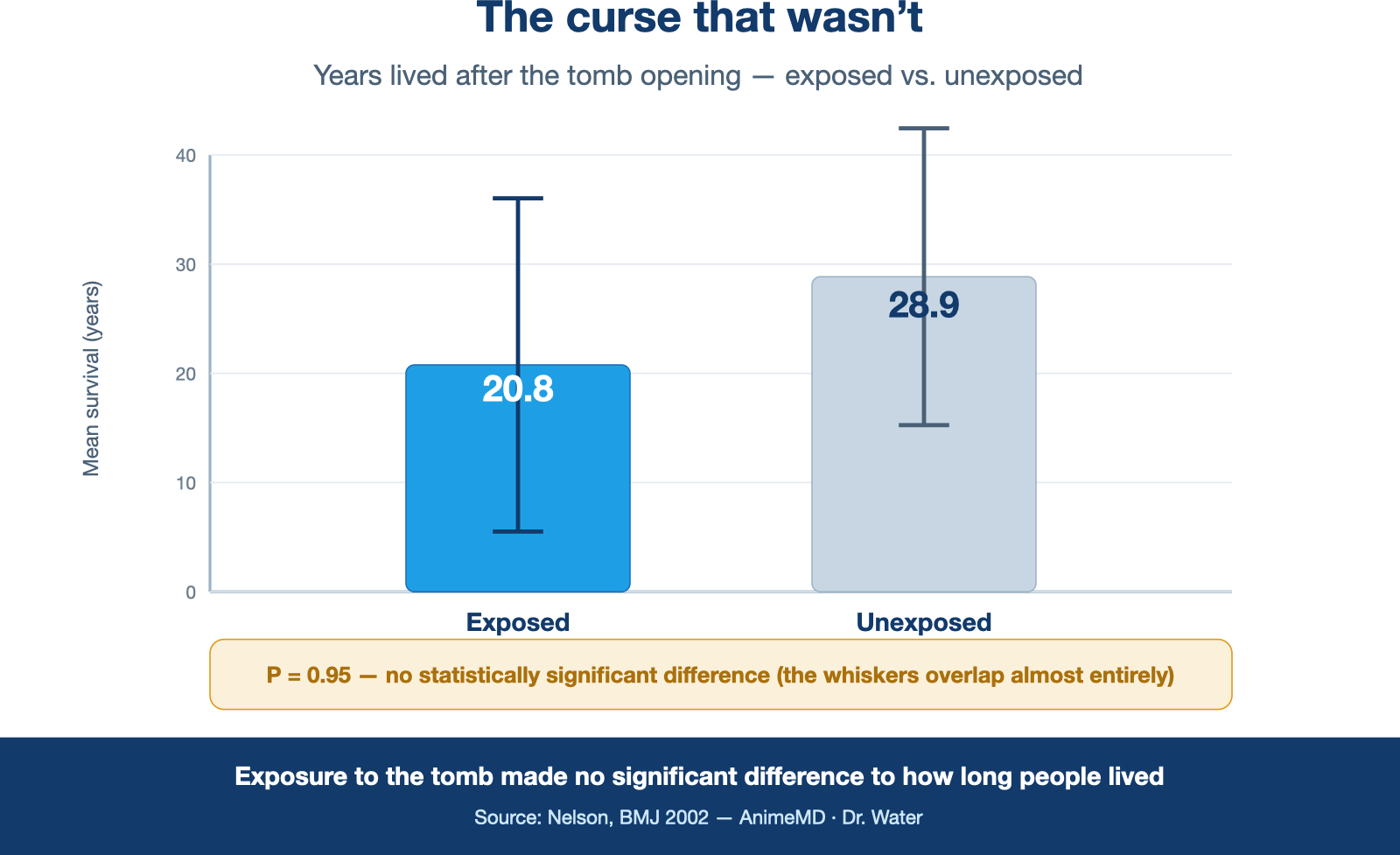
A physician-epidemiologist did precisely this and published it — in, of all places, the BMJ‘s famous Christmas issue (Nelson, BMJ 2002). He went back to Howard Carter’s own records, identified the Westerners present at the key tomb-opening events between 1923 and 1926, sorted them into exposed and unexposed, and tracked how long each one actually lived.
The result is beautifully anticlimactic. Of the 25 people identified as exposed, their mean survival after exposure was 20.8 years; the unexposed comparison group averaged 28.9 years — a difference that was not statistically significant (P=0.95). His conclusion, in plain words: there was no evidence to support the existence of a mummy’s curse.
So what happened to Lord Carnarvon? He almost certainly died of an infected mosquito bite that turned into blood poisoning — a sad, ordinary, entirely un-supernatural death, in an era before antibiotics. The “curse” was mostly a trick of memory and headlines: a handful of dramatic deaths get remembered and retold, while the many tomb-openers who lived to a comfortable old age get quietly forgotten. That selective spotlight is a cousin of survivorship bias — and it’s how almost every curse, jinx, and lucky charm survives contact with reality.
Takeaway: The headline version of the curse fails the most basic test. When a doctor counts the people who entered Tutankhamun’s tomb and measures how long they lived, exposure made no significant difference (Nelson, BMJ 2002).
Q2 | Can a sealed chamber really hold something that hurts you thousands of years later? — Yes. And it’s alive.
Now flip it around. Strip out the ghost and ask a real occupational-health question: is there anything physically dangerous about being the first person in millennia to open a sealed tomb? Sometimes, yes. Not because of magic — because of mold.
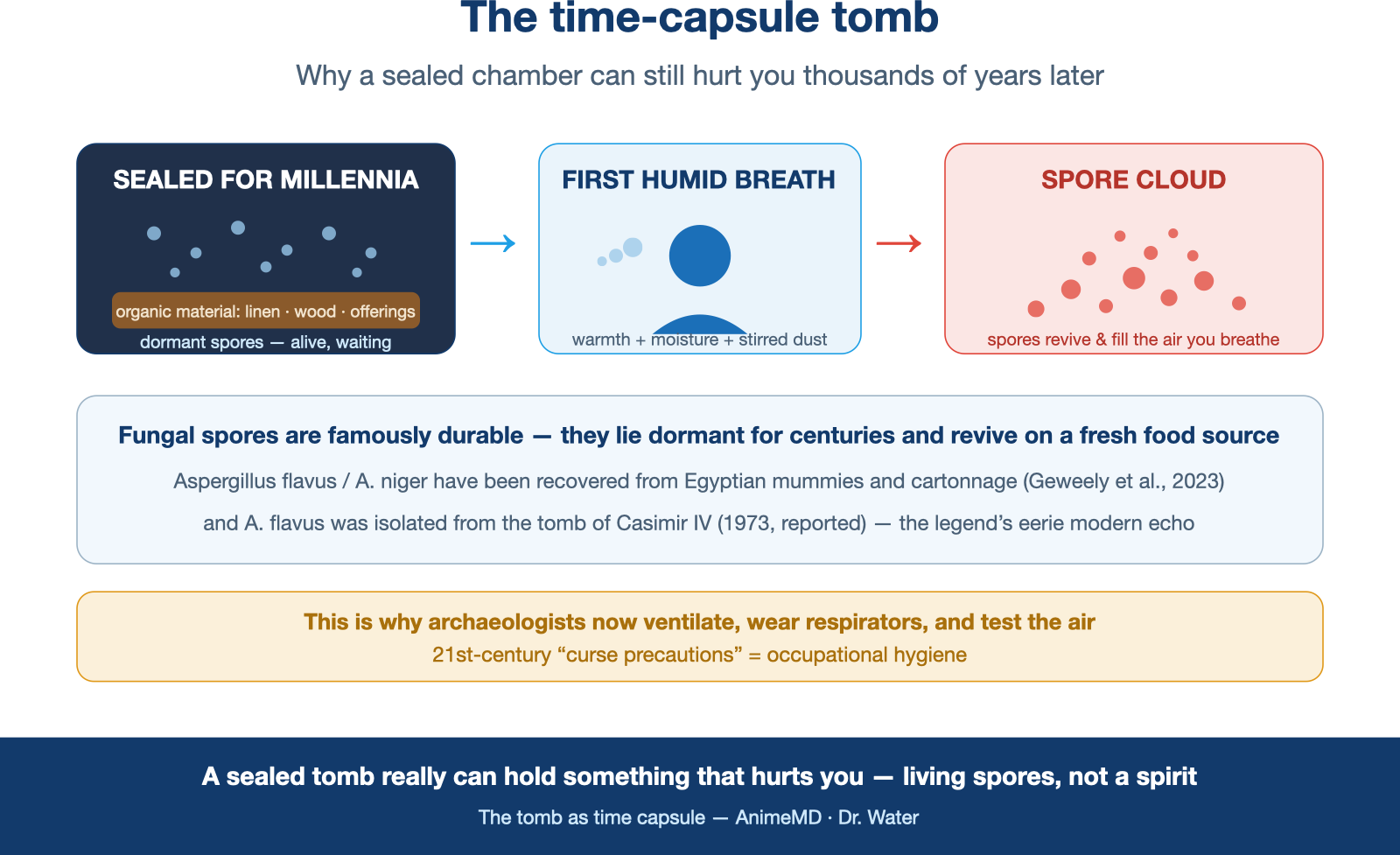
Sealed tombs are, from a microbiologist’s point of view, a strange kind of time capsule: dark, undisturbed, and often stocked with exactly what fungi love — organic material (linen wrappings, wooden coffins, food offerings, the body itself). Fungal spores are famously durable; they can lie dormant for a very long time and revive when conditions and a fresh food source return — for instance, when warm, breathing humans walk in carrying moisture and stir up centuries of settled dust. Studies of ancient Egyptian mummies and their painted cartonnage have repeatedly recovered molds — including Aspergillus flavus and Aspergillus niger — with A. flavus reported as the dominant deteriorative species on mummy cartonnage in recent mycology work (Geweely et al., Arch Microbiol 2023).
And there’s a modern case that reads like the curse legend rewritten as a lab report. In 1973, a team opened the tomb of the Polish king Casimir IV Jagiellon. Over the following weeks and months, most of the researchers present died — by many accounts, around 10 of the 12. One survivor, the microbiologist Bolesław Smyk, later isolated fungi from the tomb, among them Aspergillus flavus. (This account is widely reported but not established by a peer-reviewed source, so treat the death toll as reported and the cause as associated, not proven.) Whether the fungus truly killed the team or the story grew in the retelling is genuinely debated — but the biological premise underneath it is not fantasy.
This, by the way, is why modern archaeologists and conservators don’t fling open ancient tombs and lean in for a whiff. They ventilate, they wear respirators and gloves, they test the air. The “curse precautions” of the 21st century are just… occupational hygiene. My kind of magic.
Takeaway: A sealed tomb can absolutely hold something that hurts you — not a spirit, but living fungal spores that survive for centuries and billow up when the chamber is disturbed. The danger is real; the mechanism is mold, not malice.
Q3 | What does that mold actually do to a human body? — It causes aspergillosis, and for the wrong person it can be lethal.
The mold at the center of every serious version of this story is Aspergillus — a common, ordinary genus of fungus that is, quite literally, everywhere: soil, compost, damp buildings, and yes, ancient tombs. Most of us inhale its spores harmlessly, all the time, and never know it. The disease it can cause is called aspergillosis.
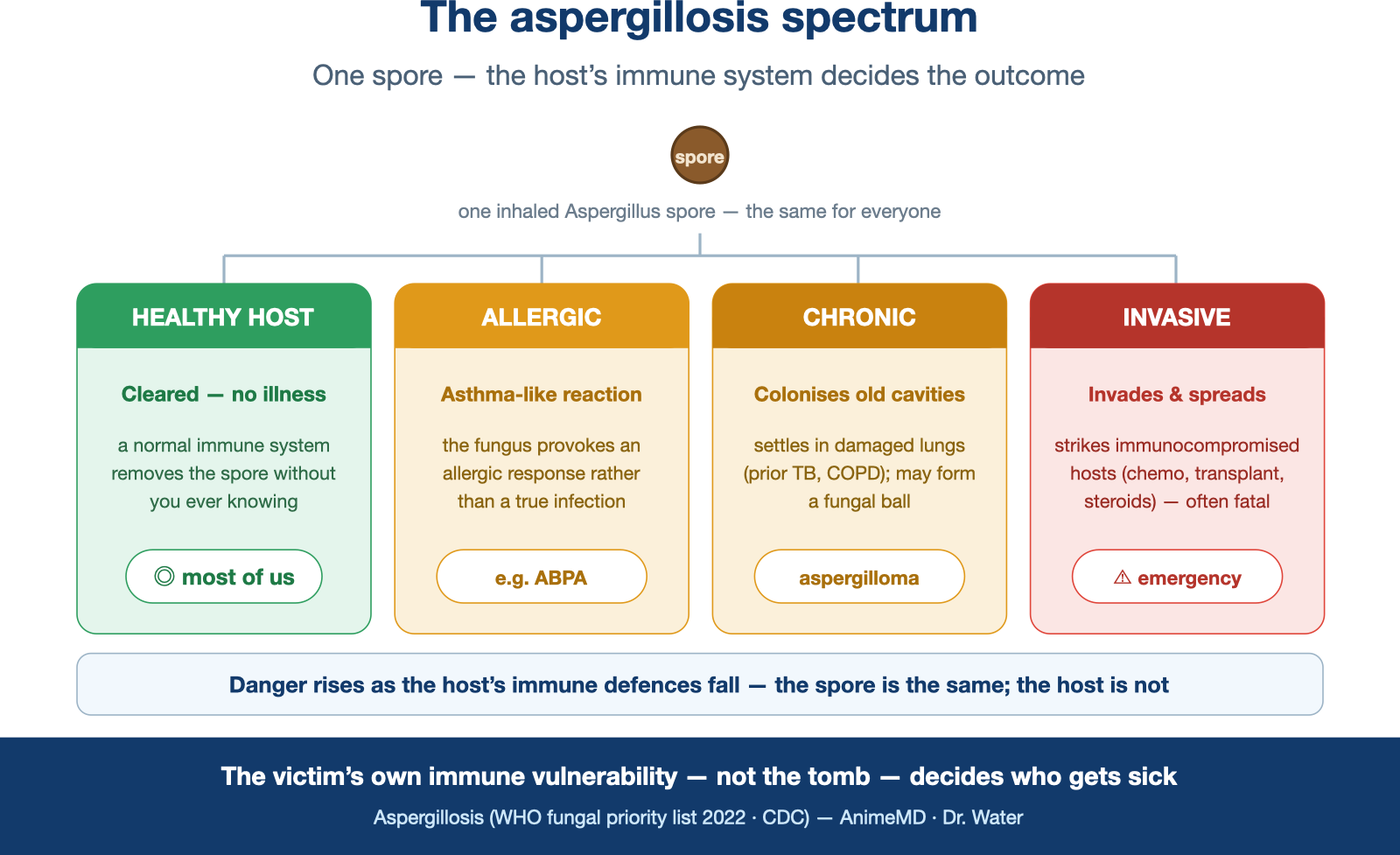
Here’s the crucial part, and it’s the whole reason the “curse” was selective. Aspergillosis is overwhelmingly a disease of vulnerability, not exposure alone. In a healthy person with a normal immune system, inhaled Aspergillus is usually cleared without incident. The disease runs along a spectrum depending on the host:
- Allergic forms (like allergic bronchopulmonary aspergillosis) — the fungus provokes an allergic, asthma-like reaction rather than a true infection.
- Chronic forms — the fungus can colonize old lung cavities (for example, after tuberculosis or in COPD), sometimes forming a fungal ball called an aspergilloma.
- Invasive aspergillosis — the dangerous one. The fungus invades lung tissue and can spread through the body. It strikes people whose immune defenses are down: those on chemotherapy, transplant recipients, people on long-term steroids, the seriously ill. In that population it is a genuine medical emergency with high mortality.
Aspergillus flavus — the very species pulled from mummies and from Casimir’s tomb — is a notable player here, and it also produces aflatoxins, some of the most potent natural carcinogens known (mostly a food-contamination and liver-cancer concern). The World Health Organization now lists Aspergillus fumigatus in the critical group of its fungal priority pathogens list (2022) — a formal acknowledgment that these molds are a serious, and rising, human threat. (General clinical facts here follow the WHO fungal priority pathogens list and the CDC aspergillosis pages.)
Put that together and the “curse” pattern snaps into focus. Imagine a tomb-opener who was already frail — recovering from illness, immune system worn down — inhaling a lungful of concentrated Aspergillus spores from a chamber sealed for millennia. For that specific person, a fatal fungal pneumonia weeks later isn’t supernatural. It’s a textbook, if dramatic, case of invasive aspergillosis. The tomb didn’t choose its victims out of vengeance; their own immune systems, tragically, did.
Takeaway: The mold’s disease is aspergillosis. In healthy people it’s usually harmless or merely allergic; in someone immunocompromised, invasive aspergillosis can be deadly. That’s the real, unglamorous “selectivity” behind the curse — biology, not the pharaoh, decided who got sick.
Q4 | ⚠️ The line I actually respect — real disease, real victims, and a real twist at the end.
Let me set the dry humor down, because underneath this fun story are real people and a real, still-active disease. Aspergillosis ends real lives, especially among the most medically vulnerable people in our hospitals right now. Aflatoxins from these molds are a genuine global health problem in contaminated food. And the people history remembers as “curse victims” were, when they truly did die of tomb exposure, victims of an infection — not of their own hubris, and certainly not of a pharaoh’s wrath.
So here’s the leap I’m happy to name: there is no curse. No spirit tracks you home from a tomb. But there is a fungus — patient, dormant, and utterly indifferent to who you are — and for the wrong lungs it is every bit as dangerous as the legend claimed, minus the mysticism. Our ancestors watched frail explorers sicken and die after entering forbidden, sealed places, and they built the best explanation their world allowed: revenge from beyond the grave. They got the pattern right — something in that room really could kill you — and the cause wrong, because germ theory was still centuries away.
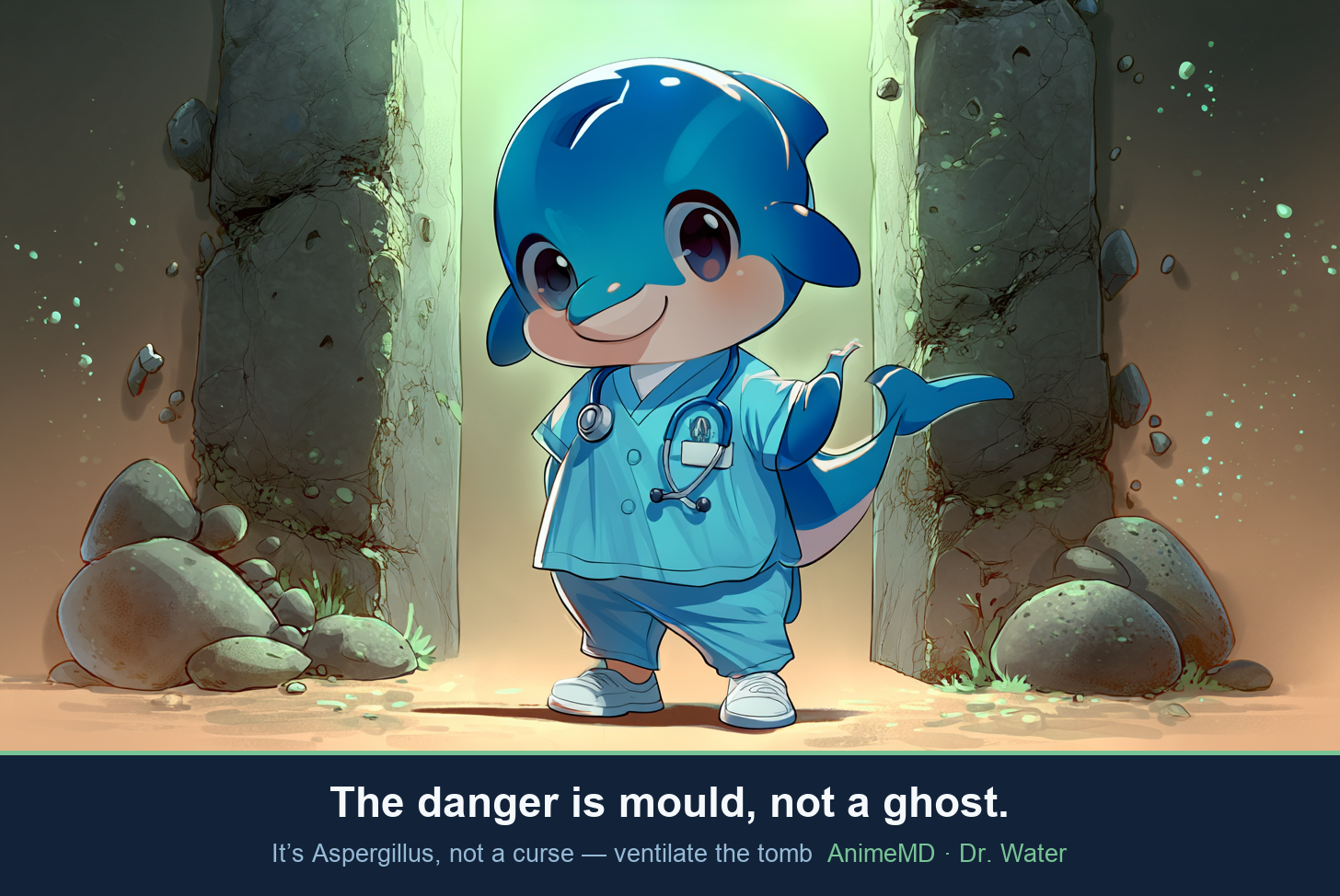
And now the twist, the one that makes me grin as a doctor. That same feared mold, Aspergillus flavus — the “curse fungus” — is the subject of recent research in which compounds derived from it (“asperigimycins”) showed early laboratory promise against leukemia cells (Nie et al., Nat Chem Biol 2025; early-stage research, not a treatment). The monster at the bottom of the tomb might, one day, help cure a cancer. That’s science doing the most human thing it does: walking straight toward the thing everyone fears, and coming back with medicine.
Takeaway: No curse — but a real, sometimes-lethal mold that earns its reputation the honest way. Respect the disease, protect the vulnerable, ventilate the tomb.
The verdict: legend vs. real medicine
| Mummy’s-curse claim | Verdict |
|---|---|
| Everyone who opened the tomb died young | ✕ fantasy — no significant survival difference between exposed and unexposed (Nelson, BMJ 2002) |
| A supernatural force takes revenge on intruders | ✕ fantasy — no curse; deaths explained by ordinary illness + selective memory |
| A sealed tomb can hold something that hurts you thousands of years later | ✓ real — dormant fungal spores survive for centuries and revive when disturbed |
| That “something” was found on real mummies and in a real royal tomb | ✓ real — Aspergillus flavus/niger documented on Egyptian mummies; A. flavus reported from Casimir IV’s tomb (1973) |
| The tomb “chooses” who to strike down | ◐ partly — not the tomb; the victim’s own immune vulnerability decides who gets invasive aspergillosis |
| The mold can be genuinely deadly | ✓ real — invasive aspergillosis is often fatal in immunocompromised patients |
| The danger is a ghost / spirit | ✕ fantasy — the danger is a fungus, treated by doctors, not exorcists |
Wrap-up
Buried inside the ghost story is a real occupational hazard, a real pathogen, and a real disease we still fight in intensive care units — plus a perfect little lesson in how humans mistake pattern for purpose. Our ancestors saw explorers die after entering sealed places and reasoned backward to revenge. We can now see the same events and reason forward to Aspergillus. Same deaths; a thousand years of better tools.
Real medicine can’t lift a curse, because there was never a curse to lift. But it can do the thing that actually protects people: name the fungus, find the vulnerable lung, open a window, put on a mask. Turning a curse back into a case of mold is the whole job. See you at the next check-up — the Monster Clinic door stays open. (I’ll prop it open with a fan, for the spores.)
As it happens, this patient already has a chart. The mummy is Chapter 7 of my book Monster Clinic — “The Mummy: the ‘curse’ vanishes when counted, and ancient arteries speak”, which is more or less the appointment we’ve just had — filed alongside thirteen other patients: the vampire, the zombie, the werewolf, and the rest of the waiting room. (Kindle, $3.99, free to read on Kindle Unlimited.)
Dr. Water — physician in occupational and preventive medicine, and a die-hard anime/manga fan.
Frequently Asked Questions
Was the “mummy’s curse” that supposedly killed Tutankhamun’s tomb explorers actually real?
No — when a physician-epidemiologist tracked how long “exposed” tomb-openers lived compared to an unexposed group, there was no statistically significant difference in their survival. Lord Carnarvon, the most famous “curse victim,” almost certainly died of an infected mosquito bite that turned into blood poisoning, an ordinary death in an era before antibiotics. The dramatic deaths were remembered while the many people who lived long, unremarkable lives were forgotten.
Can something in a sealed tomb actually be dangerous to open thousands of years later?
Yes — not a curse, but dormant fungal spores that can survive for centuries and revive when disturbed by people bringing in moisture and stirring up dust. Studies of Egyptian mummies have repeatedly found molds including Aspergillus flavus and Aspergillus niger, and a widely reported (though not peer-reviewed-confirmed) account links a 1973 royal tomb opening to a wave of deaths among the research team.
Who is actually at risk from mold like that, and what precautions should be taken before opening an old sealed space?
The danger depends heavily on the person’s immune system: in someone healthy, inhaled Aspergillus spores are usually cleared without incident, but in someone immunocompromised — such as from chemotherapy, a transplant, or long-term steroids — it can cause invasive aspergillosis, a genuine medical emergency with high mortality. This is exactly why modern archaeologists and conservators ventilate sealed spaces and wear respirators and gloves before entering, rather than walking straight in.
Disclaimer 1 | Medical
This article is general, educational medical commentary sparked by folklore and entertainment. It is not medical advice and not intended to diagnose or treat. Reading it creates no doctor–patient relationship. For any health decision, consult your own physician. The conditions described here — aspergillosis and mold-related illness — are real diagnoses affecting real people, described here with respect and never to mock any patient. If you have a weakened immune system (chemotherapy, transplant, long-term steroids, serious chronic lung disease) and develop unexplained fever, cough, or breathlessness, seek medical care promptly — invasive fungal infections are time-sensitive.
Disclaimer 2 | Copyright & Non-Affiliation
The “mummy’s curse” is public-domain folklore and history; this article references no copyrighted anime or manga work, and reproduces no panels, screenshots, or character art. All medical and historical claims are attributed to the cited sources.
🩺 Your check-up is over — but the clinic is always open
📚 This clinic has a sequel. 14 legendary monsters — vampire, zombie, werewolf and more — properly diagnosed by a real doctor. The book this blog grew into, with new write-ups added. → Get it on Amazon — $3.99 / free on Kindle Unlimited
💌 Free newsletter — new diagnoses delivered to your inbox, no appointment needed. → Subscribe on Substack
▶️ Prefer video? Watch the diagnoses on YouTube. → The Anime MD

Comments