The headaches. The shadow at the foot of the bed. The whole family feeling watched and unwell in the same house. A doctor takes the most common ghost story in the world and runs it through the exam room — and finds two pieces of established medicine and one genuinely interesting hypothesis. One of them is genuinely dangerous, and a $20 device catches it. The Monster Clinic’s most useful case yet.
Hi. I’m Dr. Water 🐬. I’m a doctor — the kind who keeps working adults healthy (occupational and preventive medicine).
Welcome back to the Monster Clinic (怪物外来), the room where a monster shows up not as a threat but as a patient, and I do what a doctor does: take a history, examine, and ask, gently, what is actually going on here?
Today’s patient isn’t a creature with fangs. It’s an experience — one that millions of ordinary, sober, sane people have had, all over the world, for all of recorded history: the house feels wrong. Something is here. I woke and couldn’t move, and there was a figure by the bed. We all keep getting headaches. We feel watched.
I want to be careful and kind about this from the first sentence, because “haunted” experiences get laughed at, and the people who have them are not fools. Quite the opposite. When I put on my doctor’s glasses, the classic haunting doesn’t dissolve into nonsense — it resolves into two pieces of well-established medicine and one genuinely interesting hypothesis, and the first of them is a silent killer that I would genuinely like every reader to go check on tonight. This is the rare Monster Clinic case where the punchline could actually save your life.
Let me take the ghost’s history in four questions.
The house rules
I love a good ghost story, and I’m not here to tell anyone they didn’t experience what they experienced — because they did. Every symptom in this article is real, felt by real people. What I’m here to do is separate the experience (100% real) from the explanation (where folklore and physiology part ways). Every medical claim gets a source, and I’ll be honest about which parts are rock-solid science (CO poisoning; sleep paralysis) and which are intriguing-but-unproven (the infrasound idea). And one thread I will not play for laughs: carbon monoxide. That part I write in my most serious doctor voice, because it’s the one that kills.
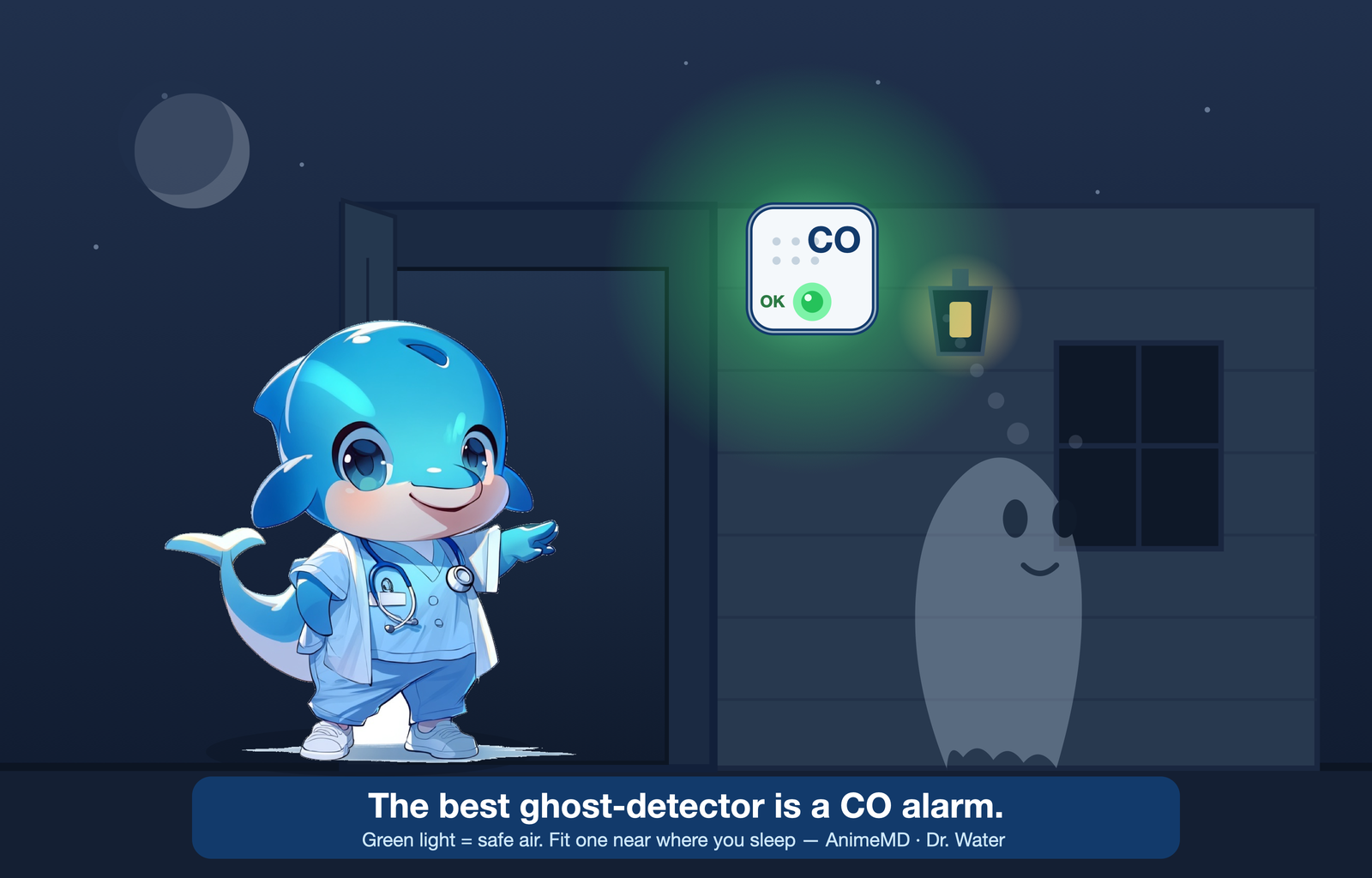

Q1 | The classic “haunted house”: headaches, dread, shadowy figures, and a whole family sickening together — is that a ghost? — no. That is what carbon-monoxide poisoning looks like, and the gas doesn’t care whether you believe in ghosts.
Start with the version of the story that shows up again and again: a family moves into a house, and things go wrong together. Everyone’s tired and low. Headaches that lift when they leave and return when they come home. A creeping dread, a sense of being watched. Then the strange perceptions — footsteps, a figure glimpsed in a doorway, bells, a presence in the room. The house, everyone agrees, is haunted.
Now read that same paragraph as a doctor, and something jumps out that no ghost story ever explains: the whole household is sick at once, in the same building, and gets better when they leave it. That is not how a vengeful spirit behaves. That is exactly how a poison behaves — specifically, a poison in the air of the house.
The prime suspect is carbon monoxide (CO) — a gas with no color, no smell, and no taste, produced whenever fuel doesn’t burn cleanly: a cracked furnace heat exchanger, a blocked chimney, a faulty gas heater, a car left running in an attached garage. CO poisons by binding to hemoglobin far more tightly than oxygen does, starving your tissues — brain first — of the oxygen they need.
Now, I have to be precise here, because this is exactly the point where ghost stories get oversold — including by people on my side of the argument. There are two different layers to CO’s symptom picture, and they are not the same strength of evidence.
Layer one — the ordinary, common presentation. This is what the public-health authorities actually list. The CDC names headache, dizziness, weakness, upset stomach, vomiting, chest pain, and confusion. The NHS names headache, dizziness, feeling sick or being sick, feeling weak, tiredness and confusion, chest and muscle pain, shortness of breath, flushing, and loss of vision . Read those lists again and notice what is not on either of them: the word hallucination. I’m flagging that myself, because it matters. The everyday face of CO poisoning is dull, flu-like, and utterly unspectacular — and it is still the one that kills you.
Layer two — the severe, prolonged, neuropsychiatric end. Hallucinations and delirium in CO poisoning are real and documented — but in the clinical literature, not in the routine public-health symptom lists. Case reports describe visual hallucinations and psychotic features following CO-induced brain injury (Park & Kim, Gen Hosp Psychiatry 2013). And the phenomenon has a name and a frequency: roughly 10–30% of patients develop a delayed encephalopathy after acute CO poisoning — memory loss, abnormal behavior, cognitive decline — appearing after a deceptive symptom-free interval that can run from two days to a year (Xu et al., Medicine 2019). So the “ghost” layer is real, but it lives at the serious end of the spectrum, and it rests on case reports and clinical series rather than on a CDC bullet point. That’s an honest distinction, and I’d rather give it to you than borrow authority I don’t have.
And here’s the correction that matters most for your safety: most carbon-monoxide poisoning involves no ghosts whatsoever. No apparitions, no presence, no shapes in the hall — just a headache, some nausea, and a tiredness everybody blames on a bug going around. It is famously mistaken for the flu. So please don’t read this article backwards: “nothing spooky is happening” is not evidence against CO. The absence of a ghost rules out precisely nothing. If anything, the boring version is the common one.
What CO does do reliably is behave like a poison rather than a poltergeist: it classically hits everyone in the home (and even the pets), and it’s worse indoors and eases outdoors. That pattern — not the shadow in the doorway — is the real diagnostic clue. That is not a séance. That is a case history.
And this isn’t a modern armchair theory — it has a beautiful origin story in the medical literature. In 1921, the American ophthalmologist Dr. William Wilmer published a paper titled “Effects of Carbon Monoxid upon the Eye” in the American Journal of Ophthalmology, which included what has become the famous “haunted house” case: a family (identified in the paper as “Mrs. H”) who moved into a house and were reportedly tormented by fatigue and low mood, the sense of being followed, listless children, and figures seen moving through the rooms — with the cause traced to a defective furnace flooding the home with carbon monoxide. Fix the furnace, and the ghost checked out for good (Wilmer WH, Am J Ophthalmol 1921;4(2):73–90). It is very likely the single most-cited “the ghost was carbon monoxide” story in existence, and it’s over a century old.
Two caveats I owe you, because this story is repeated online constantly and I’d rather be the one who checks. First, it’s a century-old single case report — a wonderful origin anecdote, not modern proof of anything. Second, I’ve confirmed the paper itself exists (the citation and DOI above resolve), but the widely repeated fine details of the anecdote — the specific year the family moved in, the “woman in a black dress,” the exact furnace fault — come to me through secondary retellings rather than the original text, which sits behind a paywall. So I’m telling it as the well-worn story it is, not as a set of facts I’ve personally checked line by line. If you want a sign this topic is taken seriously by the medical establishment rather than only by ghost-hunting blogs: JAMA itself ran a piece called “Health, hygiene and haunted houses” (JAMA 2013;309(22):2308).
Takeaway: When an entire household feels ill in the same building — headaches, fatigue, nausea, dread, and in severe cases even shadowy figures — all easing when they step outside, the leading medical explanation is not a spirit but carbon-monoxide poisoning, a colorless, odorless gas that starves the brain of oxygen. The common version is flu-like and has no ghosts in it at all; the apparitions belong to the severe end. A famous 1921 case (Wilmer) is where the “haunted house was a gas leak” story begins. Hold that thought; it’s the one that matters most in this whole article.
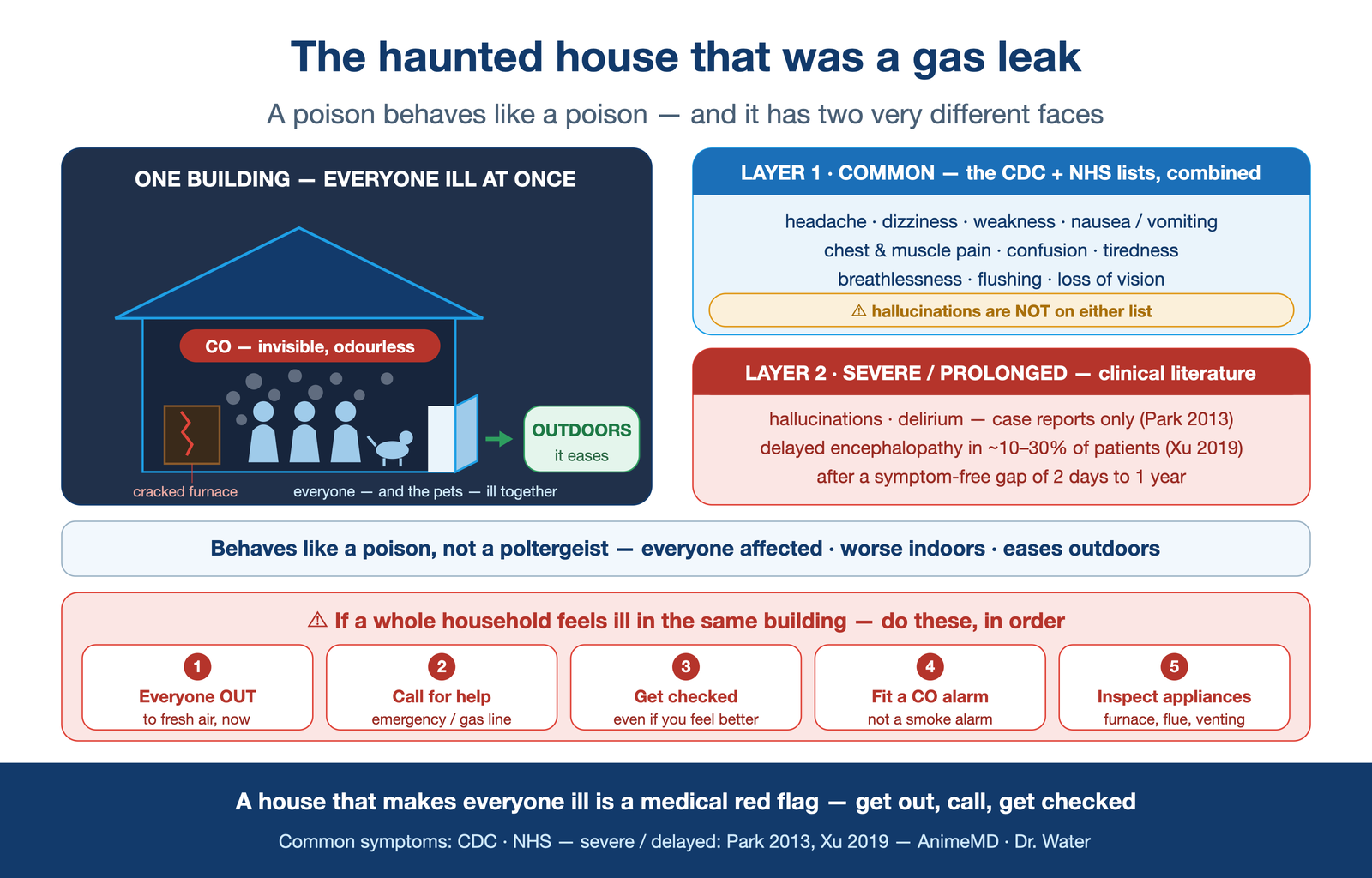
Q2 | The thing at the foot of the bed: why do so many people wake, frozen, with a presence crushing their chest? — because of sleep paralysis, and it’s one of the most universal experiences humans have.
Now the other signature haunting — and this one isn’t about the house, it’s about the bedroom, and it happens to the person alone.
The story is astonishingly consistent across every culture and century: you wake in the night and you cannot move. Your body is locked. You sense — with total, terrified certainty — that something is in the room. Often it comes closer. Sometimes you feel a crushing weight on your chest, a hand at your throat, a figure looming or sitting on you. You may see it, hear it, even feel it breathe. Then it releases you, and you can move again.
This has a name in medicine, and it is beautifully undramatic: sleep paralysis. Here’s the mechanism. During REM (dreaming) sleep, your brain deliberately paralyzes your body — a safety feature called REM atonia, so you don’t physically act out your dreams. In sleep paralysis, you wake up before that paralysis switches off. So your mind is awake and aware, but your body is still held in dream-mode stillness — and, crucially, fragments of the dream state (hypnagogic hallucinations at sleep onset, hypnopompic on waking) bleed into the real room around you. Your fully awake brain, feeling paralyzed and flooded with threat, does the most human thing possible: it builds an intruder to explain the terror (Cheyne, Rueffer & Newby-Clark, Conscious Cogn 1999).
Two things make this the strongest case in the whole clinic. First, it’s common. A systematic review pooling data from over 36,000 people found that roughly 7.6% of the general population — and about 28% of students and 32% of psychiatric patients — have experienced sleep paralysis at least once (Sharpless & Barber, Sleep Med Rev 2011). This is not a rare glitch; it’s a near-universal feature of the human nervous system. Second, the folklore matches the neurology detail for detail. That specific sensation — a demon or hag sitting on the sleeper’s chest — is so consistent that it has its own medical name, the incubus phenomenon, borrowed straight from the folklore that described it first. A meta-analysis found a lifetime prevalence of about 11% in the general population — roughly one person in nine — rising to about 41% in selected groups such as students, psychiatric patients, and refugees, a difference the authors found highly significant (Molendijk et al., Front Psychiatry 2017). (You may see “19%” quoted for this; that’s the pooled figure across both kinds of sample, and the authors deliberately separate the two. One in nine is the number for ordinary people, and it’s remarkable enough without inflating it.) Every culture met this experience and named the intruder: the Old Hag in Newfoundland, the kanashibari (metal-bound) of Japan, the night-mare (literally a crushing night-demon, the true root of the word “nightmare”), the incubus of medieval Europe. Same brain state, same terror, a thousand different masks. The word “nightmare” itself is a fossil of this ghost.
None of this makes the fear fake — sleep paralysis is genuinely one of the most frightening things a person can experience, and the terror is real physiology, not weakness. But the visitor is assembled by your own waking brain out of dream material and pure alarm. It has no address to trace. And notice that it doesn’t need you to be asleep to appear: the incubus phenomenon is defined as hallucinations experienced during brief phases of (apparent) wakefulness — people commonly report lying there with their eyes open, seeing their own real bedroom, with the figure in it. That’s not a failure of your senses. That’s dream imagery running on top of a room you are genuinely looking at.
One practical footnote from the clinic, since it’s the kind of thing worth knowing: occasional sleep paralysis is common and benign. But if it’s frequent, and especially if it comes with overwhelming daytime sleepiness, sudden muscle weakness triggered by emotion, or dreamlike imagery as you fall asleep, that cluster is worth taking to a doctor — those are features associated with narcolepsy, which is diagnosable and manageable. A ghost that visits nightly deserves a sleep specialist, not a priest.
Takeaway: The classic “someone was in my room and I couldn’t move / something sat on my chest” is sleep paralysis — waking while your body is still in REM’s protective paralysis, with dream imagery spilling into the real room. It’s common (~7.6% of people at least once) and its cross-cultural folklore names — Old Hag, kanashibari, incubus, the night-mare — map precisely onto the neuroscience.
Q3 | The room that just feels wrong: chills, unease, a shape at the edge of your vision — could a sound you can’t even hear do that? — maybe. Meet infrasound. (But I’ll be honest: this one’s unproven.)
Now the subtler haunting — not a sickening house, not a bedside demon, but a room that simply feels off. People report a cold dread, hair standing up, a shape flickering at the edge of vision, an urge to leave. No family-wide illness, no paralysis. Just… wrongness.
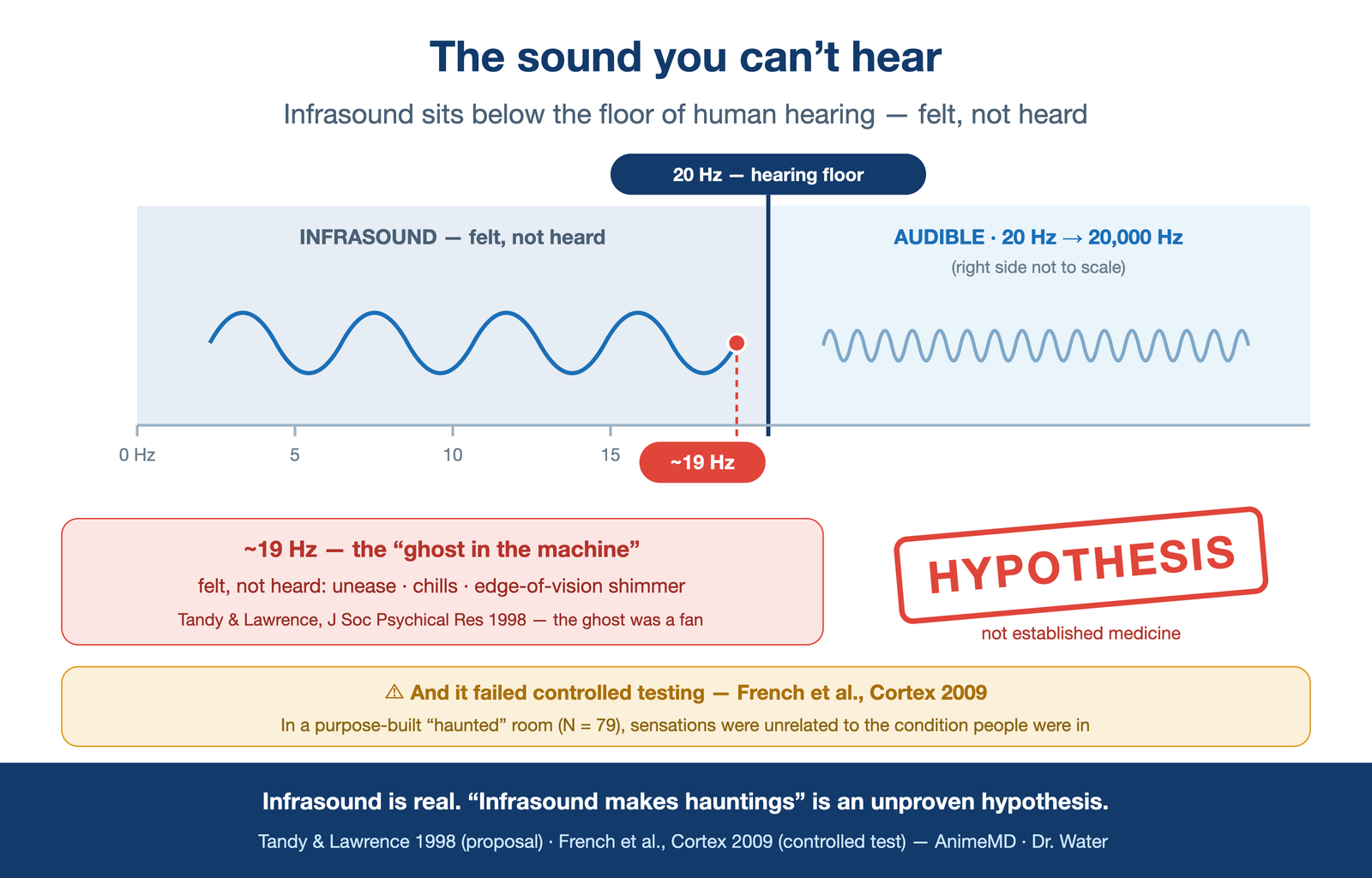
Here’s an idea I find genuinely fun, and I’m going to hold it at exactly the arm’s length it deserves: infrasound — sound too low-pitched for us to consciously hear (below about 20 Hz). In the late 1990s, an engineer named Vic Tandy was working late in a “haunted” lab, sweating with dread and catching a grey shape at the edge of his sight — until he discovered a new extractor fan was pumping out a standing wave at about 19 Hz. When he changed the setup, the “ghost” vanished. He and psychologist Tony Lawrence proposed that infrasound around 19 Hz can produce unease, chills, and a smeared, shape-like disturbance at the edge of vision (Tandy & Lawrence, “The ghost in the machine,” J Soc Psychical Res 1998). It’s a marvelous story: the ghost was a fan.
The eyeball part of that story deserves a closer look, and it’s more interesting once you check it. The popular version says “19 Hz is the resonant frequency of the human eyeball” — stated as a fact of anatomy. But Tandy himself was more careful than his internet afterlife: he noted that different sources give different resonant frequencies for the eye, and the specific ~18 Hz figure traces back to a single NASA technical report rather than a body of replicated work. Other ergonomics sources put eyeball resonance considerably higher. So the keystone detail of the most famous “science of ghosts” story rests on one document . I find that more fun than the myth, honestly.
And here’s my doctor’s duty, which I take seriously: this one is not settled science. It comes from a parapsychology journal, not the medical literature. More to the point, it has actually been tested — and it didn’t hold up. In the “Haunt” project, researchers built an artificial haunted room and put 79 people in it for 50 minutes each, exposing them to infrasound, complex electromagnetic fields, both, or neither. Plenty of participants reported anomalous sensations. But the number of sensations was unrelated to which condition they were in — the strongest predictor was simply suggestibility (French et al., Cortex 2009;45(5):619–29). Infrasound is real, and wind, traffic, machinery, and storms all produce it. But the claim that ~19 Hz reliably manufactures “hauntings” is an intriguing hypothesis that a controlled test failed to support. Treat it as a lead, not a cause.
That same experiment is also the tidiest answer to the popular idea that electromagnetic fields (EMF) make you feel ghosts: the EMF condition did no better than nothing at all. It’s not an isolated result, either — a double-blind study with sham-field controls (N=89) found no evidence for any effect of weak complex magnetic fields on sensed presence or mystical experience, and concluded that suggestibility explained the earlier famous claims (Granqvist et al., Neurosci Lett 2005;379(1):1–6). So: infrasound, a fascinating maybe; EMF, a well-tested no.
Takeaway: Some “this room feels wrong” experiences may be driven by infrasound (~19 Hz) from fans, machinery, or wind — the Tandy “ghost in the machine” idea. It’s a genuinely interesting hypothesis, but it comes from outside mainstream medicine, its famous “eyeball resonance” detail traces to a single report, and when it was tested in a purpose-built haunted room the effect didn’t separate from suggestibility (French 2009) — so I flag it as unproven. The related “EMF makes you sense ghosts” claim has failed controlled testing outright (French 2009; Granqvist 2005).
Q4 | ⚠️ The part I actually mean — the ghost hunt that saves lives. Straight-faced here.
Let me set the dry humor down completely, because this is the one Monster Clinic ending that isn’t a punchline. It’s a request.
Ghost stories are wonderful. Sleep paralysis makes for the eeriest campfire tale there is, and the infrasound fan is a delight. Enjoy all of it. But threaded through this fun is a thread that is not fun at all, and I need you to see it clearly: carbon monoxide kills quietly, every year, and it does it while looking like nothing more sinister than a bad flu. In the United States alone, the CDC reports that more than 400 people die every year from unintentional CO poisoning not linked to fires, more than 100,000 end up in an emergency department, and more than 14,000 are hospitalized . Headache. Confusion. Nausea. Drowsiness. A whole household feeling ill in the same rooms. People go to sleep in a house like that and, sometimes, don’t wake up — not because of a curse, but because an odorless gas replaced the oxygen in their blood while they slept.
So here is the practical part this entire article was built to deliver. If you or your family feel unwell, foggy, headachy, or “watched” in a specific house — especially if everyone (and the pets) feels it, and especially if it lifts when you go outside — do not call a medium. Do these things, in order:
- Get everyone out into fresh air. Now, and everyone — not just whoever feels worst. Don’t wait to see whether it gets worse, don’t wait for someone to become drowsy or confused, and don’t stop to investigate. If you suspect CO, the whole household goes outside first, symptoms or no symptoms. Turn off the suspect appliance on your way out only if it’s genuinely on your way out.
- Call for help from outside the building. Your local emergency number, or your gas emergency line. In the UK, the NHS advice is to call 111 if you think you might have symptoms, and 999 for difficulty breathing, sudden confusion, or loss of consciousness. Don’t go back in until someone qualified says the source is found and fixed.
- Get medically assessed — even if you feel better in the fresh air. This is the step people skip, and it’s the one I care about most. Feeling better outdoors does not mean you’re in the clear: CO poisoning can be followed by a delayed encephalopathy in roughly 10–30% of patients, arriving after a deceptively symptom-free interval that can last from two days to a year, and bringing memory loss, cognitive decline, and behavioral change (Xu et al., Medicine 2019). The NHS says it plainly — get medical advice as soon as possible. A doctor can measure what a window cannot.
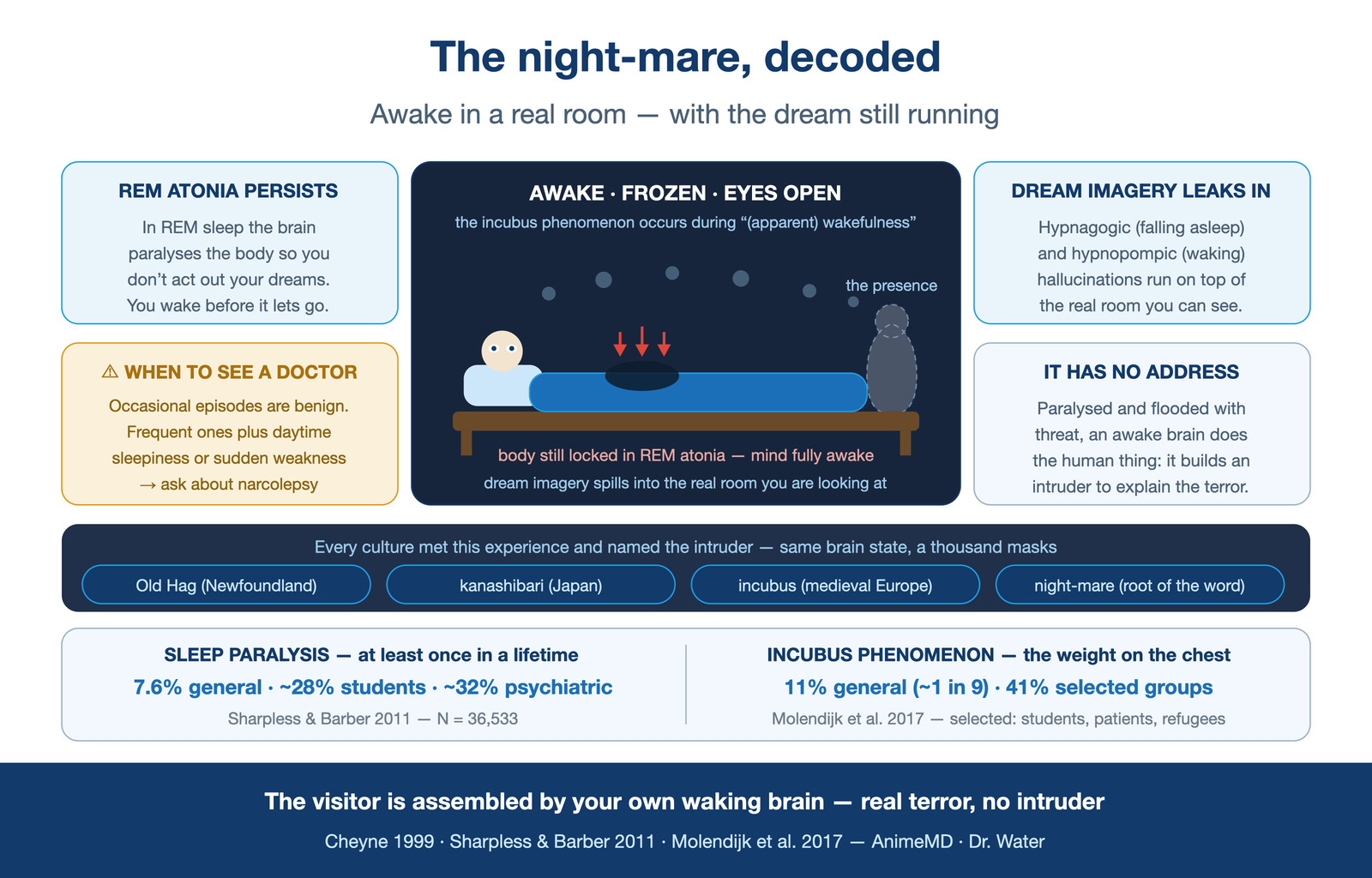
- Install a carbon-monoxide alarm. The CDC’s emphasis is on placing alarms where an alarm will wake you up — near sleeping areas; broader fire-safety guidance (NFPA/USFA) recommends one on every level of the home . They cost about as much as a pizza and they are the single most effective “ghost detector” ever invented — because the thing they detect can actually hurt you. (Smoke alarms do not detect CO; you need a CO alarm specifically.)
- Have your furnace, water heater, gas appliances, chimney, and venting inspected by a qualified professional, and never run engines or fuel-burning heaters in enclosed spaces .
Notice that steps 1 through 3 all happen before you own a single gadget. Fresh air, a phone call, and a doctor. That’s the whole emergency.
Our ancestors weren’t stupid to call these houses haunted. They watched families sicken, saw shadows in the gaslight, felt the dread — and, with no concept of an invisible combustion gas, they reached for the best explanation their world offered: the dead are angry here. They got the pattern right — something in this house is hurting us — and the cause wrong, because the chemistry was still a century away. We can do better now. We can name the gas, get the family out, make the call, and hang the alarm.
— Confession: I have absolutely lain awake in a strange old house, heart pounding, certain something was there. Knowing it’s probably my own REM system or a drafty vent doesn’t make me braver in the moment. But it does make me get up and check the CO alarm instead of hiding under the blanket. The alarm sleeps better than I do, and it’s a far more reliable guardian than any charm.
Takeaway: No ghost — but a real, sometimes-lethal gas that hides behind the ghost story, and far more often behind no story at all. If a household feels ill together in one building, that’s a medical red flag whether or not anything spooky is happening: everyone out, call for help, get checked by a doctor, then a CO alarm and an appliance/venting inspection. The most useful thing folklore ever taught us is that when a house makes everyone sick, you should take it seriously. We just finally know what to blame.
The verdict: legend vs. real medicine
| Haunted-house claim | Verdict |
|---|---|
| A whole family gets headaches, dread, fatigue, and sees figures in one house | ✓ real symptoms — and the pattern fits carbon-monoxide poisoning (common symptoms per CDC/NHS; the apparition end documented in clinical case reports and Wilmer 1921) |
| The symptoms lift when you leave the house and return when you’re back | ✓ real — a hallmark of an airborne toxin in the building, not a haunting |
| A supernatural entity is responsible | ◐ outside medicine — I can’t weigh this one on a doctor’s scale. What I can say is there’s no medical evidence for it, and that the illness and deaths in these houses are fully accounted for by gas, sleep physiology, and perception |
| You woke, couldn’t move, and something was in the room / on your chest | ✓ real experience — it’s sleep paralysis with dream imagery + the incubus sensation (Cheyne 1999; Sharpless 2011; Molendijk 2017) |
| The “presence” can be traced, photographed, or removed by ritual | ✕ no supporting evidence — the figure is built by your own waking brain from REM dream material, so there’s nothing external to trace |
| A room can “feel wrong” from a cause you can’t consciously perceive | ◐ maybe — infrasound (~19 Hz) is a real, interesting hypothesis (Tandy) but unproven; a controlled test couldn’t separate it from suggestibility (French 2009) |
| Electromagnetic fields make you sense ghosts | ✕ tested and not supported — no effect in controlled and double-blind studies (French 2009; Granqvist 2005) |
| No ghost means it isn’t carbon monoxide | ⚠️ dangerously wrong — most CO poisoning produces no apparitions at all, just headache, nausea and fatigue. “Nothing spooky is happening” rules out nothing |
| The danger in a “haunted” house is a ghost | ✕ / ⚠️ — the real danger is a gas leak: get out, call for help, get checked, then alarm and inspection |
Wrap-up
Here’s what stays with me after reopening this case. We file “haunted houses” under superstition and move on — but that’s a mistake, because buried inside the ghost story are three things worth knowing: a genuine, lethal poisoning whose severe end can reach all the way to apparitions; one of the most common and most terrifying quirks of the sleeping human brain; and a strange acoustic idea that’s still, honestly, just an idea. Two of those are established medicine. One is a maybe. I’d rather hand you the maybe labelled as a maybe than pass off three certainties I don’t have. Our ancestors met all three, had no germ theory and no gas chemistry and no sleep science, and did the most human thing there is: they told a story that fit. Same experiences; a few centuries of better tools.
Real medicine can’t exorcise a ghost, because there was never a ghost to exorcise. But it can do the thing that actually protects people: name the gas, recognize the sleep state, get everyone outside, make the call, get checked, hang the alarm. Turning a monster back into a patient — or here, turning a haunting back into a furnace inspection and a good night’s sleep — is the whole job.
The human body, and the ordinary physics of the houses we live in, are stranger and more worth respecting than any ghost we invented to explain them. That’s the real magic, and it’s the kind I get to practice. And it’s the kind that, unlike a ghost, will actually keep your family safe tonight.
One of today’s patients already has a chart, by the way. The thing at the foot of the bed — the one that pins you down and won’t let you speak — is **Chapter 5 of Monster Clinic: “The Ghost / Sleep Paralysis — ‘I can’t move, and someone’s here.'”** It’s the same clinic, in book form: fourteen monsters, taken one at a time, examined instead of debunked. Monster Clinic on Kindle (also on Kindle Unlimited).
See you at the next check-up — the Monster Clinic door stays open. (I’ll leave the CO alarm blinking green on my way out.)
If this was fun — the Monster Clinic takes a new patient each time: I look at the medicine hiding inside a classic monster, through a doctor’s eyes. Get the next one via the [free newsletter].
Dr. Water — physician in occupational and preventive medicine, and a die-hard anime/manga fan (a double insider).
Monster Clinic file: “The Mummy’s Curse Was Real — It Was Mold” (Article 25) · “A Werewolf Walks Into My Clinic” (Article 24)
Frequently Asked Questions
Could a “haunted” feeling in a house actually be carbon monoxide poisoning?
Yes — when an entire household feels sick together in the same building, with headaches, fatigue, and dread that improve when they leave, that pattern fits carbon monoxide poisoning far better than a haunting. CO is a colorless, odorless gas produced by faulty furnaces, blocked chimneys, or faulty gas heaters, and it starves the body’s tissues, brain first, of oxygen. Most CO poisoning is flu-like with no ghostly symptoms at all, so “nothing spooky” does not rule it out.
What’s really happening when someone wakes up unable to move and senses a presence in the room?
This is sleep paralysis, a well-documented and surprisingly common phenomenon in which a person wakes up while their body is still held in the muscle-paralyzed state normally used during dreaming (REM sleep), and fragments of dream imagery bleed into the real room around them. About 7.6% of people experience it at least once, and the “figure pressing on the chest” sensation is common enough to have its own name, the incubus phenomenon, found across cultures worldwide.
🔴 What should you actually do if your whole household feels sick or “haunted” in the same house?
Get everyone outside into fresh air immediately, whether or not anyone feels unwell yet, and call your local emergency number or gas emergency line from outside the building — do not go back in until the source is found and fixed. Get medically assessed even if you feel better outdoors, since carbon monoxide poisoning can cause delayed effects appearing days to a year later. Then install a carbon monoxide alarm and have fuel-burning appliances professionally inspected.
Disclaimer 1 | Medical & Safety
This article is general, educational medical commentary sparked by folklore and entertainment. It is not medical advice and not intended to diagnose or treat. Reading it creates no doctor–patient relationship. For any health decision, consult your own physician. The conditions described here — carbon-monoxide poisoning and sleep paralysis — are real and affect real people, described here with respect and never to mock anyone’s experience. ⚠️ Carbon monoxide is a genuine, life-threatening hazard. If you or others in a building develop unexplained headache, dizziness, nausea, confusion, or drowsiness — especially if several people or pets are affected at once and symptoms improve on going outdoors — get everyone into fresh air immediately, call your local emergency number or gas emergency line, and do not re-enter until the source is found. Install carbon-monoxide alarms (separate from smoke alarms) on every level and near sleeping areas, and have fuel-burning appliances and venting professionally inspected. If sleep paralysis is frequent or distressing, or you have unexplained neurological symptoms, see your doctor.
Disclaimer 2 | Copyright & Non-Affiliation
“Ghosts,” “haunted houses,” and the folklore of the night-mare/Old Hag/incubus are public-domain folklore and history; this article references no copyrighted anime, manga, or film work, and reproduces no panels, screenshots, or character/creature designs. No image resembles any specific film studio’s ghost or its logo. All medical, historical, and safety claims are attributed to the cited sources. Any brand, character, or title mentioned in passing belongs to its respective owner and is referenced solely for identification and commentary.
🩺 Your check-up is over — but the clinic is always open
📚 This clinic has a sequel. 14 legendary monsters — vampire, zombie, werewolf and more — properly diagnosed by a real doctor. The book this blog grew into, with new write-ups added. → Get it on Amazon — $3.99 / free on Kindle Unlimited
💌 Free newsletter — new diagnoses delivered to your inbox, no appointment needed. → Subscribe on Substack
▶️ Prefer video? Watch the diagnoses on YouTube. → The Anime MD






Comments