A lightning bolt, a stitched-together body, and the dead sitting up. Two centuries after Mary Shelley, a doctor runs the workup: what did the electricity really do, why can’t you “shock a flatline” back to life, and what does it actually take to build — and restart — a human being? The Monster Clinic sees its most misunderstood patient.
Hi. I’m Dr. Water 🐬. I’m a doctor — the kind who keeps working adults healthy (occupational and preventive medicine).
Welcome back to the Monster Clinic (怪物外来), the room where a monster shows up not as a threat but as a patient, and I do what a doctor does: take a history, examine, and ask, gently, what is actually going on here?
Today’s patient is the most famous of them all — the creature from Mary Shelley’s Frankenstein (1818). You know the picture the movies gave us: a body assembled from graveyard parts, a lightning bolt, a switch thrown, and the dead thing rising. Here’s the twist that makes it perfect for this clinic: Shelley wrote that book at the exact moment when the newest, most shocking science in Europe was electricity applied to the dead — and she got one big thing genuinely, spookily right, even as the rest is pure fantasy.
So let me separate the two. There are four real medical stories folded into this monster: what electricity actually does to a dead body; whether life really is electric (it is); what happens when you try to build a person out of other people’s parts; and what real “reanimation” looks like in a modern hospital. Four questions.
The house rules
I love this novel, and I’m not here to spoil it. I am here to separate the ghost from the germ — or here, the lightning from the biology — because one side of this story is fairy tale and the other is some of the most beautiful science we have. Every medical claim gets a source, and I’ll flag which parts are solid and which are famous-but-fictional. These are real procedures and real diseases affecting real people; I write about them the way I’d want a doctor to write about me.
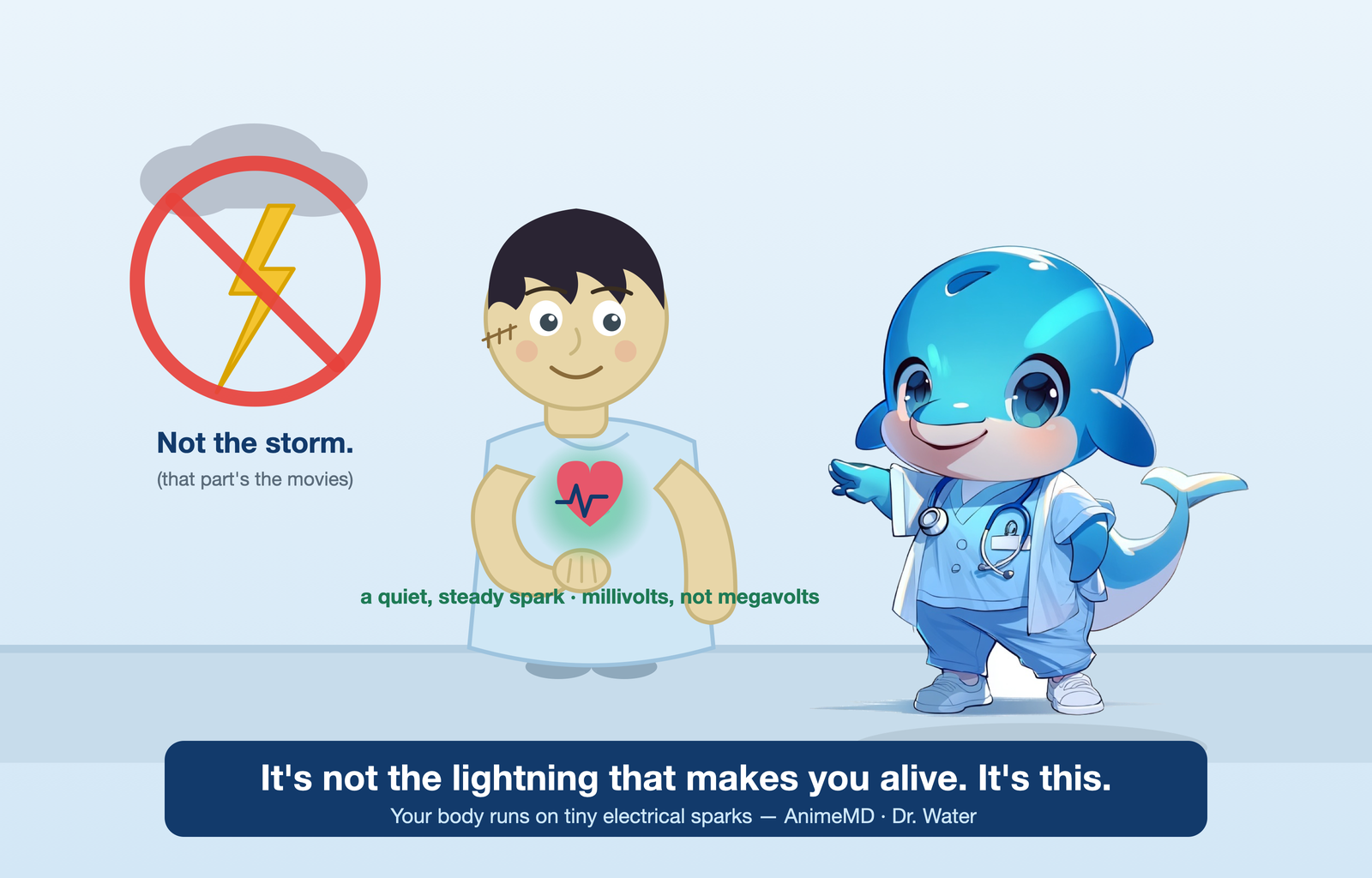

Q1 | Did the electricity bring the dead back to life? — no. It made dead muscle move — and that is not the same thing.
Start where the story starts: with a spark and a corpse.
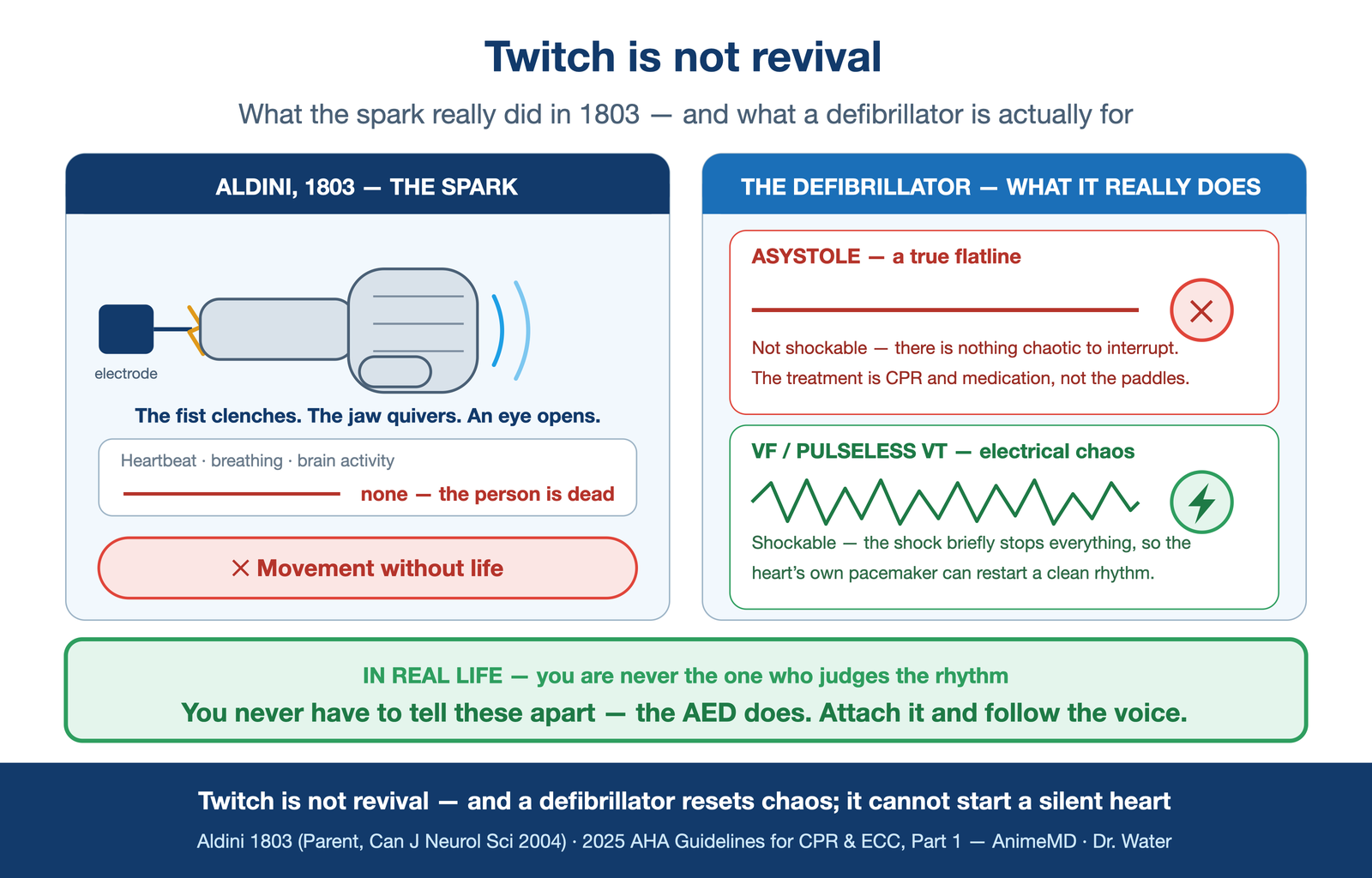
The science behind Shelley’s imagination was real and recent. In the 1780s Luigi Galvani found that a jolt of electricity made a dead frog’s legs kick, and argued that living tissue held a special “animal electricity.” His nephew, Giovanni Aldini, turned this into public theatre. In 1803, in front of a London crowd, he applied electrodes to the freshly executed body of a murderer named George Forster (Parent, Can J Neurol Sci 2004). The reports are genuinely eerie: the jaw quivered, one eye opened, a fist clenched, the legs kicked. Onlookers wondered if the man was about to sit up and breathe.
He wasn’t. And here’s the crucial medical point that the spectacle hid: electricity makes muscle contract whether or not the person is alive. A muscle cell is built to shorten when it’s electrically stimulated; a fresh corpse’s muscles still have that machinery loaded and ready for a little while after death. So a current makes the hand clench — but there’s no heartbeat driving blood, no breathing moving oxygen, no brain running the show. You get movement without life. Aldini was reading the twitch of an unplugged appliance, not restarting the person.
This misunderstanding is not a museum piece — it’s alive on television every night, and it’s worth killing. On screen, a patient “flatlines,” someone shouts clear!, a defibrillator delivers a shock, and the heart leaps back into rhythm. That is medically backwards. A defibrillator does not start a stopped heart. It works on a heart that is quivering instead of beating — ventricular fibrillation, or pulseless ventricular tachycardia: electrical chaos so fast and so disorganised that the muscle never actually squeezes, so no blood moves. The shock briefly stops everything so the heart’s own natural pacemaker can restart a clean rhythm. A true flatline (asystole — the “silent” heart) is not shockable; there is nothing chaotic to interrupt. The treatment for asystole is CPR and medication, not the paddles (2025 AHA Guidelines for CPR & ECC, Part 1). Shocking a flatline — the single most common medical scene in fiction — is the modern echo of Aldini’s crowd: mistaking an electrical event for the return of life.
Now the most important paragraph in this article, and please don’t skim it. Everything I just told you is for your inner TV critic — not for the worst day of your life. You are never the one who decides whether a rhythm is shockable, and you must never talk yourself out of using an AED. From the outside, a collapsed person looks the same whether their heart is in ventricular fibrillation (shockable, and the AED is their best chance) or asystole (not shockable) — even I cannot tell by looking. That’s the entire point of the machine: an AED reads the rhythm itself and decides. It will not shock a flatline; it physically won’t let you. So if someone collapses and is unresponsive and not breathing normally: call your local emergency number, start chest compressions — push hard and fast in the centre of the chest — and if an AED is nearby, switch it on, stick the pads on their bare chest, and do exactly what the voice tells you. The device does the diagnosis. You do the hands. In the 2025 guidelines you are the “lay rescuer,” and your job is beautifully simple: never hesitate, never diagnose.
Takeaway: Electricity makes dead muscle twitch; it does not restore life (Aldini, 1803). And its descendant, the defibrillator, does the opposite of the movie version — it stops a dangerous rhythm so the heart can reset. You cannot “shock a flatline” back. Movement is not the same as living. But in real life: never judge the rhythm yourself — attach the AED and follow the prompts. It decides whether to shock; you never have to.
Q2 | So was Shelley just wrong about electricity? — no. This is the part she got hauntingly right: you are electric.
Now the pleasant surprise, because it’s easy to laugh at the lightning bolt and miss what’s underneath it.
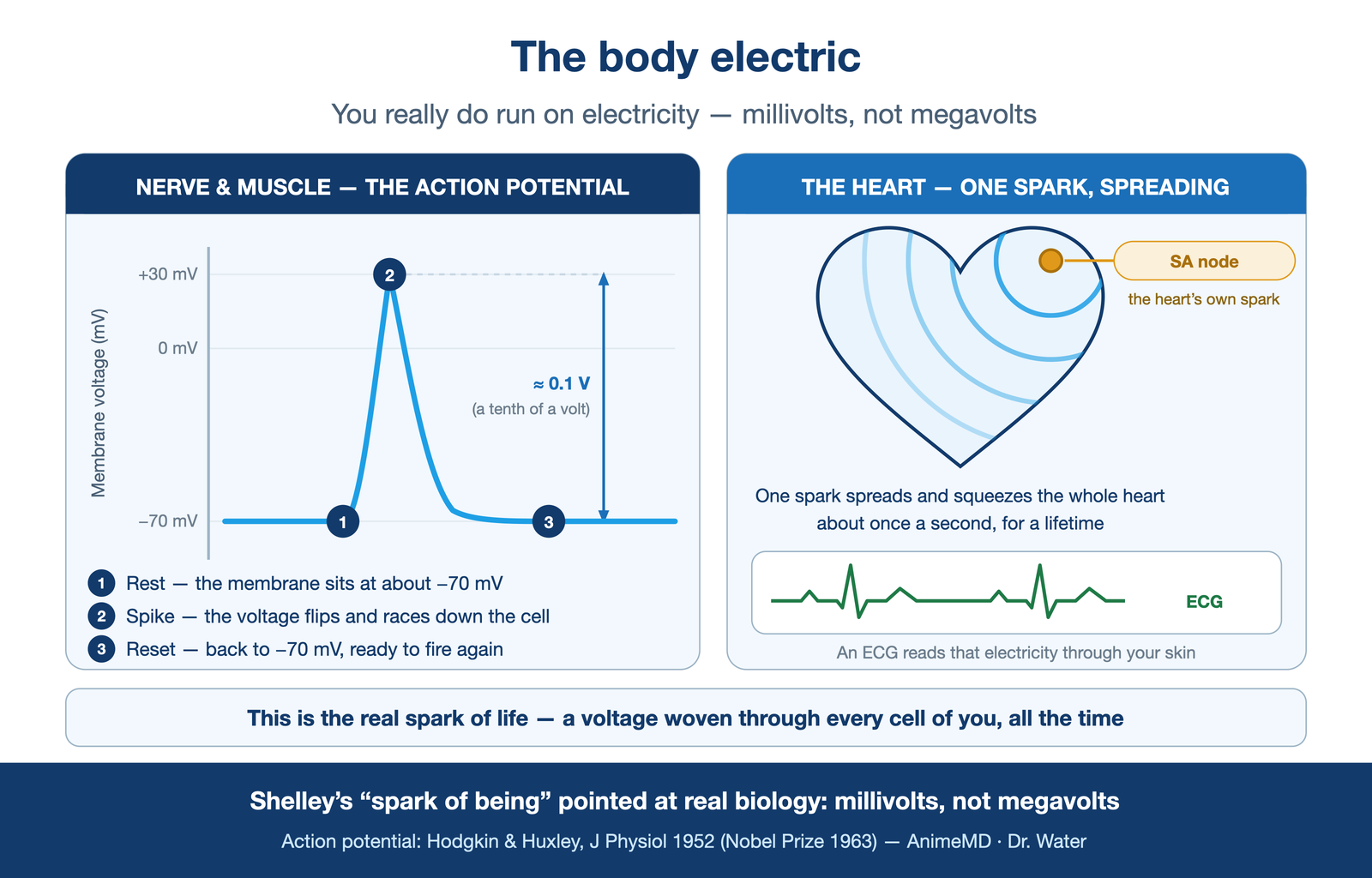
Strip away the storm, and ask the real question: does electricity have anything to do with being alive? And the honest answer is a resounding yes — just not at the voltage of a thunderclap. Your nervous system and your heart don’t run on chemistry or electricity; they run on both at once. Every nerve cell holds a tiny voltage across its membrane by pumping charged particles (ions like sodium and potassium) in and out. When a nerve “fires,” that voltage flips and races down the cell as a travelling electrical wave — the action potential. In 1952 Alan Hodgkin and Andrew Huxley measured this so precisely, in the giant nerve of a squid, that they wrote down the equations for it (Hodgkin & Huxley, J Physiol 1952) — work that won the Nobel Prize in 1963 and still underpins neuroscience today.
Your heartbeat is the same trick, scaled up: a patch of specialized cells (the sinoatrial node) fires an electrical spark that spreads across the heart and squeezes it, about once a second, for a lifetime. When a doctor tapes an ECG to your chest, we are literally reading the electricity of your heart. Your thoughts, your reflexes, the fact that you can read this sentence — all of it is electrical signals crossing living tissue. It runs at a few hundredths of a volt: a resting nerve cell sits at about −70 millivolts, and the spike that carries your every thought is roughly a tenth of a volt tall. Not a thunderclap. A whisper.
And here’s the detail almost everyone gets wrong, including me until I went back to the book. Shelley never wrote the lightning bolt. Go to the creation scene in Chapter 5 and you find no storm, no switch, no crackling apparatus — only Victor gathering “the instruments of life” around him to infuse “a spark of being” into the thing at his feet. That’s it. He explicitly refuses to tell Walton how he did it, and Shelley refuses to tell us. The one time lightning appears, it’s back in Chapter 2, splitting an oak tree in front of a teenage Victor and lighting the fuse of his obsession with electricity — atmosphere, not method. The bolt, the levers, the “It’s alive!” — those are Hollywood’s, invented for James Whale’s 1931 Universal film. So Mary Shelley’s central intuition, written before any of this was understood, was astonishingly close to the mark: life really does have something to do with electricity. And she was careful enough — at twenty — not to explain how. She left a blank where the mechanism should be. A century of movies filled it in with a storm; biology filled it in with something quieter and far stranger: a voltage woven through every cell of you, all the time.
Takeaway: True — and the best part of the whole legend. The body genuinely runs on electricity: action potentials in nerves and the heart’s own electrical spark (Hodgkin & Huxley, 1952). Shelley’s “spark of being” was poetry that turned out to point at real biology — millivolts, not megavolts. And the lightning bolt everyone remembers isn’t hers: she declined to explain the method at all. The 1931 film supplied the storm.
Q3 | Could you really build a person from many donors’ parts? — no. The immune system was built to refuse exactly that.
Here’s where the graveyard premise meets a wall that Shelley couldn’t have known about: your body has a ruthless internal border control.
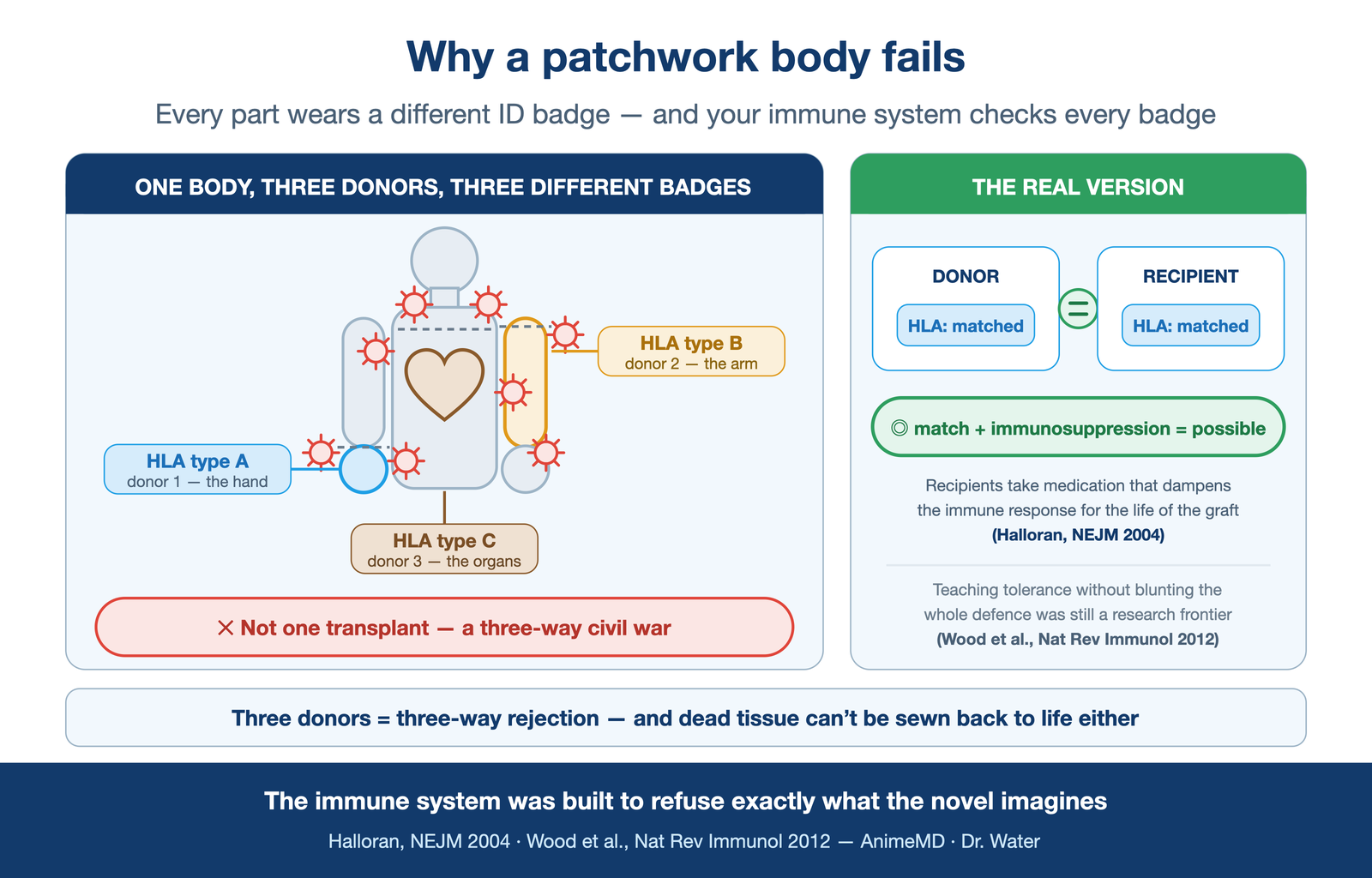
Transplanting tissue between people is real, routine, and one of the triumphs of modern medicine — kidneys, livers, hearts, lungs, even faces and hands. But it works despite your immune system, not because your body is happy to accept spare parts. Your cells carry molecular ID badges (the HLA / MHC proteins) that mark them as “self.” The immune system constantly checks these badges, and tissue wearing the wrong badges — a graft from someone else — is attacked as an invader. That’s rejection. It’s why we match donors and recipients by those badges as closely as we can before a transplant. And it’s why a transplant is never a one-day event: recipients take medication that dampens the immune response for the life of the graft — the drug classes, and the reason they can’t simply be stopped, are laid out in Halloran’s review of immunosuppression in kidney transplantation (Halloran, NEJM 2004). The harder prize is teaching the immune system to tolerate one particular graft without blunting the whole defense force — as of a 2012 review of regulatory immune cells in transplantation, that remained an open research frontier rather than a bedside reality (Wood et al., Nat Rev Immunol 2012).
Now imagine the monster’s body: a hand from one corpse, an arm from another, organs from a third, all sewn into one frame. Each piece wears a different set of ID badges. That isn’t one transplant — it’s a civil war, every part attacking every other, immunologically impossible to hold together. And that’s before the simpler problem: the parts were dead. Tissue starved of blood and oxygen dies fast — the brain within a handful of minutes — so “fresh from the graveyard” material is, medically, already ruined. The novel’s genius was emotional, not surgical: it asked what we owe a creature we’ve made. The surgery itself is pure fantasy.
Takeaway: Fantasy as depicted — a patchwork body of many donors would be an immunological catastrophe (rejection; Halloran, NEJM 2004), and dead tissue can’t be revived by stitching. But the real version, transplantation between carefully matched people, is one of medicine’s genuine miracles.
Q4 | Then what does real “reanimation” look like? — hands, a machine the size of a book, and a stranger’s generosity.
Let me end where a doctor would want to: with the true, unglamorous, genuinely life-saving version of the story.
We can pull people back from the edge of death — not with lightning, but with a chain of very ordinary acts. When a heart stops, CPR (chest compressions) keeps a trickle of oxygen-rich blood moving to the brain, buying time. That’s the part that buys the minutes; nothing else does. Then an AED — the small defibrillator now bolted to walls in train stations and offices — is switched on and its pads go on the chest, and the machine itself reads the rhythm and decides whether a shock will help. (Say it with me: you attach it and follow the voice. You never judge, and you never skip it because you’ve decided it “looks like a flatline.”) Those two things — hands and a box on the wall — are the links a lay rescuer starts, and they are the links that decide whether there is a patient left to save (2025 AHA Guidelines, Part 1). It’s the honest descendant of Aldini’s spark, except it actually works, and the “machine” is often just a pair of hands pressing hard and fast on a chest until help arrives.
The chain doesn’t end when the heart restarts, but the rest of it belongs to the hospital. One link worth naming, because it’s the one fiction never shows: for survivors who aren’t waking up, the ICU holds body temperature in a controlled window — temperature control after cardiac arrest, keeping an adult somewhere between 32°C and 37.5°C and, above all, not letting a fever take hold, because a hot brain after an arrest does worse (2025 AHA Guidelines, Part 11). This used to be called “therapeutic hypothermia,” and you’ll still hear “cooling” — but the trials that compared deep cooling against simply keeping people normal found no survival advantage, so the modern goal is control, not cold. It is not something anyone starts on a train platform. It’s an intensive-care intervention, after the heart is already beating again — brain protection for a patient we got back, not a way of buying time for one we haven’t.
And there’s one more real echo of the monster’s origin, and it’s the opposite of horror. Every day, people who have died give life to strangers through organ donation — a heart still beating in a new chest, sight restored by a donated cornea, years added by a transplanted kidney. It is, quite literally, life assembled from the dead — done not by a mad scientist in secret, but by consent, by careful matching, and by generosity. Shelley’s creature spent the whole novel asking to be understood rather than feared. The kindest thing medicine does with the human body is exactly that: treat it — living or gone — with tenderness, and let it keep doing good.
Takeaway: Real reanimation isn’t a bolt from the sky. It’s CPR and an AED — the two links an ordinary person can start, today, with no training and no permission. (Temperature control comes later and belongs to the ICU; it protects the brain of someone already restarted.) And the humane, real version of “built from the dead” is organ donation: consent and generosity turning a death into someone else’s life.
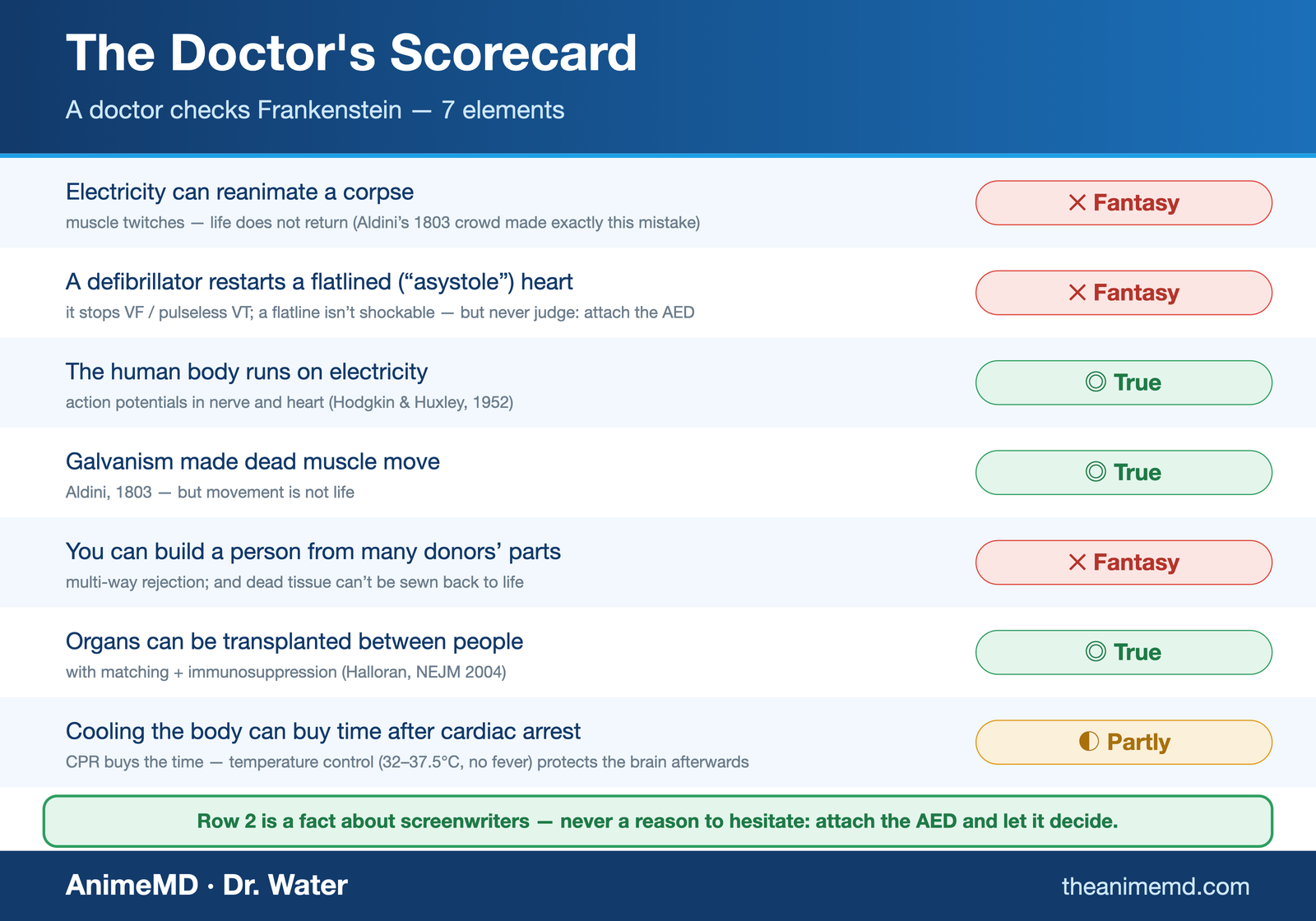
The Monster Clinic scorecard — Frankenstein edition
| # | The story says… | Doctor’s verdict |
|---|---|---|
| 1 | Electricity can reanimate a corpse | ✕ Fantasy — muscle twitches; life doesn’t return |
| 2 | A defibrillator restarts a flatlined (“asystole”) heart | ✕ Fantasy — it stops VF/pulseless VT; can’t shock a flatline |
| 3 | The human body runs on electricity | ◎ True — action potentials in nerve and heart |
| 4 | Galvanism made dead muscle move | ◎ True — Aldini, 1803 (but movement ≠ life) |
| 5 | You can build a person from many donors’ parts | ✕ Fantasy — multi-way rejection; dead tissue can’t be sewn back to life |
| 6 | Organs can be transplanted between people | ◎ True — with matching + immunosuppression |
| 7 | Cooling the body can buy time after cardiac arrest | ◐ Partly — but not as told: temperature control (32–37.5°C, and no fever) protects the brain after the heart is restarted. CPR buys the time; cooling doesn’t |
Reading: Three ✕ where the movies live (lightning reanimation, shocking a flatline, the patchwork body), balanced by ◎ where the real science is quietly astonishing (you are electric; transplantation works). Shelley’s instinct — that life and electricity are entangled — lands closer to ◎ than anyone in 1818 had a right to expect. Note that row 1 isn’t even her claim: the reanimating bolt is the 1931 film’s invention, not the novel’s.
One row to carry out of this table: row 2 is a fact about screenwriters, never a reason to hesitate. If a real person collapses, you attach the AED and let it decide. It knows the difference; nobody expects you to.
Wrap-up. The monster is the perfect Monster Clinic patient because it’s half fantasy and half prophecy. The graveyard-parts body is fairy tale — the immune system says no — and the lightning-bolt reanimation is fairy tale twice over, since Shelley never wrote it; the movies did. But underneath, she reached for something true and got there before the science did: you really do run on electricity, and we really can move life from the dead to the living. It just looks like an ECG, a matched transplant, and an ordinary pair of hands on a chest — not a storm.
And if you take one practical thing out of this room, make it this: the AED on the wall is the only thing in this article allowed to decide what a heart is doing. Your job, if that day ever comes, is to push hard and fast and let the box talk. Take care of the wonderful, electric, borrowable machine you’re walking around in. — Dr. Water 🐬
If this was fun — the Monster Clinic takes a new patient each time: I look at the medicine hiding inside a classic monster, through a doctor’s eyes. Get the next one via the [free newsletter].
This creature already has a chart. He’s Chapter 6 of Monster Clinic — my Kindle collection of these workups, fourteen patients in all: the vampire, the zombie, the werewolf, the mummy, and everyone else who’s knocked on this door. (Free to read on Kindle Unlimited.)
Dr. Water — physician in occupational and preventive medicine, and a die-hard anime/manga fan (a double insider).
Monster Clinic file: “A Werewolf Walks Into My Clinic” (Article 24) · “The Mummy’s Curse” (Article 25)
Frequently Asked Questions
Could electricity actually bring a dead body back to life, like in Frankenstein?
No — electricity can make dead muscle twitch, but that is not the same as restoring life. In 1803, a scientist applied electrodes to an executed criminal’s corpse and the jaw quivered and a fist clenched, but there was no heartbeat, no breathing, and no brain activity restored. A muscle cell still has the machinery to contract for a while after death, so a current produces movement without bringing back life.
Is it true that a defibrillator can restart a flatlined heart, like it’s often shown on TV?
No, this is medically backwards. A defibrillator does not start a stopped heart; it works only on a heart that is quivering chaotically instead of beating (ventricular fibrillation), briefly stopping everything so the heart’s natural pacemaker can restart a clean rhythm. A true flatline (asystole) is not shockable, since there’s nothing chaotic to interrupt — it’s treated with CPR and medication instead.
🔴 What should you actually do if someone collapses and might be in cardiac arrest?
Call your local emergency number, start chest compressions by pushing hard and fast in the center of the chest, and if an AED is nearby, switch it on, attach the pads to their bare chest, and follow its voice prompts exactly. Never try to judge the heart rhythm yourself and never withhold or hesitate to use the AED — the device reads the rhythm and will only shock if a shock can actually help; it will not shock a flatline.
Disclaimer 1 | Medical
This article is general, educational medical commentary sparked by a novel and by the history of science. It is not medical advice and not intended to diagnose or treat. Reading it creates no doctor–patient relationship. For any health decision, consult your own physician. Cardiac arrest, resuscitation, and transplantation are real and serious, described here with respect and never to mock any patient. If someone collapses and is unresponsive and not breathing normally: call your local emergency number, start CPR (push hard and fast in the centre of the chest), and if an AED is available, switch it on and follow its voice prompts. Do not attempt to judge the heart rhythm yourself and do not withhold an AED for any reason — the device analyses the rhythm and will only shock when a shock can help. Nothing in this article should ever be used to delay or discourage emergency care.
Disclaimer 2 | Copyright & Non-Affiliation
Frankenstein; or, The Modern Prometheus (Mary Shelley, 1818) is in the public domain, and the galvanism history is documented history of science; this article references no copyrighted anime or manga work, and reproduces no panels, screenshots, film stills, or character art. Later film depictions of the creature — including Universal Pictures’ 1931 design (flat head, neck bolts, green skin) — are separate works that are not public domain; nothing here is drawn from, or made to resemble, them, and this article is not affiliated with, endorsed by, or sponsored by any film studio or rights holder. All medical claims are attributed to the cited sources. Any brand, character, or title mentioned in passing belongs to its respective owner and is referenced solely for identification and commentary.
🩺 Your check-up is over — but the clinic is always open
📚 This clinic has a sequel. 14 legendary monsters — vampire, zombie, werewolf and more — properly diagnosed by a real doctor. The book this blog grew into, with new write-ups added. → Get it on Amazon — $3.99 / free on Kindle Unlimited
💌 Free newsletter — new diagnoses delivered to your inbox, no appointment needed. → Subscribe on Substack
▶️ Prefer video? Watch the diagnoses on YouTube. → The Anime MD





Comments