In 1692, girls in Salem convulsed, felt their skin crawl, and saw things that weren’t there — and their neighbors were hanged for witchcraft. One famous theory says the real culprit was a fungus in the rye. A doctor weighs the evidence, names the disease, and refuses to let the ghost story bury the real people. The Monster Clinic takes on a mass panic.
Hi. I’m Dr. Water 🐬. I’m a doctor — the kind who keeps working adults healthy (occupational and preventive medicine).
Welcome back to the Monster Clinic (怪物外来), the room where a monster shows up not as a threat but as a patient, and I do the doctor’s job: take a history, examine, and ask, gently, what is actually going on here?
Today’s patient isn’t a creature with fur or fangs. It’s a panic — one of the most studied in history. In 1692, in Salem Village, Massachusetts, a group of girls and young women began to convulse. They twisted into impossible postures, complained that invisible hands were pinching and pricking them, felt things crawling on their skin, and saw apparitions no one else could see. The community reached for the only explanation its worldview allowed: witchcraft. Before the terror burned out, around twenty people had been executed — nineteen hanged, one crushed to death under stones — and several more had died in jail.
And here’s what makes it a case for this clinic. In 1976, a graduate student published a hypothesis in Science that has haunted the story ever since: what if the afflicted girls weren’t possessed, or lying, but sick — poisoned by a fungus growing on their daily bread? It’s a beautiful idea. It’s also fiercely contested. So today I’m doing something a little different: I’m going to give you the honest science, including the part where the star theory might be wrong, and I’m going to keep the real, executed human beings at the centre of the frame the whole time.
Four questions. Let’s open the case file.
The house rules
I love a good historical mystery, and the “witches were on drugs” version is catnip. But this one comes with a duty attached: real people were killed in Salem, and the disease at the heart of the theory is a real illness that still maims and kills today. So I’ll do two things carefully — separate solid science from famous-but-shaky legend (and tell you which is which), and never turn either the accused or the afflicted into a punchline. Every medical claim gets a source. These were people, not props.


Q1 | The “possession”: were the Salem girls’ convulsions and visions actually a disease? — quite possibly. The leading medical theory is ergot poisoning.
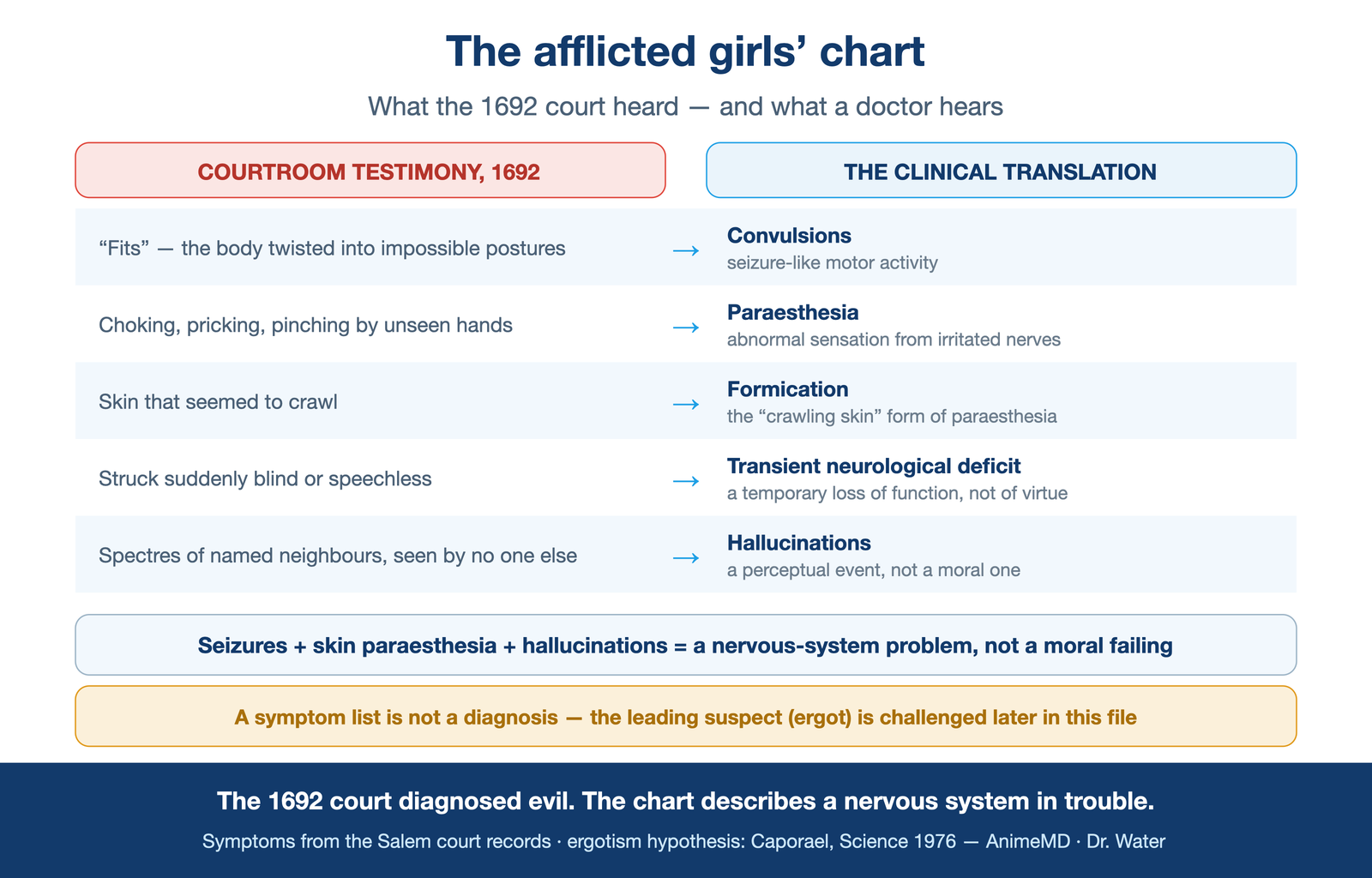
Start with the symptoms, because that’s where a doctor starts — not with “witchcraft” or “fraud,” but with the clinical picture.
The records of the afflicted describe a strikingly physical illness: violent convulsions and contortions, a choking or pricking sensation, the feeling of being pinched or bitten by something unseen, skin that seemed to crawl, temporary blindness or speechlessness, and vivid hallucinations. To a modern clinician, “seizures plus skin paraesthesia plus hallucinations” is not a description of evil. It’s a description of a neurological problem — something acting on the brain and the peripheral nerves at once.
In 1976, the behavioural scientist Linnda Caporael put a name to that suspicion. In a paper in Science titled — I promise I’m not making this up — “Ergotism: the satan loosed in Salem?” she argued that the afflicted may have been suffering from convulsive ergotism: poisoning by ergot, a fungus that grows on rye (Caporael, Science 1976). Her case rested on a tidy convergence of facts. Rye was the staple grain of Salem Village. Ergot, she argued, is favoured by a warm, damp spring followed by a wet summer — and the growing season of 1691, whose rye would have been eaten through the winter and spring of 1692, fit that profile. The low, marshy meadows west of Salem Village, where the most heavily afflicted families farmed, were exactly the kind of ground ergot favours. And the symptoms of convulsive ergotism — spasms, crawling skin, hallucinations — map disconcertingly well onto the court testimony.
Hold that last piece of geography loosely, though, because it’s where the theory first starts to leak. Her critics later went through the residences one by one: four of the eleven afflicted girls lived outside the area Caporael identified as exposed, and the whereabouts of two more can’t be established — which leaves, on their count, no evidence that six of the eleven ever ate the suspect grain before their symptoms began (Spanos & Gottlieb, Science 1976). Park that. We’ll come back to it in Q4.
It’s an elegant piece of medical detective work, and it did something important: it took the Salem afflicted seriously as patients, instead of dismissing them as liars or hysterics. That reframing alone — from “wicked or faking” to “possibly poisoned” — is why the theory has stuck around for fifty years.
I’ll tell you in Q4 why “possibly” is doing a lot of work in that sentence. But first, meet the fungus.
Takeaway: The Salem afflictions look, clinically, like a nervous-system illness — convulsions, skin sensations, hallucinations — not a moral failing. The leading medical explanation, proposed by Caporael in Science (1976), is convulsive ergotism: poisoning from a fungus on the rye. It’s a serious, respectful hypothesis. It is not a settled fact.
Q2 | The suspect: what is ergot, and why is a fungus hiding in the bread? — it’s Claviceps purpurea, and it’s a chemistry factory.
Let’s put the real suspect on the exam table, because it’s genuinely one of the strangest organisms that ever affected human history.
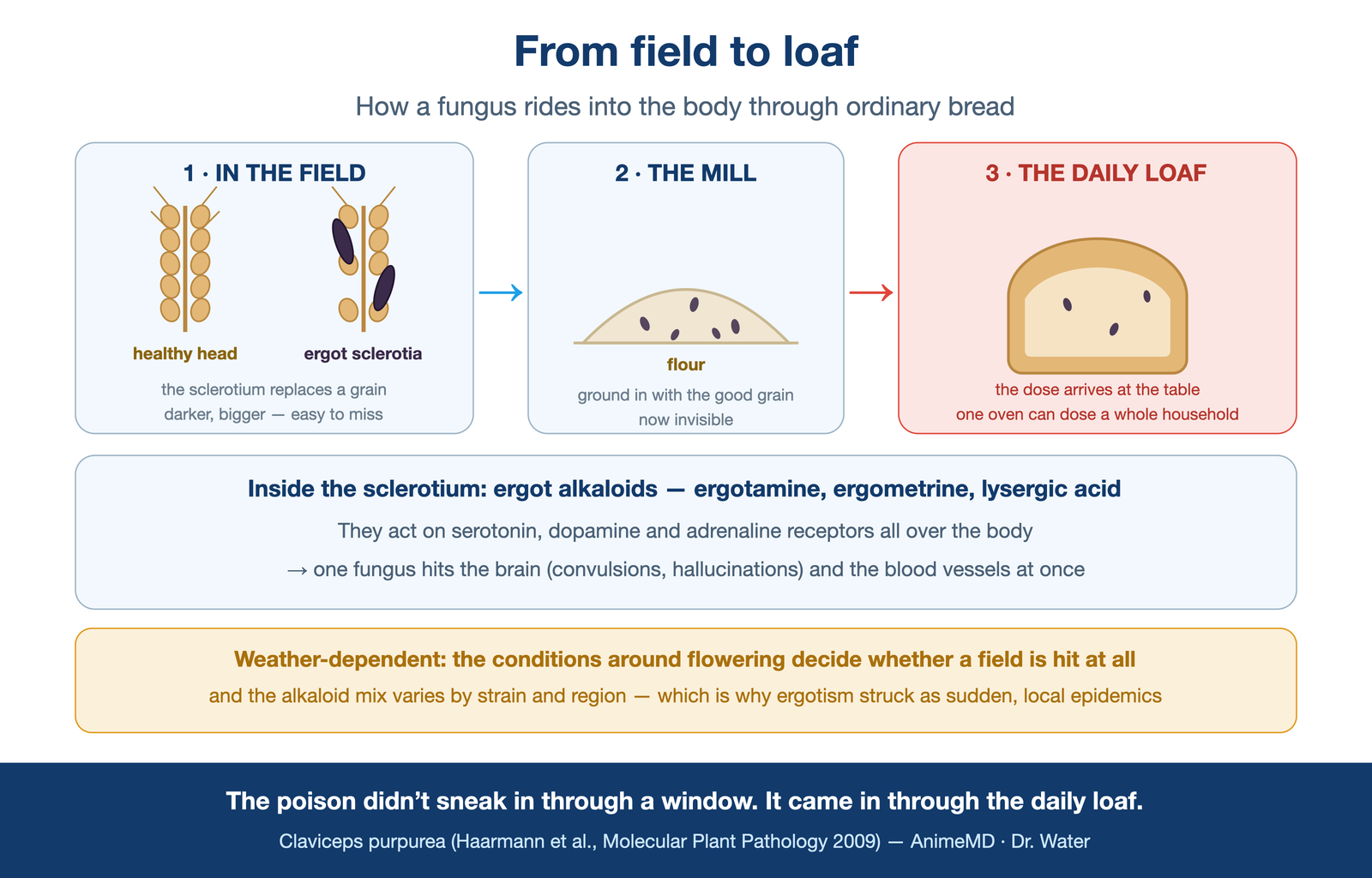
Ergot is the common name for Claviceps purpurea, a fungus that infects cereal grasses — above all rye. When it colonises a flowering rye plant, it hijacks the spot where a healthy grain should form and grows in its place a hard, dark, curved body called a sclerotium — the “ergot.” To a medieval farmer it just looked like a slightly larger, darker, purplish-black grain: easy to miss, easy to grind into the flour, easy to bake into the bread (Haarmann et al., Molecular Plant Pathology 2009). That’s the whole quiet horror of it. The poison didn’t sneak in through a window. It came in through the daily loaf.
And what a poison. That little sclerotium is packed with a family of compounds called ergot alkaloids — including ergotamine, ergometrine (ergonovine), and the lysergic-acid backbone from which, centuries later, a chemist would build LSD (more on that at the end). These molecules are biologically loud: they act on receptors for serotonin, dopamine, and adrenaline all over the body. That’s why ergot can do two apparently unrelated things at once — mess with the brain (hallucinations, convulsions) and clamp down blood vessels (the gangrene we’ll meet in Q3). One fungus, a whole pharmacology textbook’s worth of effects.
Crucially, ergot is weather-dependent. Whether a field gets hit turns on the conditions around flowering — damp weather at the wrong moment opens the door — and the alkaloid mix varies between fungal strains and growing regions, which means one bad harvest could carry a very different chemical punch from the next (Haarmann et al. 2009). This is exactly why ergotism showed up as sudden, localised epidemics rather than a steady background hum: one bad season, a single infected field, a single village’s bread supply, and dozens of people could be dosed at once from the same oven.
So the premise underneath Caporael’s theory — that a whole community could be poisoned, invisibly, through ordinary bread, in a specific bad-weather year — is not fantasy at all. That part is rock-solid biology.
Takeaway: Ergot is Claviceps purpurea, a fungus that replaces rye grains with alkaloid-loaded sclerotia and rides into the body through bread. Its toxins hit the brain and the blood vessels at once, and whether it blooms at all can hinge on a single season’s weather — which is exactly why ergotism struck as sudden local epidemics. The delivery system in the Salem theory is entirely real.
Q3 | The real disease: what does ergot poisoning actually do to a body? — it causes ergotism, in two terrifying forms.
Now the diagnosis itself, because “ergotism” isn’t a metaphor. It’s a documented human disease with a long and grim medical record.
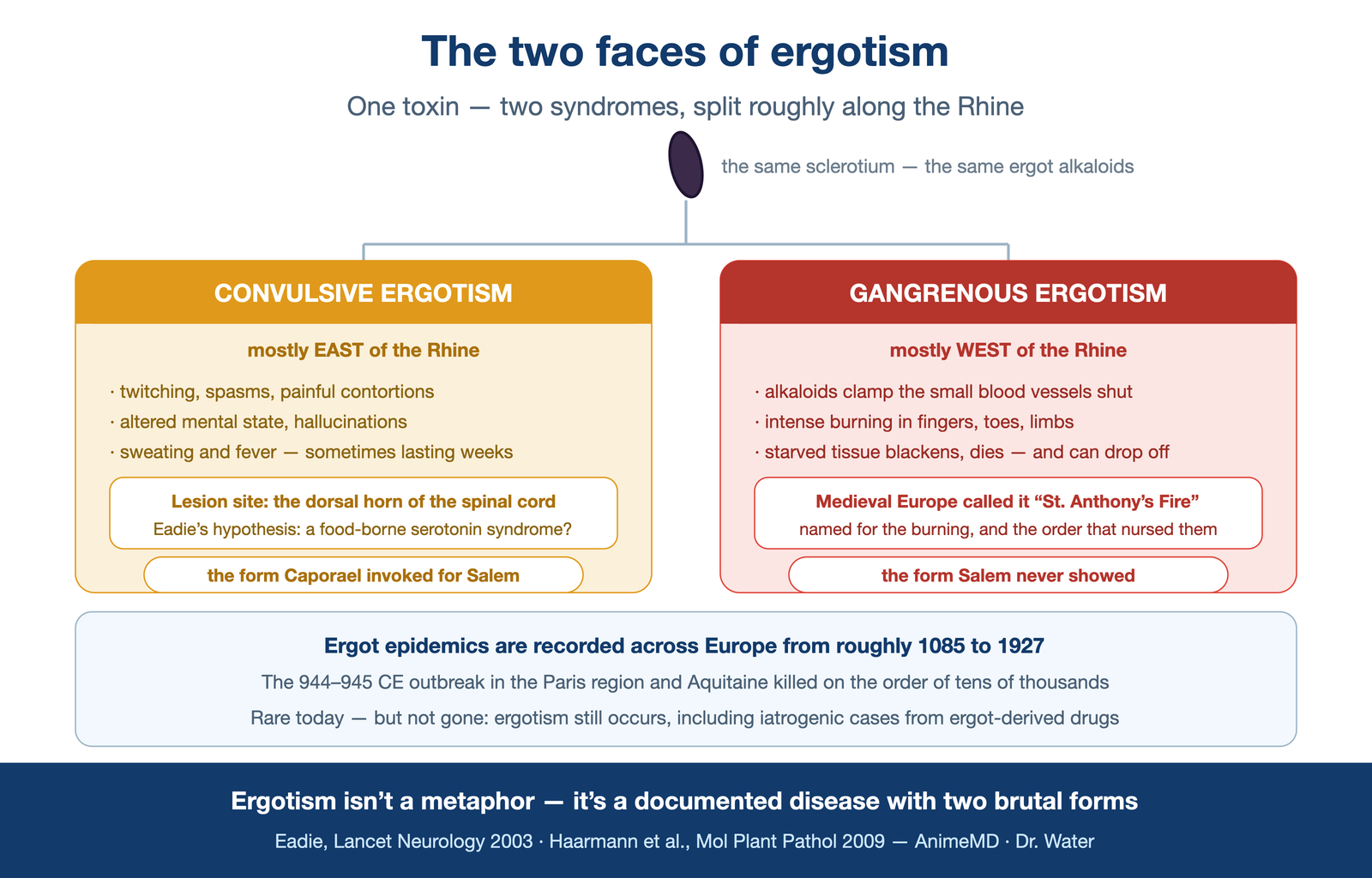
Historically, ergotism came in two forms, and which one you got depended largely on where you lived. The classic account, drawn from centuries of European epidemics between roughly 1085 and 1927, splits along the Rhine (Eadie, Lancet Neurology 2003):
- Convulsive ergotism (mostly east of the Rhine): muscle twitching and spasms, painful contortions, altered mental state, hallucinations, sweating and fever, sometimes lasting weeks. Eadie reads that cluster as serotonergic overstimulation of the central nervous system, and points to a specific address for it: the dorsal horn of the spinal cord, where ergot compounds bind serotonin receptors and where the neuropathological changes of convulsive ergotism are found. His proposal — and note the question mark in his own title — is that these epidemics may have been a food-borne version of what today we’d call the serotonin syndrome, a public-health problem centuries before modern psychopharmacology gave it a name. This is the form Caporael invoked for Salem.
- Gangrenous ergotism (mostly west of the Rhine): the alkaloids clamp the small blood vessels shut, choking off blood to the fingers, toes, and limbs. Victims felt intense burning — then the starved tissue blackened, died, and could drop off. This is the form medieval Europe called “St. Anthony’s Fire,” for the burning, and named after the saint whose order ran hospitals that cared for the afflicted (Haarmann et al. 2009).
This was not a rare curiosity. Ergot epidemics killed at scale: one outbreak recorded in 944–945 CE, in the Paris region and Aquitaine, is estimated to have killed on the order of tens of thousands of people (Haarmann et al. 2009). For most of European history, nobody knew the cause. People watched their neighbours convulse, hallucinate, and rot, in waves that came and went with the weather, and — reasonably, given their tools — reached for the supernatural. Cursed. Bewitched. Punished by God.
Here’s the sobering modern coda: ergotism still exists. It’s rare now, thanks to better grain cleaning and milling, but it hasn’t vanished — outbreaks from contaminated grain have occurred into the twentieth and twenty-first centuries in various parts of the world, and a related “iatrogenic” ergotism (ergotism caused by medicine, when ergot-derived drugs are overdosed or dangerously combined with certain other drugs) turns up in hospitals today. The fungus that may have haunted Salem is filed under “historical,” but the disease is filed under “still real.”
Takeaway: Ergotism is a genuine disease with two historical faces — convulsive (seizures, hallucinations; possibly, Eadie suggests, a food-borne serotonin syndrome) and gangrenous (vessel-clamping that rots the limbs; “St. Anthony’s Fire”). It killed by the tens of thousands in past epidemics, and it still occurs, rarely, today. The illness at the heart of the Salem theory is as real as any diagnosis in my clinic.
Q4 | ⚠️ The line I actually respect — an unproven theory, twenty dead, and a poison that became a cure. Straight-faced here.
Let me set the dry humour down, because this is where the honest work happens.
I’ve spent three sections making the ergot theory look strong, so now I have to tell you the other half, or I’m not doing my job. The ergot explanation for Salem is contested — seriously, in the same journal that published it. Later in 1976, the psychologists Nicholas Spanos and Jack Gottlieb published a detailed rebuttal in Science, and their objections are not easy to wave away (Spanos & Gottlieb, Science 1976).
Their opening argument is the one that stopped me, because it’s the kind of thing only a specialist would notice. The two forms of ergotism aren’t a menu you order from at random — on the classic accounts they cite, diet largely decides which one you get, and the deciding nutrient is vitamin A. Convulsive epidemics occurred almost exclusively where people were severely vitamin A deficient. Where vitamin A intake was adequate, ergot poisoning tended to produce gangrenous symptoms instead. And vitamin A comes from fish and dairy. Now look at where we are: Salem Village was a farming community with cows, and Salem Town next door was a well-known seaport. Fish and milk were plentiful, and several of the afflicted girls came from well-to-do farming families. There’s no evidence of vitamin A deficiency anywhere in the picture — which means that if ergot had struck Salem at all, it should have struck in its gangrenous form. And there is not one recorded blackened finger in the entire crisis. Their conclusion is blunt: the absence of any gangrenous symptomatology makes it highly unlikely that ergot played any role in the Salem crisis.
Then they did the unglamorous part, which I respect enormously. They went to the records and counted. The Records of Salem Witchcraft holds 117 depositions by the afflicted girls and 79 more in which other witnesses describe them, plus the contemporary eyewitness accounts — and Spanos and Gottlieb read the lot, hunting for the symptoms convulsive ergotism reliably produces. Vomiting and diarrhoea sit at the top of that list, and across every source they were unable to find a single reference to either. No livid skin colour. No ravenous appetite after the convulsions. No permanent contractures of the limbs, no dementia, no deaths from the illness itself — all of which severe convulsive ergotism leaves behind. Caporael had written that complaints of vomiting were common in the depositions of the accusers; Spanos and Gottlieb quote her and answer in four words: this statement is incorrect.
The rest of their case compounds it. Convulsive ergotism hits young children hardest — in the Finnish epidemic, 56 percent of cases were under ten — yet only three of the eleven afflicted girls at Salem were under fifteen, and only one under ten. Convulsive ergotism tends to sweep through an entire household sharing the same bread (it was so consistent about this that it was long, and wrongly, thought to be contagious), yet most of the people living in the same houses as the afflicted girls simply never got sick. And the fits tracked the courtroom, not the dinner table: the girls convulsed en masse when an accused person entered the room, glanced their way, or shifted in a chair, and their convulsions could stop when a particular passage of scripture was read. Food poisoning does not take social cues.
Even the visions don’t fit, and this is the detail I keep turning over. Ergot- and LSD-type compounds mostly produce perceptual distortion — halos around objects, persistent afterimages, undulating contours, depth going strange. That’s not what Salem reported. The girls described “formed persons”: the recognisable spectres of specific, named neighbours, biting and pinching and choking them. A drug bending the edges of the visible world is a different phenomenon from a named human shape walking into the room. On Spanos and Gottlieb’s reading, that points somewhere other than the rye — toward girls enacting the role of the bewitched as their own century understood it, a role learned from sermons, pamphlets, and each other.
So where does that leave us? Honestly: not with a conviction. The ergot hypothesis is a genuine, testable idea — which is a real compliment, not a dismissal — and when it was tested against the actual records, it did badly. It fits a few facts (a rye-eating village, a bad year, symptoms that rhyme) and collides with a lot of them, and the sharpest objections come from the documents themselves. It sits alongside explanations historians take seriously — social and religious tension, local feuds, fear, suggestion, and the terrible feedback loop of a trial that rewarded accusation. A careful doctor’s verdict is not “it was ergot,” and not, in fairness, “it was categorically impossible.” It’s: Salem was almost certainly not caused by any one thing, and on the evidence we have, probably not by this.
And that humility matters here more than in any other Monster Clinic file, because of who’s in the story. Around twenty people were executed at Salem, and none of them were witches. They were mothers, farmers, a former minister, an old man pressed to death under stones for refusing to enter a plea. Whatever made the afflicted convulse — fungus, fear, or both — the people who died were innocent human beings killed by a court that mistook a medical and social crisis for a supernatural war. I’m not here to reduce them to a footnote in a fungus’s biography. The real lesson of Salem isn’t “case closed, it was mould.” It’s how fast a frightened community, certain of the wrong explanation, can kill.
Now the twist I promised, because science does keep one grimly hopeful card. The very alkaloids that made ergot a killer became, in careful hands, real medicines. Ergot preparations have been used to treat migraine since the second half of the nineteenth century, and ergot alkaloids have been used since the 1800s to control bleeding during and after childbirth (Haarmann et al. 2009) — first as crude, unpredictable extracts, and only later, once chemists learned to pull the individual molecules out of the sclerotium and measure them, as precise drugs. That refinement is the whole difference between a poison and a prescription. Ergometrine (ergonovine) clamps the uterus after childbirth and has saved countless mothers from bleeding to death — haemorrhage around childbirth still accounts for almost half of postpartum maternal deaths in developing countries, and this “witch’s poison,” dosed precisely, is one of the tools we fight it with. And the lysergic-acid core of ergot is literally where Albert Hofmann’s LSD came from. The fungus that may have convulsed Salem, and that rotted medieval limbs off in the name of a saint, is also the raw material of drugs delivered in maternity wards and neurology clinics right now. That’s not magic turning evil into good. That’s chemistry, plus the human willingness to walk toward the thing that scares us and come back with medicine.
— Confession: I still find it wild that the same molecule can be a public-health catastrophe and a life-saving obstetric drug depending entirely on dose and control. That’s not a loophole. That’s basically the entire story of pharmacology in one fungus.
Takeaway: The ergot theory of Salem is a real, respectable hypothesis that fared badly under scrutiny: a peer-reviewed rebuttal in the same journal (Spanos & Gottlieb, Science 1976) found no gangrene where the villagers’ fish-and-dairy diet predicts it, and — across 117 depositions by the afflicted girls plus 79 by witnesses — not one mention of the vomiting or diarrhoea that convulsive ergotism reliably causes. Salem had many causes, and its twenty executed victims were innocent people, not a fungal case study. Yet the same ergot alkaloids became genuine medicines for migraine and childbirth. Poison and cure, one sclerotium.
The verdict: legend vs. real medicine
| Salem “witchcraft” claim | Verdict |
|---|---|
| The afflicted were possessed by demons / by witches | ✕ fantasy — no supernatural agent; the fits describe a neurological/behavioural illness |
| The afflicted were simply lying or faking | ◐ too simple — Spanos & Gottlieb argue the fits were role enactment: behaviour learned from the culture, cued by the room, and shaped (perhaps unwittingly) to fit what a “bewitched” girl was expected to do. They explicitly stop short of calling it conscious faking, and so do I |
| A fungus in the bread (ergot) could poison a whole village at once | ✓ real — Claviceps purpurea on rye, blooming when the weather of a single season allows it, really did cause mass poisonings |
| Ergot poisoning can cause convulsions, crawling skin, and hallucinations | ✓ real — that’s textbook convulsive ergotism |
| Ergotism definitely caused the Salem afflictions | ◐ unproven, and looking unlikely — no gangrene despite a fish-and-dairy diet, no vomiting or diarrhoea in ~200 depositions, wrong age profile, households unaffected, fits cued by the courtroom (Spanos & Gottlieb, Science 1976); Salem was multi-causal |
| Ergotism is a made-up or purely historical disease | ✕ false — it killed at epidemic scale for centuries and still occurs, rarely, today |
| The “witch’s poison” was pure evil, good for nothing | ✕ false — ergot alkaloids became real medicines (migraine, postpartum haemorrhage) |
| The people executed at Salem were guilty of something | ✕ false — around twenty innocent people were killed; this is the part that isn’t a puzzle, it’s a tragedy |
Wrap-up
Here’s what stays with me after reopening this case. It’s tempting to file Salem under “superstition” and move on, or to file it under “actually, it was just drugs” and feel clever. Both are too easy. The truth is more useful and more humbling: there really is a fungus that can convulse a village through its bread — and when two researchers checked that story against the depositions, line by line, it mostly fell apart, and the actual dying was done by a court, not a mould. Same events, three layers: real biology, honest uncertainty, and a human catastrophe.
There’s a lesson in that middle layer I didn’t expect to find. The ergot theory is the most satisfying explanation of Salem — it’s clean, it’s scientific, it hands you a villain you can look at under a microscope. And it’s probably wrong. Being the tidy explanation and being the true one are different jobs, and the 1692 court got that exactly backwards too: it also had a clean story that explained everything. That’s the trap, and it doesn’t care whether your story is about demons or about mould.
Real medicine can’t retry the Salem court. But it can do the thing that actually protects people: name the disease instead of the demon, hold the theory to the evidence instead of the mood of the room, and remember that the fastest way to hurt the innocent is to be certain about the wrong cause. Turning a monster back into a patient — or in this case, turning a “witch” back into a frightened, ordinary, and ultimately wronged human being — is the whole job.
The human body, and the invisible world of fungi it shares a planet with, are stranger and more worthy of respect than any curse we invented to explain them. That’s the real magic, and it’s the kind I get to practice.
See you at the next check-up — the Monster Clinic door stays open. (Mind the rye.)
As it happens, this patient already has a chart. The witch is Chapter 4 of my book Monster Clinic — “Was the ‘curse’ hiding in the bread?”, which is more or less the question we’ve spent today’s appointment on — filed alongside thirteen other patients: the vampire, the zombie, the werewolf, the mummy, and the rest of the waiting room. (Kindle, $3.99, and free to read on Kindle Unlimited.)
If this was fun — the Monster Clinic takes a new patient each time: I look at the medicine hiding inside a classic monster or mystery, through a doctor’s eyes. Get the next one via the [free newsletter].
Dr. Water — physician in occupational and preventive medicine, and a die-hard anime/manga fan (a double insider).
Monster Clinic file: “The Mummy’s Curse Was Real — It Was Mold” (Article 25) · “A Werewolf Walks Into My Clinic” (Article 24)
Frequently Asked Questions
Were the Salem witch trial convulsions actually caused by a poison in the bread?
Possibly, but it’s unsettled — the leading medical theory, proposed in 1976, is convulsive ergotism, poisoning from a fungus called ergot that grows on rye and produces alkaloids that act on the brain and blood vessels. The theory rests on a real convergence of facts: rye was Salem’s staple grain, the growing conditions matched, and the symptoms in court records resemble the illness. But it is seriously contested, not a settled fact.
Does the evidence actually hold up for ergot poisoning explaining the Salem witch trials?
Not well — a peer-reviewed rebuttal published in the same journal found no evidence of gangrene, which should have appeared given Salem’s fish-and-dairy diet, and across nearly 200 depositions there is not one mention of the vomiting or diarrhea that convulsive ergotism reliably causes. The afflicted girls’ convulsions also tracked the courtroom rather than the dinner table, and most people sharing the same household bread never got sick — patterns food poisoning doesn’t produce.
Is ergot poisoning only something from history, or could it still happen today?
It still exists today, though it’s now rare thanks to better grain cleaning and milling; outbreaks from contaminated grain have occurred into the twentieth and twenty-first centuries, and a related “iatrogenic” form still turns up in hospitals when ergot-derived drugs are overdosed or combined dangerously with other medications. Those same ergot alkaloids are also used as real medicines for migraine and to control bleeding after childbirth, but only under a doctor’s direct supervision.
Disclaimer 1 | Medical
This article is general, educational medical commentary sparked by history and folklore. It is not medical advice and not intended to diagnose or treat. Reading it creates no doctor–patient relationship. For any health decision, consult your own physician. The conditions described here — ergotism and related illness — are real diagnoses, described with respect and never to mock any patient. Ergot-derived medicines (for migraine, or to control bleeding after childbirth) are powerful prescription drugs with serious interactions; never take, adjust, or combine them except under a doctor’s direct supervision. If you or someone else has taken too much, or develops severe symptoms, seek emergency care.
Disclaimer 2 | Copyright & Non-Affiliation
The Salem witch trials and the “witch” of folklore are public-domain history and folklore; this article references no copyrighted anime or manga work, and reproduces no panels, screenshots, or character art. No specific film or studio “witch” design, costume, or logo is used — any illustration is an original, generic depiction. All medical and historical claims are attributed to the cited sources. Any brand, character, or title mentioned in passing belongs to its respective owner and is referenced solely for identification and commentary.
🩺 Your check-up is over — but the clinic is always open
📚 This clinic has a sequel. 14 legendary monsters — vampire, zombie, werewolf and more — properly diagnosed by a real doctor. The book this blog grew into, with new write-ups added. → Get it on Amazon — $3.99 / free on Kindle Unlimited
💌 Free newsletter — new diagnoses delivered to your inbox, no appointment needed. → Subscribe on Substack
▶️ Prefer video? Watch the diagnoses on YouTube. → The Anime MD




Comments