
For a century the mountains have hidden a giant hairy man-beast — the yeti, the sasquatch, Bigfoot. So scientists finally did the un-romantic thing: they sequenced the “yeti” hairs. In the Himalayas the answer was a bear. In North America it was mostly cattle and somebody’s dog. A doctor walks you through what actually came back, why your own eyes would have made the same mistake, and whether a hidden giant ape could survive at all. The Monster Clinic takes a patient who never shows up for the appointment.
Hi. I’m Dr. Water 🐬. I’m a doctor — the kind who keeps working adults healthy (occupational and preventive medicine).
Welcome back to the Monster Clinic (怪物外来), the room where a monster shows up not as a threat but as a patient, and I do what a doctor does: take a history, examine, and ask, gently, what is actually going on here?
Today’s patient has the worst attendance record in the clinic. He’s eight feet tall, covered in hair, leaves enormous footprints, and has been sighted for over a century across the Himalayas (the yeti) and the forests of North America (Bigfoot, the sasquatch). And yet, across all that time, he has never once sat on my exam table, never left a bone in a museum drawer, never turned up as a body. What he has left behind is hair. Tufts of coarse hair, collected by expeditions, guarded in cabinets, whispered over for decades as the physical proof that a giant unknown primate walks the mountains.
Here’s why that makes him a perfect case for this clinic. Hair is not a ghost story. Hair has DNA. And a few years ago, scientists did the least romantic, most doctorly thing imaginable: they took the actual “yeti” hairs and ran them through a lab. So this article isn’t going to mock anyone. It’s going to follow the evidence, in four questions — and the answer that comes back is stranger and, honestly, kinder than “you all imagined it.”
The house rules
I love a good cryptid, and I’m not here to spoil the fun or call eyewitnesses fools. I am here to separate what the mountain actually contains from what our brains add to it — because there’s real biology in both. Every scientific claim gets backed by a source, and I’ll flag what’s locked-down peer-reviewed science versus what’s careful inference. Nobody in this article is stupid; the whole point is that the mistake is one your own brain is built to make.
Q1 | The evidence: when you DNA-test the actual “yeti” hairs, what comes back? — bear in the Himalayas. Cattle and dogs in North America.
Start where a doctor always starts: with the specimen, not the story.
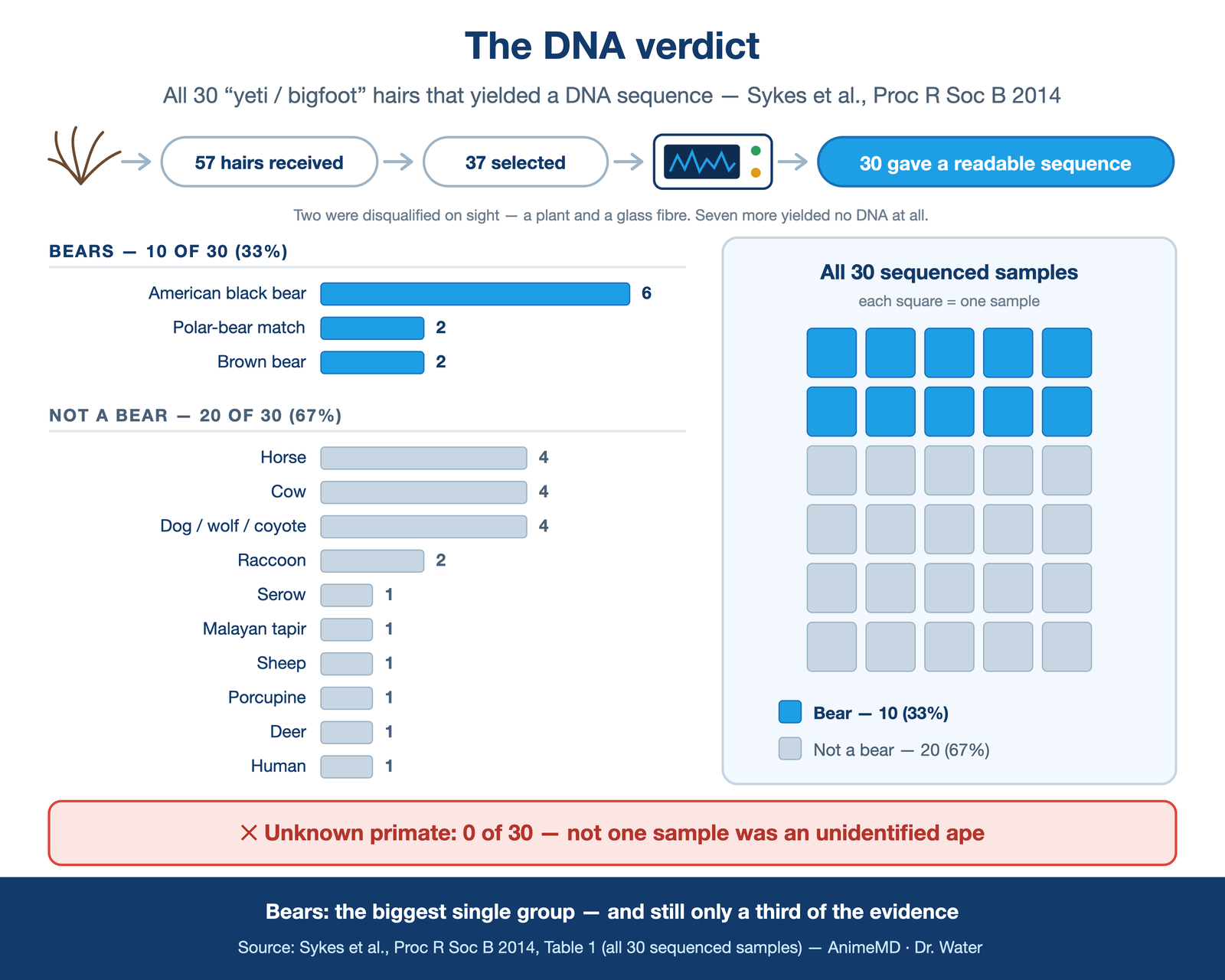
For most of the yeti’s history there was nothing to test — just footprints in snow and eyewitness accounts. But museums and expeditions had quietly accumulated physical samples: hairs, and later bits of skin, bone, and scat, each attributed to a yeti, a Bigfoot, an almasty. Modern genetics can read those. So in 2014 a team led by an Oxford geneticist did exactly that (Sykes et al., Proc R Soc B 2014). I want to be precise about the design, because the honesty of it is the point: they put out a public call and received 57 samples. Two were disqualified on sight — one was a plant, one was glass fibre. Thirty-seven were selected for genetic analysis on provenance or historical interest. Seven of those refused to give up any DNA at all. That left 30 samples that actually yielded a readable sequence — a stretch of mitochondrial DNA (the 12S RNA gene), read against GenBank to name the species.
Not one was an unknown primate. What came back instead is, I think, the funniest table in modern science — and it is not the table the legend would have you expect. Here is the full roll-call of all 30: six American black bears, four horses, four cattle, four dogs-or-wolves-or-coyotes, two raccoons, two polar-bear matches, two brown bears — and then, one each: a serow (a Himalayan goat-antelope), a Malayan tapir, a sheep, a North American porcupine, a white-tailed or mule deer, and one human being.
Do the arithmetic, because this is where I have to correct the story people usually tell — including the one I nearly told you. Bears were 10 of the 30. That’s 33%. Bears are the single most common answer, yes — but they are a minority of the evidence. Two-thirds of the world’s physical yeti-and-Bigfoot evidence is not a bear. It’s mostly livestock and pets.
And it gets better when you sort by which monster the sample was blamed on. Of the 18 samples submitted as Bigfoot, only five were black bear. Four were dogs, three were cattle. In other words: point a sequencer at North America’s legendary man-beast and the single most likely answer isn’t a bear at all — it’s somebody’s dog or somebody’s cow. Seven to five, cattle-and-canines over bears. The sasquatch’s hair is, more often than not, livestock.
The Himalayas are the exception that rescues the legend’s dignity. Only three samples were submitted as yeti — and two of those were bears (the polar-bear matches, which set off a brief, delicious flurry of “unknown hybrid bear!” headlines). The third was a serow. Small numbers, but they point somewhere real. Meanwhile the one sample submitted from Sumatra as orang pendek was a Malayan tapir, and someone, somewhere, submitted a porcupine as evidence of Bigfoot.
Now — what happened to that polar bear? This is the part of the story I like most, and it’s worth slowing down for, because it is science working exactly as advertised.
Sykes himself flagged the result as shaky. The match was to “a segment only 104 bp long,” he wrote, and so “this result should be regarded as preliminary.” That caution got flattened by the headlines, as caution does. Then other scientists went to work in public. A comment appeared in the same journal asking whether the signal was a polar bear or simply degraded DNA (Edwards & Barnett, Proc R Soc B 2015). A separate team re-ran the comparison from scratch and reported that the fragment was “not sufficiently informative” to support any such claim, concluding there was “no reason to believe that the two samples came from anything other than Brown Bears” (Gutiérrez & Pine, ZooKeys 2015). The original paper was formally corrected in 2015 (Correction, Proc R Soc B); today its abstract says the samples had their “closest genetic affinity” with a Palaeolithic polar bear — noticeably quieter than a 100% match.
The reason the polar bear evaporated is beautifully mundane: 104 base pairs of a highly conserved gene is simply too short to tell closely related bears apart. It’s a screening tool, not an identification. It’s the genetic equivalent of identifying a stranger from a blurry photo of their elbow.
Then in 2017 a different team did the job properly, sequencing whole mitochondrial genomes from Himalayan and Tibetan bears, including nine specimens collected as yeti — bone, tooth, skin, hair, scat (Lan et al., Proc R Soc B 2017). Eight of the nine were bears: an Asian black bear, a Himalayan brown bear, Tibetan brown bears. The ninth — a tooth, from a stuffed museum yeti — was a dog. They also sequenced a Ladakh hair which, from its collection locality and the film company’s own account, may have come from the very specimen Sykes had wondered about. It was a Himalayan brown bear. (To be careful: they never re-tested Sykes’s actual samples, and the Bhutan hair has never been re-examined. Nobody needed to. The method had already been shown to be too blunt to support the claim.)
Their summary line is one of my favourites in all of cryptozoology, precisely because it’s so calm. The evidence, they wrote, is “strongly supporting the biological basis of the yeti legend to be local, extant bears.”
Read that again. The scientists are not sneering. They’re saying: there is a real animal behind this legend — it’s just a bear you already knew about. The yeti isn’t nothing. The yeti is a bear with excellent PR.
Takeaway: No unknown primate — not in 30 sequenced samples. But the honest version is funnier and more specific than “it’s always a bear.” Bears were only 10 of 30 (33%); two-thirds of the physical evidence was livestock, pets, and wildlife — horses, cattle, dogs, a raccoon, a tapir, a porcupine, one human. For Bigfoot specifically, dogs and cattle (7) outnumbered bears (5). It’s in the Himalayas that the bear answer holds: the yeti samples came back bear, and the whole-genome follow-up tied nine yeti specimens to local bears. The legend has a real animal at its centre — that animal wears fur, and it solves winter by hibernating. Hold that thought.
Q2 | The witness: why does a normal person see a monster where there’s a bear? — because your brain is built to, especially on a cold mountain.
Now the part I refuse to skip, because it’s where the medicine lives: how does a sane, sober person end up certain they saw an eight-foot man-beast? Not by lying. By having a completely normal human brain, running in completely abnormal conditions.
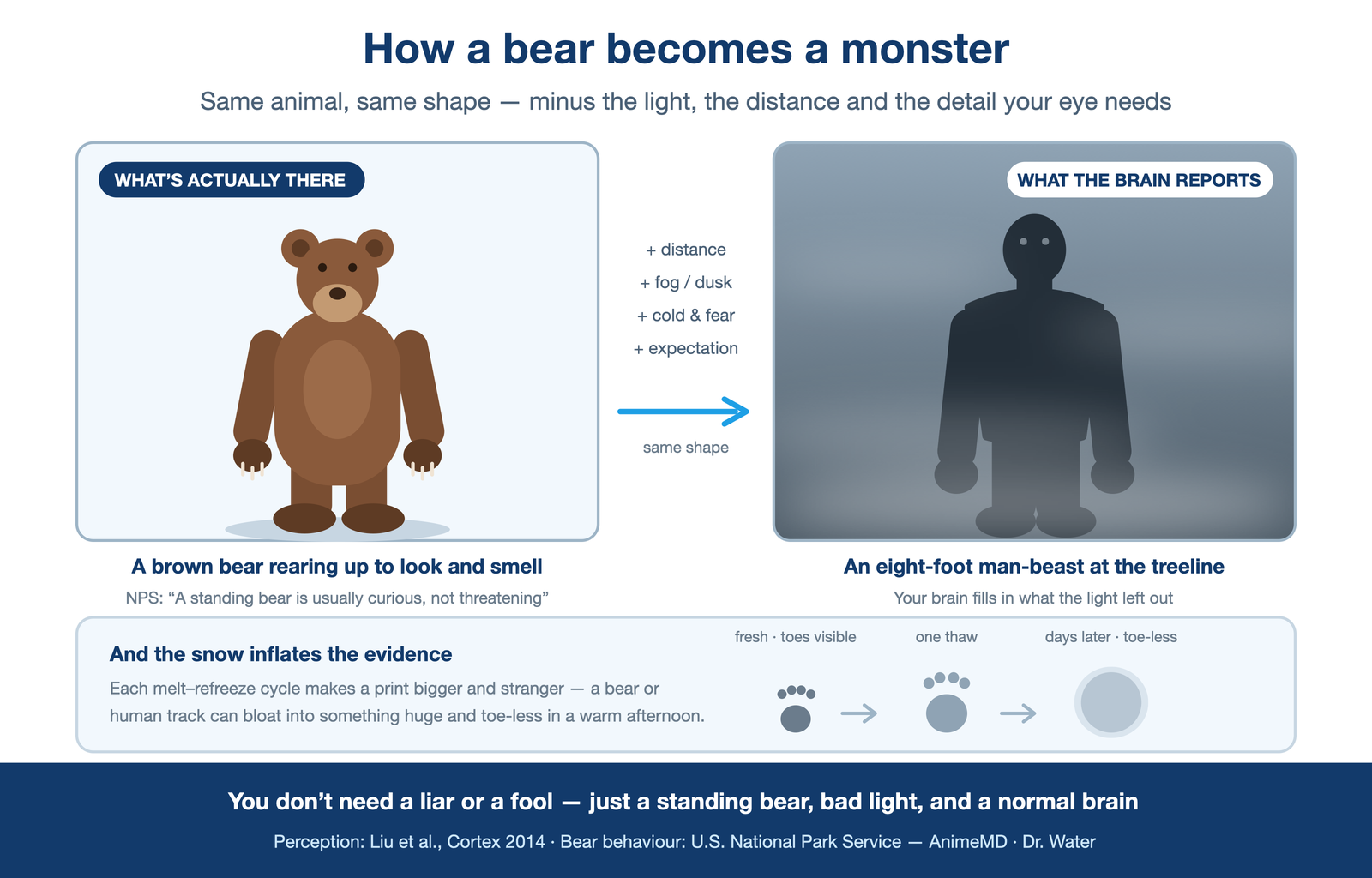
Start with the animal. A brown bear standing on its hind legs is a genuinely uncanny sight — 7-plus feet of upright, broad-shouldered, forward-facing bulk. And here’s the thing people get backwards: a bear rears up not to attack, but to investigate — to lift its nose and eyes higher and gather information about the strange thing (you) that just appeared. It’s a curiosity posture, not a war stance — and you don’t have to take my word for it, because the U.S. National Park Service says it in one flat sentence in its bear-safety guidance: “A standing bear is usually curious, not threatening.” I enjoy that this advice comes from the agency that runs the national parks of the Pacific Northwest — which is to say, the official caretakers of Bigfoot country are on record telling visitors that the big upright thing watching you is just being nosy.
So the classic encounter is a bear doing the single most human-looking thing in its repertoire — standing tall and studying you — at exactly the moment your adrenaline is peaking.
Now stack the conditions the way a real sighting stacks them. Distance and bad light: dusk, fog, deep forest, or a snowfield — the eye is starved of the fine detail (a snout, small ears, claws) that would say “bear.” The brain fills the gap. Perception isn’t a camera; it’s a prediction.
We can put a number on how eagerly it fills that gap. In one study, people were shown images of pure visual noise — literally nothing at all — but told that half contained faces. They reported seeing faces in that static about a third of the time, and when they did, the face-processing region of their brain lit up as if a real face were there. The authors’ conclusion is the sentence I’d frame on the clinic wall: human face processing “has a strong top-down component whereby sensory input with even the slightest suggestion of a face can result in the interpretation of a face” (Liu et al., Cortex 2014). That’s the machinery that makes you see a face in a wall socket — measured, in a scanner.
Now, honesty check, because this is the seam where a fun article would cheat: that study was about faces in noise, not eight-foot silhouettes in fog. Nobody has put “seeing a yeti” in an fMRI scanner. So take the study for exactly what it proves — that your perception runs on expectation to a degree that is genuinely startling — and let me be upfront that extending it to a whole upright body at 80 metres in failing light is my inference, not a measured finding. It’s a reasonable one. It isn’t a citation.
Then add the mountain itself, which is where my occupational-medicine hat goes on — and where I want to be careful, because the sloppy version of this argument insults people. Ascending to high altitude has real, well-described effects on the brain: everything from high-altitude headache and acute mountain sickness through to, at the extreme, high-altitude cerebral oedema (Wilson, Newman & Imray, Lancet Neurol 2009). Pile on cold, exhaustion, dehydration and fear, and a nervous system is running below spec.
But notice who that applies to. It applies to the non-acclimatised outsider — the visiting expedition, the climber three days off a plane, me. It emphatically does not explain the yeti, because the yeti’s oldest and richest tradition belongs to Sherpa, Tibetan and other Himalayan communities who are superbly adapted to that altitude and have lived and worked at it for generations. Explaining their folklore as “thin air made them muddled” isn’t science; it’s condescension wearing a lab coat, and it’s wrong on the physiology besides. Their stories are about an animal in their own mountains, told by people who know those mountains better than any of us.
And the same limit applies at the other end of the map: most Bigfoot sightings happen in the low-elevation forests of the Pacific Northwest, where there is no altitude and no hypoxia to blame at all. Just trees, dusk, and a brain doing its job. Altitude is a footnote here, not the explanation. The explanation is the ordinary brain — which is a far more interesting culprit anyway.
And footprints? Snow is a serial liar. A track in snow melts and refreezes at the edges, and each cycle makes it bigger and stranger — a normal bear or human print can bloat into something huge and toe-less over a warm afternoon. Overlapping prints (a bear’s hind foot landing near its fore foot) can read as one giant impossible foot. No malice, no hoax required — just physics acting on slush.
Takeaway: You don’t need a liar or an idiot to produce a yeti sighting — you need a standing bear, bad light, and a normal brain doing its normal job of guessing. That guessing is powerful enough to conjure faces out of pure static a third of the time. Add cold, fear and fatigue, plus snow that inflates every footprint, and a real bear reliably becomes a real memory of a monster. (Altitude belongs in this list only for the non-acclimatised visitor — not for the Himalayan communities whose tradition this is, and not at all in the low forests where Bigfoot is seen.) The witness isn’t broken. The witness is human.
Q3 | The biology: could a giant bipedal ape actually be hiding out there at all? — the physiology says: almost certainly not.
Fine, says the believer — but what if? What if a real giant primate is out there, just very good at hiding? This is my favourite question, because we can answer it without a single sighting. We just ask what a giant ape’s body would require, and whether the mountains could quietly supply it.
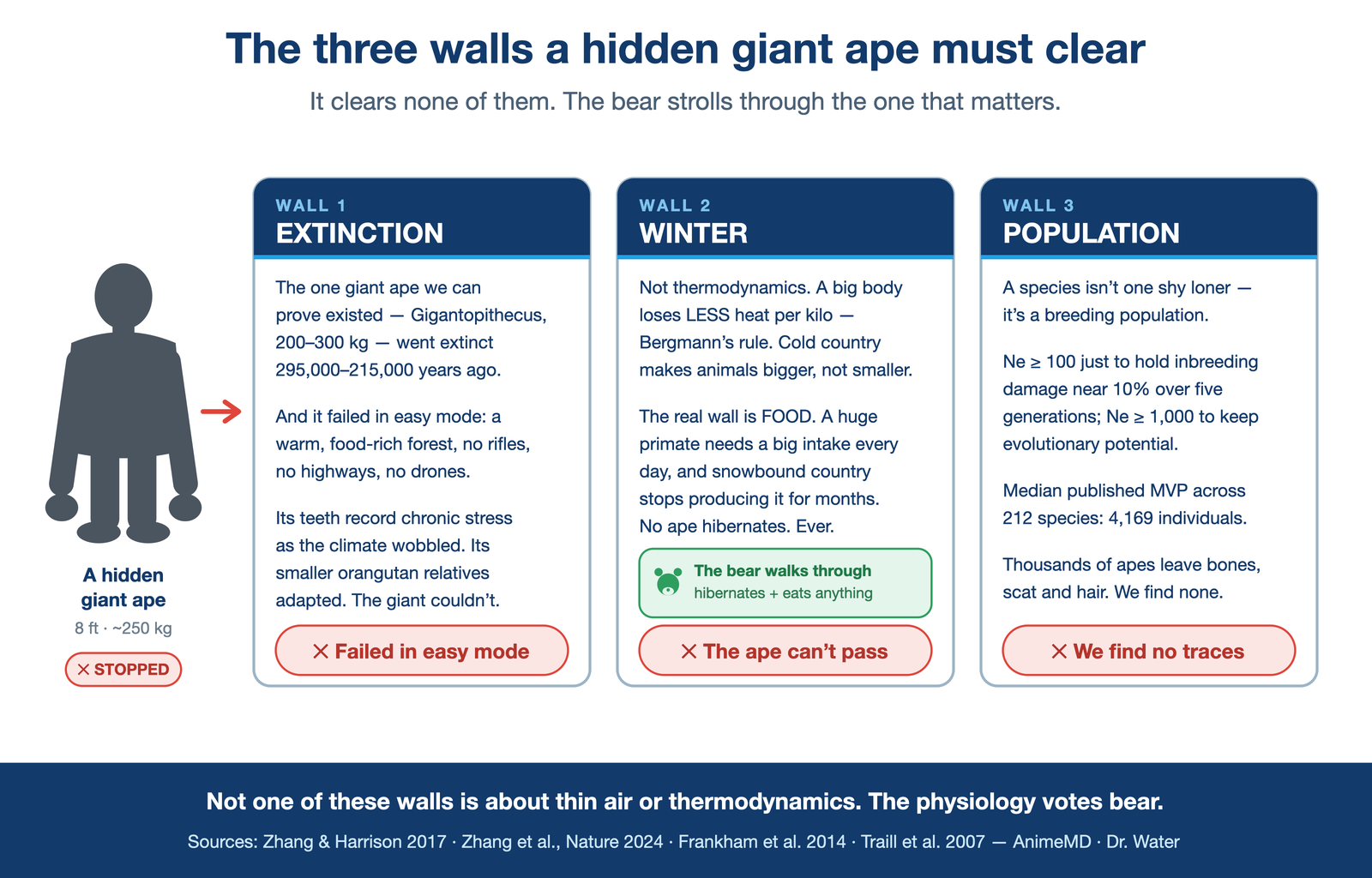
And we’re not speculating in a vacuum, because a giant ape really did exist. Gigantopithecus blacki was real — the largest primate that ever lived, roaming southern China during the Pleistocene. Reconstructing it from its enormous teeth and jaws, researchers estimate a body mass of roughly 200–300 kg (Zhang & Harrison, Am J Phys Anthropol 2017). So “huge ape” is not fantasy. It’s the hiding that’s fantasy, for three hard biological reasons — and I’m going to lead with the one that should stop the argument dead.
One: the real giant ape already tried this, and died. Gigantopithecus — an actual giant ape, in a warm forest, with no rifles, no highways, no drones — still went extinct, somewhere around 295,000 to 215,000 years ago. A 2024 study reconstructed why: as the environment grew more variable, its smaller relatives (the orangutan lineage) adjusted their diets and behaviour and came through. The giant couldn’t. Its teeth record chronic stress and dwindling numbers right up to the end (Zhang et al., Nature 2024). Being enormous is a fragile strategy: it demands a great deal and bends poorly when conditions shift. So the believer’s position, stated plainly, is this — the one giant ape we can actually prove existed could not survive the easy version of this test, in a lush forest, with the whole Pleistocene to work with. And we’re asked to believe a second one is passing the hard version right now, in colder mountains, on a planet with eight billion people and a camera in every pocket.
Two: a big body in a cold, seasonal place needs a plan for winter. Let me kill a bad argument here, because it’s the one everybody reaches for — including, I’ll admit, an earlier draft of this article. People say a giant ape in the Himalayas would be “fighting thermodynamics,” burning impossible calories to stay warm. That’s backwards. Being big is thermally efficient: volume rises faster than surface area, so a large animal loses proportionally less heat per kilogram than a small one. That’s Bergmann’s rule, and it’s why cold climates tend to produce bigger-bodied animals, not smaller. If heat retention were the whole story, the Himalayas would be an excellent place to be enormous.
The real wall isn’t heat — it’s food, in winter, for a primate. A huge body needs a large absolute intake every day, and high, snowbound country simply stops producing food for months at a time. Gigantopithecus solved this by never facing it: it lived in a closed-canopy subtropical monsoon forest, grinding through fruit, leaves, stems and probably tubers, in a warm and food-dense habitat, year-round (Zhang & Harrison 2017).
And here’s the part that makes me smile, because the answer to this article is standing right in the middle of the question: the bear already solved it. The Himalayan brown bear is a big-bodied mammal in exactly the terrain we’re arguing about, and it survives on two adaptations a great ape simply does not have. It’s an omnivore, so it eats essentially whatever the season offers. And it hibernates — it opts out of winter entirely, spending the hungry months asleep on its own fat. No ape does that. No ape has ever done that. A giant primate in the high Himalaya would have to stay awake through a season with nothing to eat, at 250 kg, every year, for centuries. The bear isn’t just the answer to the DNA. The bear is the answer to the biology — it’s the body plan that actually works up there, which is precisely why it’s the one that’s really there.
Three: one is impossible; you need a crowd. A species is not one mysterious individual — it’s a breeding population. And this is where the numbers get brutal. To hold inbreeding depression to even ~10% over five generations, the genetics literature puts the required effective population at 100 or more — and for a population to keep its evolutionary potential indefinitely, at 1,000 or more (Frankham et al., Biol Conserv 2014). Effective size, note, is smaller than a head-count, so the real animals on the ground would number more still. And when researchers pooled 30 years of published minimum-viable-population estimates across 212 species, the median came out at 4,169 individuals (Traill et al., Biol Conserv 2007).
Sit with that. The honest ask isn’t one shy giant dodging cameras. It’s thousands of eight-foot apes, spread across the range, mating, giving birth, dying, for centuries — and leaving behind droppings, carcasses, bones, hair with real primate DNA, kills, browse damage, roadkill. A population that size doesn’t hide; it litters. We have exactly none of it. We went and tested the hair, remember, and got cattle and dogs (Q1). A hidden individual is a nice story. A hidden population big enough to still be here is a biological contradiction.
Takeaway: A giant ape isn’t impossible — one genuinely existed, and then died in far friendlier conditions than these. A giant ape surviving hidden today has to clear three walls: extinction already claimed the real one; a huge primate has no way through a high-altitude winter (the bear does — it hibernates and eats anything); and a species needs not a loner but a population in the hundreds to thousands, which would leave traces we simply never find. Not one of those walls is about thin air or thermodynamics. The physiology votes bear.
Q4 | ⚠️ The line I actually respect — the witnesses aren’t fools, and the search grew up into real science. Straight-faced here.
Let me set the dry humour down, because underneath this fun story are real people who saw something real, and a science that owes them more respect than a punchline.
The yeti and Bigfoot are public-domain folklore and a genuine joy — footprints in fresh snow, a shape at the treeline, a story told around a fire. Enjoy every second of it. But two things under the fur aren’t costume. First: the witnesses were not idiots. A person who reports a yeti usually saw something — a real bear, a real trick of light, a real footprint bloated by real snow — and their brain did what every human brain does, which is to make the best guess it can from bad data under stress. I would have made the same call standing next to them, cold and scared, at dusk. The reflex to see an upright figure in an ambiguous shape isn’t gullibility; it’s the same finely-tuned pattern-detector that kept our ancestors alive when the shape in the grass might have been a predator. Better to see a monster that isn’t there than to miss one that is. The yeti is that ancient alarm system, firing in a modern mountain.
Second: watch what the science did to itself. I skated past this in Q1, but it’s the best thing in this whole story, so let me say it plainly. A famous geneticist published a startling result. He flagged his own uncertainty in the paper. Other scientists publicly challenged it — in the same journal, under their own names. An independent team re-ran the analysis and reported it didn’t hold. The original authors issued a correction. A different team then settled the question with better tools. Total elapsed time: about three years.
Nobody was humiliated. Nothing was covered up. That is not science failing — that is the only system humans have ever built that reliably catches its own mistakes, running exactly as designed, on live television. The yeti hunt didn’t embarrass science. It gave science a chance to show its working. If you want to know why I trust a peer-reviewed paper more than a certainty, it’s not because papers are always right — this one wasn’t. It’s because papers can be wrong out loud, and then fixed.
Third: the hunt for hidden animals stopped being a joke and became a real tool — and that’s the twist I promised. The dream underneath cryptozoology, “there are undiscovered creatures out there and we can find them,” turns out to be true — just not in the way the legend hoped. Today scientists routinely find rare, shy, hard-to-see species not by glimpsing them, but by detecting the DNA they leave behind in water, soil, and snow — environmental DNA, or eDNA (Taberlet et al., Mol Ecol 2012). Sequence a cup of river water and you can read off which fish, amphibians and mammals passed through, including cryptic and endangered ones, without anyone ever seeing the animal — a tool now described as “transforming how we survey animal and plant communities,” and used across freshwater, marine and terrestrial habitats for conservation and biomonitoring (Deiner et al., Mol Ecol 2017). It is non-invasive, it is sensitive, and it is genuinely changing how we find the rare and the hidden. (Measured, as ever: eDNA is excellent at telling you something was there. It’s still poor at telling you how many — and it has never once handed anyone an unknown giant primate.)
And notice what those very same methods keep doing to the yeti: every time we point real genetic tools at the mystery, they answer bear — and in doing so they hand us something better than a monster. They give us the actual, threatened, magnificent animals that live up there for real: the Himalayan brown bear and its relatives, whose true evolutionary story the “yeti” studies helped map (Lan et al. 2017). The legend was pointing at a real creature the whole time. The kindest thing science can do is look where the legend pointed, and protect what it actually finds.
— Confession: I would absolutely still freeze if a huge shape stood up out of the fog on a mountain trail. Knowing it’s a curious brown bear and not an abominable snowman doesn’t make me calmer in the moment. And here’s the embarrassing part — every instinct I have says back away slowly, and the Park Service says that instinct is wrong: stand your ground, stay still, slowly wave your arms, leave the bear its escape route. Even writing this article, I typed “back away slowly” without blinking, and had to go and check. That’s the whole lesson in miniature, isn’t it — my gut is confidently wrong about the bear, exactly the way it would be confidently wrong about the monster. The difference is that the bear comes with a manual, written by people who went and looked. So: I stand still, I respect the bear, and I take the authority’s word over my own adrenaline — because the bear, frankly, deserves the respect more than the legend does.
Takeaway: No hidden man-beast — but no fools, either. The witnesses saw real things through a brain built to guess, in conditions built to fool it. Along the way the science got one wrong in public and fixed it in public, which is the whole reason it’s worth trusting. And the genuine version of the cryptid dream came true: eDNA now finds hidden species for real, and when it looks for the yeti it keeps handing back a bear worth protecting. Respect the witness, respect the science, respect the bear.
The verdict: legend vs. real science
| Yeti / Bigfoot claim | Verdict |
|---|---|
| The physical “yeti/Bigfoot” hairs prove an unknown primate | ✕ fantasy — of 30 sequenced samples, unknown primates = zero; every match was a known mammal (Sykes 2014) |
| It’s always a bear | ◐ half — bears were only 10 of 30 (33%): the biggest single group, but a minority. The other 20 were horses, cattle, dogs, raccoons, a serow, a tapir, a sheep, a porcupine, a deer and one human (Sykes 2014, Table 1) |
| Bigfoot’s hair is bear hair | ✕ mostly not — of 18 bigfoot samples: black bear 5, dogs 4, cattle 3, plus a raccoon, sheep, porcupine, horse, deer and human. Dogs + cattle (7) outnumber bears (5) (Sykes 2014, Table 1) |
| The yeti (Himalaya) is a bear | ✓ real — this is where it holds: the yeti samples came back bear, and nine Himalayan yeti specimens = local bears (+ one dog); “strongly supporting the biological basis of the yeti legend to be local, extant bears” (Lan/Lindqvist 2017) |
| The 2014 “Himalayan polar bear” was a new hybrid species | ✕ fantasy — a 104 bp fragment is too short to separate close bear relatives; “no reason to believe that the two samples came from anything other than Brown Bears” (Gutiérrez & Pine 2015); paper formally corrected (2015) |
| People who report yetis are lying or foolish | ✕ unfair — normal top-down perception + bad light + cold/fear reliably turn a standing bear into a monster. (People see faces in pure noise ~34% of the time — Liu et al. 2014) |
| A bear standing upright can look like a man-beast | ✓ real — bears rear to see/smell/investigate; upright bulk + poor visibility reads as “giant biped.” Per the U.S. National Park Service: “A standing bear is usually curious, not threatening” |
| A giant ape could physically exist | ◐ partly — one did (Gigantopithecus, ~200–300 kg), but in a warm, food-rich forest (Zhang & Harrison 2017) |
| A giant ape in the Himalaya would freeze / burn impossible calories | ✕ backwards — big bodies retain heat better (Bergmann’s rule). The real wall is winter food for a primate that can’t hibernate — which is exactly how the bear wins |
| A giant ape could stay hidden as a breeding population today | ✕ fantasy — you’d need Ne ≥100–1000 (Frankham 2014); median published MVP across 212 species = 4,169 individuals (Traill 2007). Thousands of apes leave traces. Even the real giant ape went extinct (Zhang 2024) |
| We can genuinely search for hidden species now | ✓ real — environmental DNA detects rare/cryptic animals from traces (Taberlet 2012; Deiner 2017) — and it keeps returning “bear” |
| Science quietly buried its yeti mistake | ✕ the opposite — challenged in print, independently re-analysed, formally corrected by its own authors, then settled by a better study. About 3 years, all in the open |
Wrap-up
Here’s what stays with me after examining a patient who never showed up. We tend to file the yeti under “silly,” laugh, and move on. But it’s a sharper story than that. Buried in the legend is a real animal (a bear — in the Himalayas, at least; in Oregon it’s mostly somebody’s dog), a real and honest account of how human perception works at its limits, a real lesson in why “big and hidden” is a losing bet in biology, and a real, thrilling scientific tool that grew out of the very same impulse to find what’s hiding in the wild. Our ancestors saw an upright shape in the snow and reasoned toward a monster. We can see the same shape now and reason toward a brown bear — and then go protect it.
Real science can’t produce a yeti, because there was never a yeti to produce. But it can do the thing that actually matters: identify the animal, understand the eye that mistook it, and turn a century of monster-hunting into biology that finds and safeguards the real, rare creatures of the high country. Turning a monster back into a patient — or, here, a legend back into a bear — is the whole job.
The living world, and the brain we use to perceive it, are stranger and more worthy of respect than any monster we invented to explain the shape at the edge of the fog. That’s the real magic, and it’s the kind I get to practice.
See you at the next check-up — the Monster Clinic door stays open. (I’ll leave the porch light on, so you can tell the bear from the yeti.)
Today’s patient, of course, never came in. He never does. **The ones who actually showed up — fourteen of them — are collected in Monster Clinic (Kindle, also on Kindle Unlimited):** the vampire, the zombie, the werewolf, the mummy, the mermaid, and the rest of the case files, each one examined the way we just examined this no-show. Same doctor, same exam table, better attendance record.
If this was fun — the Monster Clinic takes a new patient each time: I look at the medicine and biology hiding inside a classic monster, through a doctor’s eyes. Get the next one via the [free newsletter].
Dr. Water — physician in occupational and preventive medicine, and a die-hard anime/manga fan (a double insider).
Monster Clinic file: “The Mummy’s Curse Was Real — It Was Mold” (Article 25) · “A Werewolf Walks Into My Clinic” (Article 24)
Frequently Asked Questions
When scientists actually DNA-tested “yeti” and “Bigfoot” hair samples, what did they find?
Not a single sample came back as an unknown primate. Of 30 samples that yielded readable DNA, the results included black bears, horses, cattle, dogs, raccoons, and even one human — with bears making up only about a third of the total. In the Himalayas specifically, the yeti samples did come back as bears, later confirmed by whole-genome sequencing of nine specimens collected as “yeti.”
Is Bigfoot’s hair usually from a bear?
Actually, no — of the 18 samples specifically submitted as Bigfoot evidence, dogs and cattle together (7) outnumbered bears (5). It’s the Himalayan yeti evidence, not the North American Bigfoot evidence, where bears are the dominant match. The popular idea that “it’s always a bear” oversimplifies the data: two-thirds of all the physical evidence tested was livestock, pets, and other wildlife, not bears at all.
What should you actually do if you encounter a large animal standing upright in the wild, like a bear?
Stay still and stand your ground rather than running, since a standing bear is usually curious rather than threatening — it rears up to see and smell better, not to attack. Move away slowly and sideways if the bear stays put, always leave it an escape route, never get between a mother and her cub, and never let it access your food.
Disclaimer 1 | Medical & safety
This article is general, educational commentary on biology and human perception, sparked by folklore and entertainment. It is not medical advice and not intended to diagnose or treat, and reading it creates no doctor–patient relationship. For any health decision, consult your own physician. One practical, non-folkloric safety note: bears are real and can be dangerous. If you are in bear country, follow the guidance of the wildlife authority for the place you’re actually in — advice differs by species and situation, and this article is not a substitute for it. As a general shape, the U.S. National Park Service advises that a standing bear “is usually curious, not threatening”; to remain still and stand your ground rather than run; to move away slowly and sideways if the bear is stationary; to always leave the bear an escape route; never to place yourself between a mother and her cub or approach them; and not to let a bear get access to your food.
Disclaimer 2 | Copyright & Non-Affiliation
The yeti, sasquatch, and “Bigfoot” as folklore are public-domain legend; this article references no copyrighted anime, manga, or film work, and reproduces no panels, screenshots, character art, or any specific film studio’s creature design. All scientific and historical claims are attributed to the cited peer-reviewed sources and named authorities. Any brand, character, or title mentioned in passing belongs to its respective owner and is referenced solely for identification and commentary.
🩺 Your check-up is over — but the clinic is always open
📚 This clinic has a sequel. 14 legendary monsters — vampire, zombie, werewolf and more — properly diagnosed by a real doctor. The book this blog grew into, with new write-ups added. → Get it on Amazon — $3.99 / free on Kindle Unlimited
💌 Free newsletter — new diagnoses delivered to your inbox, no appointment needed. → Subscribe on Substack
▶️ Prefer video? Watch the diagnoses on YouTube. → The Anime MD









Comments