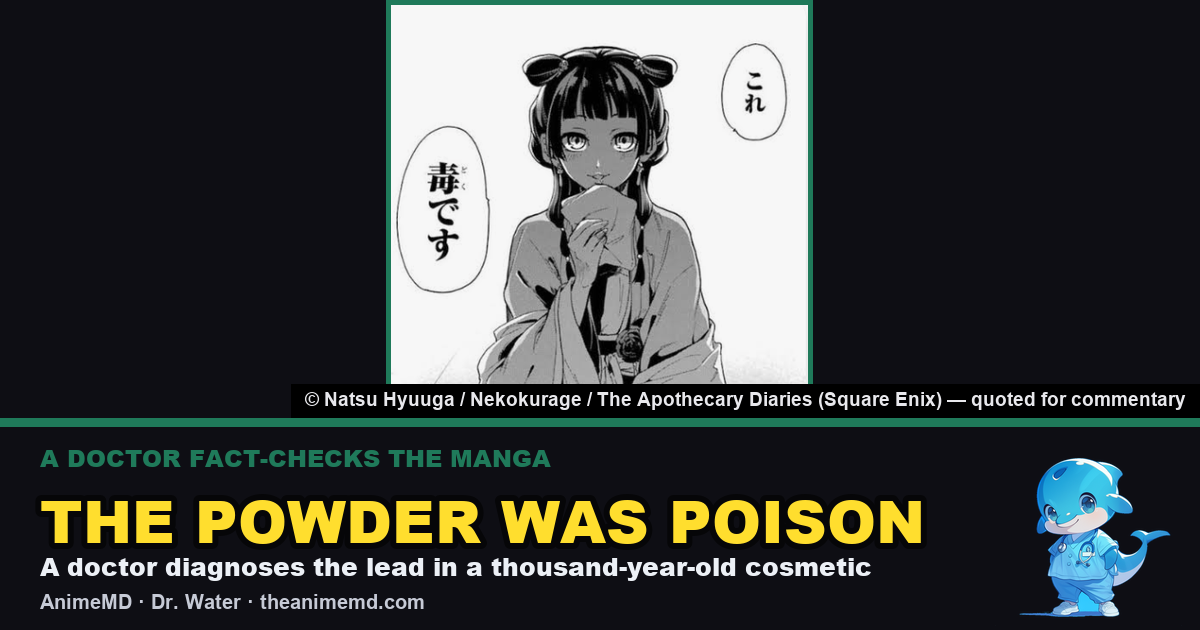
Hi, I’m Water 🐬 — an occupational physician. My day job is looking after the health of people at work.
Reading this series set in an imperial rear palace, it’s easy to get pulled in by the poison-and-antidote puzzles. But the moment that made me sit up straight as a doctor wasn’t a murder plot.
It was this: a cosmetic was quietly harming people.
That is not fiction. It happened in Japan. And the people hit hardest were not the women wearing the makeup — they were the babies in their arms.
So today, instead of judging the story, let’s talk about
your body
and check the fiction against real medicine. The short version:
The face powder in this story is the most realistic poison in the whole series.

The house rules
I’m not grading the manga. I’m asking, “if a human body went through this, what would actually happen?” Every medical claim links to a paper (DOI).
Also: this article contains nothing about how to make or use any poison. Only what happens inside the body, and how to prevent it.
Q1 | Can face powder really harm someone? — Yes. And it did, in Japan.
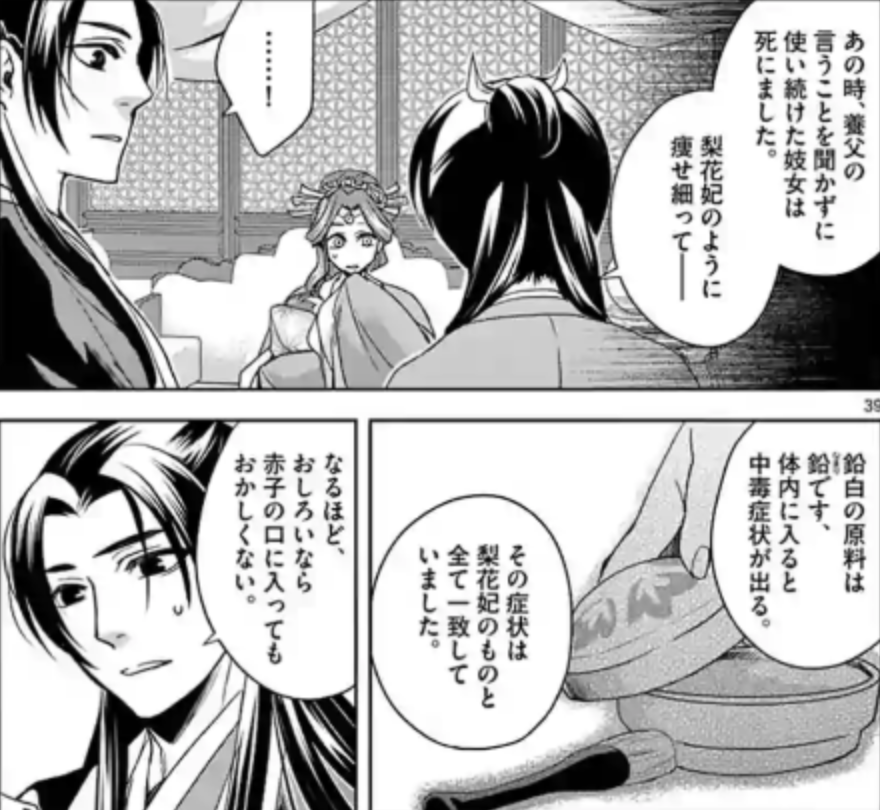
In the story, it’s stated plainly that the raw material of lead white is lead, that it causes poisoning once it enters the body, and that face powder could easily reach an infant’s mouth.
The first thing to say is that this explanation is essentially medically correct.
Lead white is a white pigment based on lead carbonate. It spreads beautifully and covers well, which is exactly why it was used as face powder for centuries. And lead harms the body.
Japan’s own medical history backs this up. From the Meiji era onward, infants kept falling ill with a severe condition nobody could explain; it was provisionally called “so-called meningitis.” In 1923, Professor Ikutaro Hirai of Kyoto Imperial University’s paediatrics department identified it as poisoning by the lead in the face powder their mothers were wearing — a history documented in the occupational-health literature (Horiguchi et al. 2012).
In other words, “a cosmetic’s lead makes babies collapse” is a road Japan actually walked. Manufacture of lead-containing face powder was finally banned in the mid-1930s (sources differ between 1934 and 1936).
As for symptoms: the US ATSDR’s clinical teaching material lists, for a moderate lead exposure dose, arthralgia, constipation, difficulty concentrating, diffuse abdominal pain, general fatigue, headache, tremor, vomiting, and weight loss (ATSDR: Lead Toxicity — Signs and Symptoms).
The consort in the story wasting away? That isn’t a storytelling flourish. It matches the course lead poisoning is actually reported to take.
The reverse does not follow. “Tired, thin, stomach hurts” does not mean lead. Those symptoms are common and have countless causes. Symptom patterns vary widely between people, and you cannot name a toxin from symptoms alone — that’s a general principle in toxicology.
Q2 | Why did it hit the baby harder than the woman wearing it?

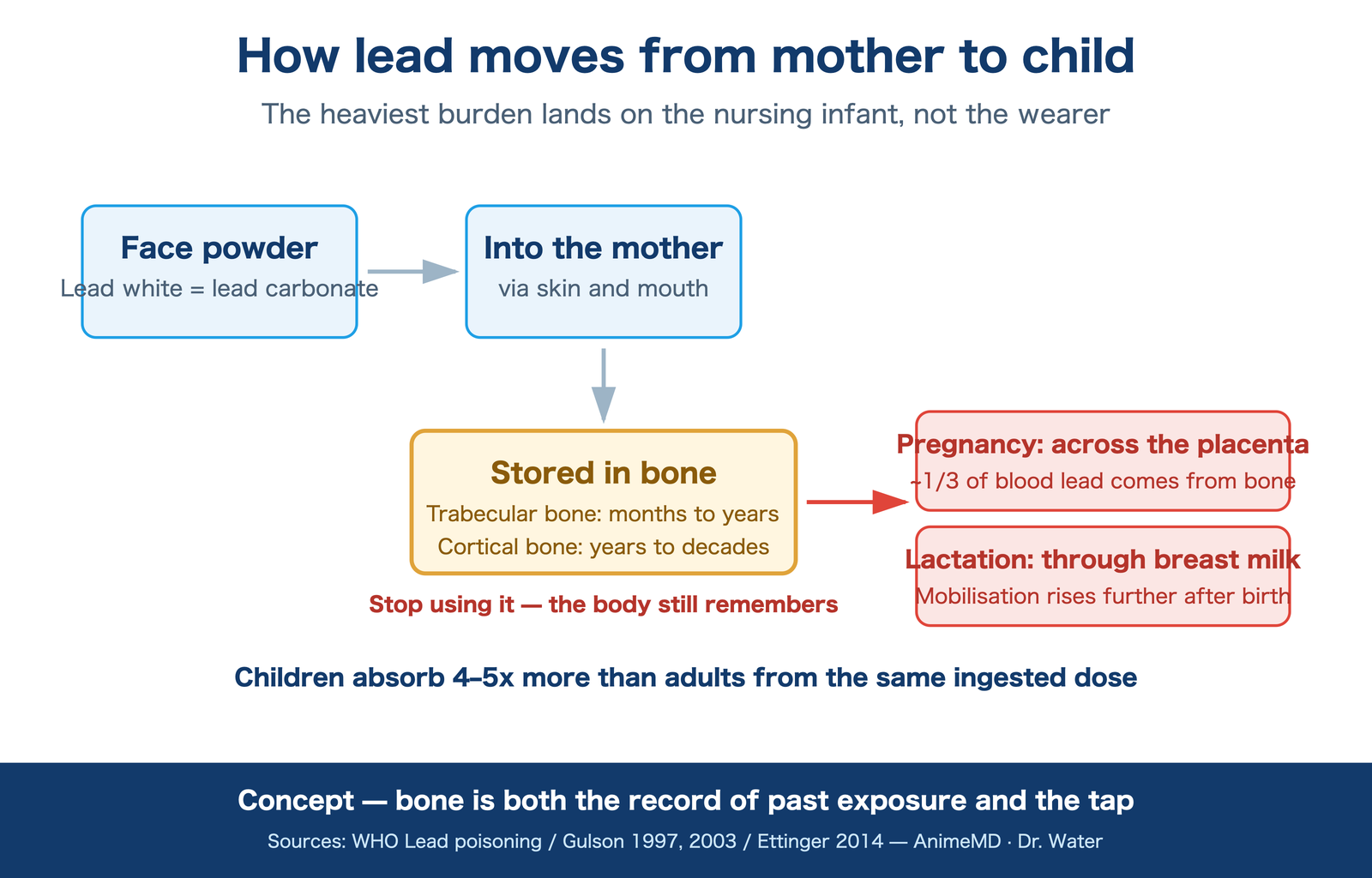
“The lead works its way through you.” There is a surprising amount of real physiology packed into that line.
Three reasons.
1. A child’s body takes in more of the same dose
WHO states that “young children are particularly vulnerable to lead poisoning as they may absorb up to 4–5 times as much lead as adults from an ingested dose” (WHO: Lead poisoning). Same room, same exposure — a child ends up carrying more.
2. Lead takes calcium’s seat and walks into the brain
The route is well characterised. As one review puts it, primarily because of its ability to substitute for calcium ions, lead crosses the blood–brain barrier rapidly and concentrates in the brain (Sanders et al. 2009). A brain still under construction pays the higher price.
3. It passes straight through breast milk
In a study of lead in breast milk, every 1 μg/L rise in breast-milk lead was associated with a 1.8 μg/dL rise in the infant’s blood lead at three months (Ettinger et al. 2014). The authors concluded that breast milk is an important determinant of an infant’s lead burden during lactation.
And here is the part I most want you to see.
It is literally in the ground in Japan.
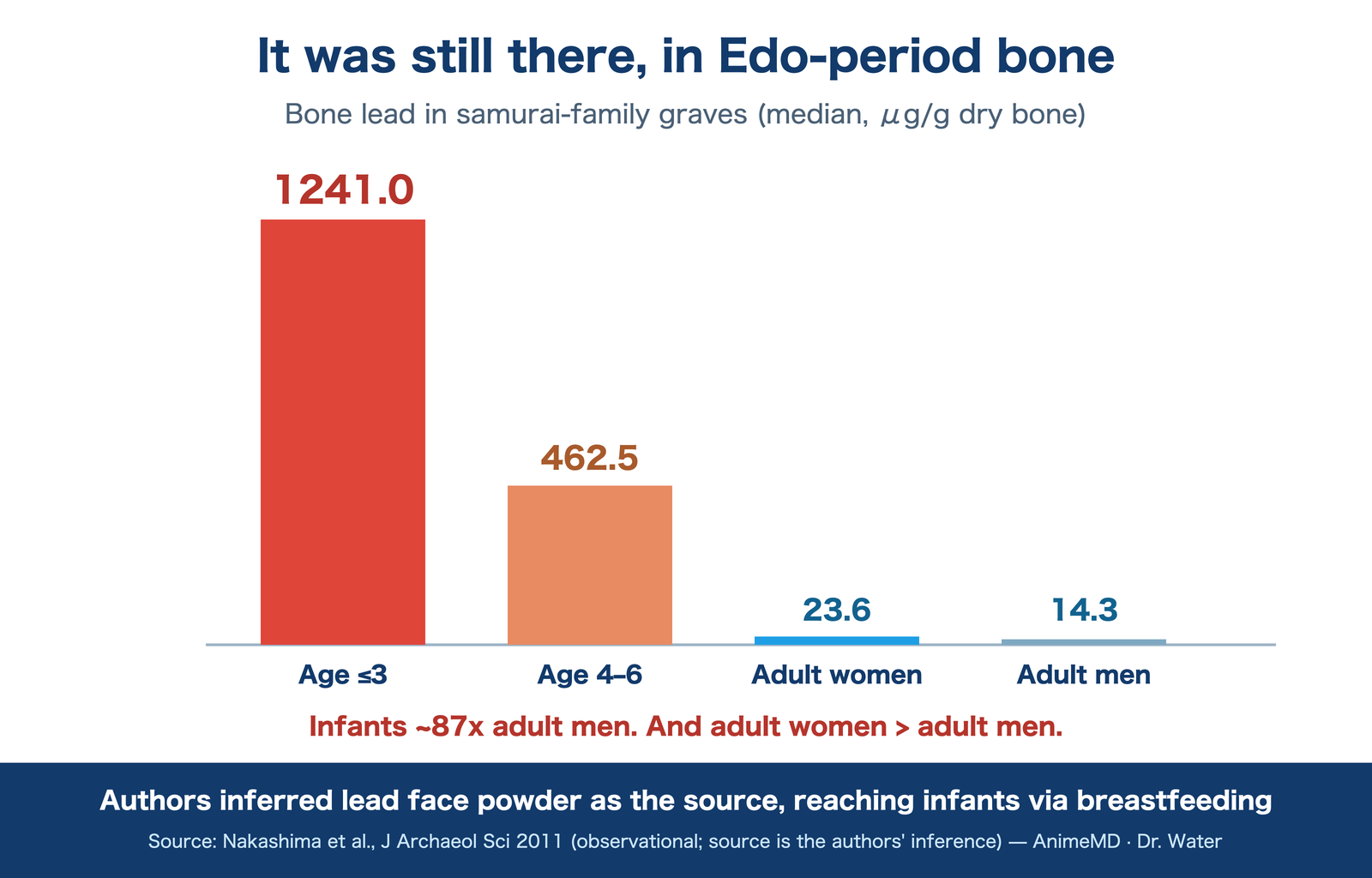
Researchers analysed bones excavated from samurai-family graves of the Edo period. The lead concentrations came out like this (Nakashima et al. 2011):
- Children aged 3 and under: median 1241.0 μg/g (dry bone)
- Ages 4–6: 462.5 μg/g
- Adult men: 14.3 μg/g
- Adult women: 23.6 μg/g
Adult women higher than adult men. And the infants, higher by orders of magnitude.
From that distribution the authors inferred lead-based face powder used by women as the source, and considered breastfeeding the route to the youngest children.
The women wore the makeup. The heaviest burden ended up in the children in their arms. The order the story describes is the order preserved in the bones.
This is an archaeological observational study, and the authors describe the source as an inference. Post-burial contamination of excavated bone is a limitation the paper itself addresses. Read it as strong circumstantial evidence, not an experiment.
Q3 | ⚠️ Is a little bit safe? — This is the part I’m serious about.

Makeup is a daily thing. Which invites the thought: surely it’s fine as long as it isn’t a large dose at once?
Let me be blunt. There is no line below which we can call it safe.
In WHO’s own words:
“There is no level of exposure to lead that is known to be without harmful effects.”
WHO also states that there is no known safe blood lead concentration, and that even blood lead concentrations as low as 3.5 µg/dL may be associated with decreased intelligence in children, behavioural difficulties and learning problems (WHO: Lead poisoning).
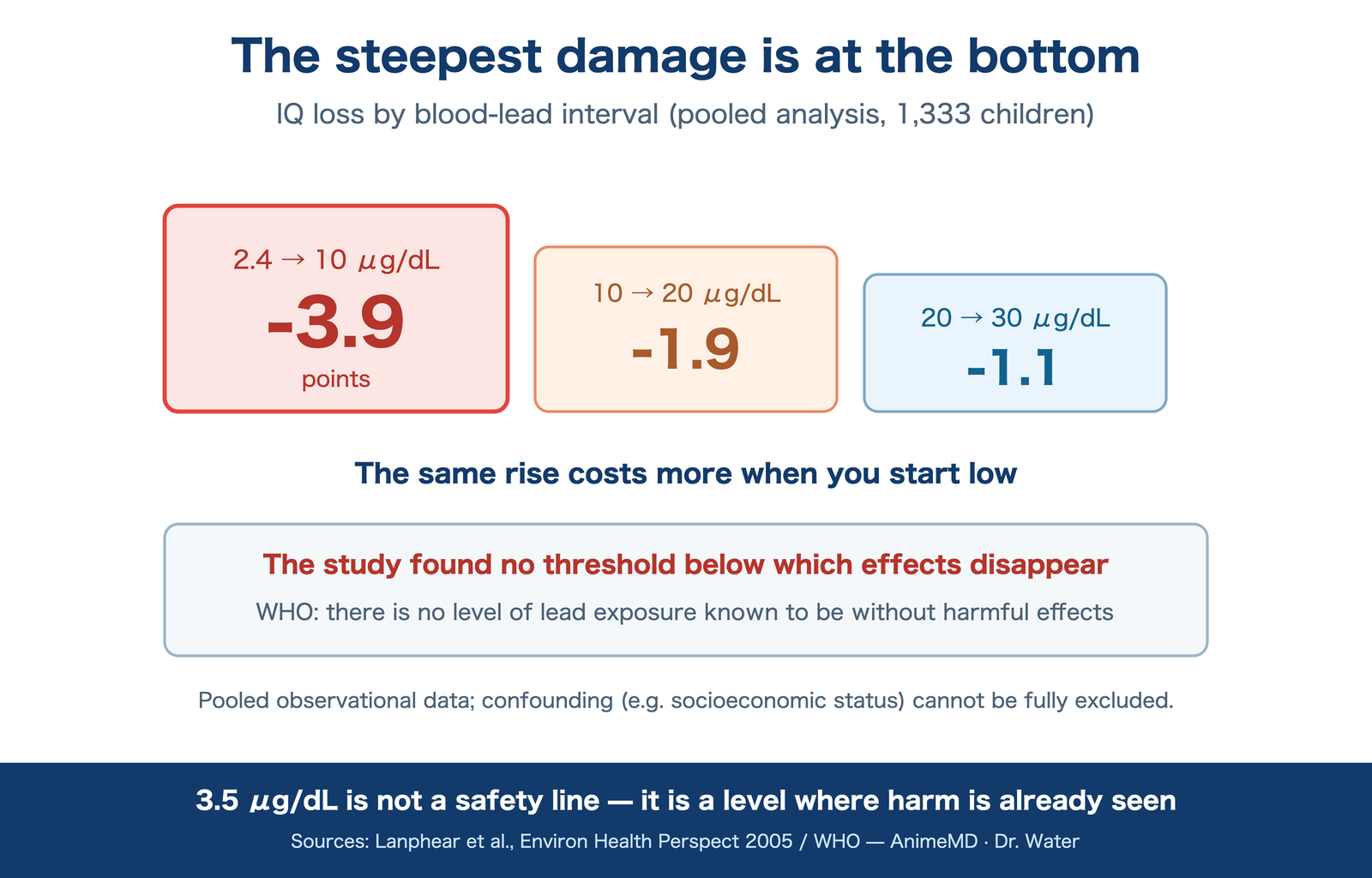
The numbers behind this come from a pooled analysis of seven international cohorts — 1,333 children (Lanphear et al. 2005):
| Rise in blood lead | Drop in IQ |
|---|---|
| 2.4 → 10 μg/dL | 3.9 points |
| 10 → 20 μg/dL | 1.9 points |
| 20 → 30 μg/dL | 1.1 points |
Read that carefully. The slope is steepest at the bottom. It is not “a little exposure, a little harm” — the first few micrograms carry the most weight per unit. The study found no evidence of a threshold.
And one more point, the one most often misread.
You will see the figure “3.5 µg/dL” quoted. Do not read it as “safe up to here.” WHO describes 3.5 µg/dL as a level at which harm is *already* observable in children. It is not the boundary of safety; it is a level where effects have been seen.
That is what “no safe line” means.
Lanphear et al. is a pooled analysis of observational studies and cannot fully exclude confounding by factors such as socioeconomic status; the statistical approach has been contested. The direction of the finding, however, matches WHO’s current position.
Q4 | If you stop using it, does it leave the body?

This is the nastiest property of lead.
Lead moves into bone and stays.
The skeleton holds the majority of the body’s lead burden, and the residence time depends on the type of bone: months to years in trabecular bone (the spongy interior), years to decades in cortical bone (the hard outer shell) (Hu et al. 1998).
In workers followed after occupational exposure ended, the decline in blood lead showed half-lives of 5–19 years — the long tail of bone slowly feeding lead back into the blood (Rabinowitz 1991).
So bone is a record of past exposure.
And records can be reopened.
Pregnancy and breastfeeding.
Using stable-isotope tracing, researchers found that on average 31% (±19%) of blood lead during pregnancy came from the mother’s own skeleton (Gulson et al. 1997). A long-term follow-up put the skeletal contribution at a geometric mean of about 33%, and found that mobilisation from bone increased further after delivery, during lactation (Gulson et al. 2003). WHO likewise states that lead stored in bone may be released into the blood during pregnancy and expose the fetus.
Lead banked in youth is withdrawn during pregnancy and nursing — and handed to the next generation.
You can stop wearing the powder. The body still remembers. That’s why “stop and you’re fine” isn’t something I can write.
The Gulson studies are small isotope-tracing studies in populations with low calcium intake (calcium status affects release from bone). They are not representative values for the general Japanese population.
Q5 | Is this a thousand-year-old story? — It’s also a 2024 story.
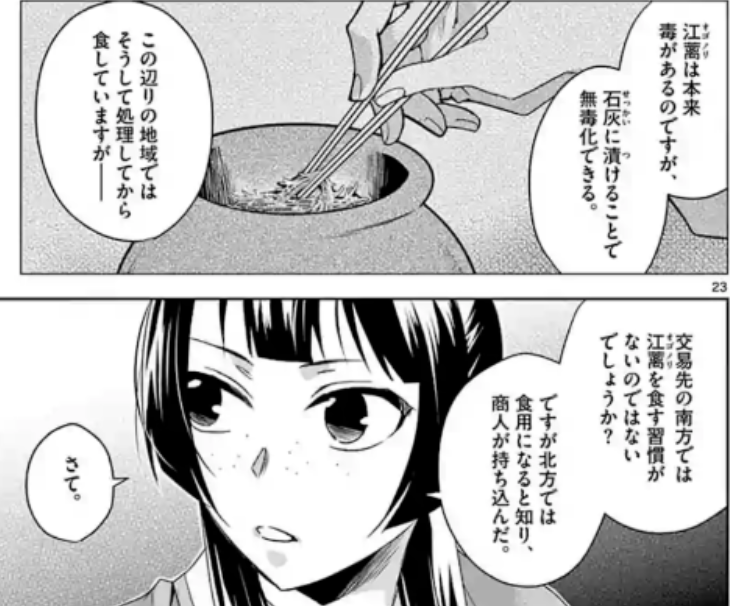
The series includes an ingredient that is toxic as it is, but can be rendered safe by soaking it in lime — the idea that toxicity isn’t a fixed property of a substance, but something handling and knowledge can change.
That is preventive medicine in one image. And the lead story isn’t over.
A case published by the US CDC in 2024:
A mother and her four children had been using “surma,” a traditional eye cosmetic made in Pakistan. The tested surma contained 390,000 ppm of lead — 39% by weight. The children’s blood lead ran from 11 to 30 μg/dL; the mother’s was 15 μg/dL during pregnancy.
And every one of them was asymptomatic (Hore et al. 2024, MMWR).
Not a rear palace a thousand years ago. In New York, lead poisoning from a cosmetic was progressing through an entire family while nobody felt ill.
WHO’s own list of products containing lead runs: pigments, paints, solder, stained glass, lead crystal glassware, ammunition, ceramic glazes, jewellery, toys — and some traditional cosmetics, and some traditional medicines.
So where does Japan stand?
Reasonably well. A review of lead in the Japanese living environment reports that the mean blood lead concentration of Japanese children in the 21st century is under 2 μg/dL, among the lowest reported anywhere. Embers remain, though: leaching from some lead service pipes, and paint chips recovered from surface soil in Tokyo parks containing 0.002–16% lead (Yoshinaga 2012).
And here is the occupational medicine part
What the imperial palace didn’t have, and modern Japan does, is a health check written into law.
Japan’s Ordinance on Prevention of Lead Poisoning requires employers to provide a physician’s health examination for workers regularly engaged in lead work — on hiring, on reassignment, and thereafter at least once every 6 months (once a year for certain categories of lead work). The required items include:
- blood lead concentration
- urinary delta-aminolevulinic acid
with anaemia testing and others added when the physician judges it necessary.
That second one is quiet but fundamental. Delta-aminolevulinic acid is an intermediate in the manufacture of haem, the pigment in your blood. Lead jams that production line, so the unused raw material spills into the urine. The test is literally the mechanism of lead-induced anaemia, turned into a measurement.
There is more. Article 56 of the same ordinance names the symptoms that oblige an employer to have a worker examined by a physician:
abdominal colic, extensor paralysis of the limbs, sensory abnormality, pallor, joint pain, muscle pain
Pallor. Abdominal colic. What happened to a consort in a thousand-year-old story is written, in those words, into a Japanese statute in force today. The fiction and the law are describing the same state.
What the apothecary of this story actually did was not identify a poison. She found the source and removed it from the environment.
That is precisely the job of an occupational physician. Before treating anyone, take the cause out of the workplace.
The ordinance text has been checked verbatim against e-Gov (Ministry of Labour Ordinance No. 37 of 1972).
The verdict: fantasy vs. real
| Claim | Verdict |
|---|---|
| Face powder (lead white) can cause poisoning | ◎ True (lead carbonate; identified in Japan in 1923 as the cause of infant poisoning) |
| It hits the nursing infant harder than the woman wearing it | ◎ True (children absorb 4–5× per ingested dose; Edo-era infant bone lead ~87× adult men) |
| Wasting, fatigue and abdominal pain as the course | ○ Partly true (matches reported lead toxicity, but symptoms alone don’t identify lead) |
| Stop using it and you’re back to normal | ✕ Fantasy (bone holds it for years and releases it in pregnancy and lactation) |
| An old story with no modern relevance | ✕ Fantasy (a family case from a cosmetic was reported in 2024) |
Wrap-up
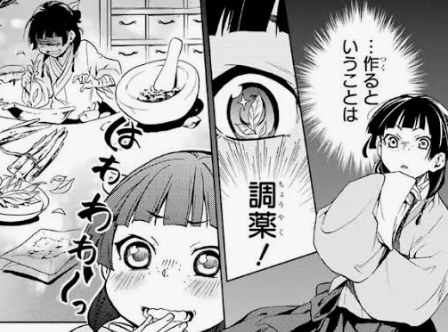
What makes this story remarkable isn’t the sharpness of the deduction. It’s that she turned the question outward: the cause isn’t inside this person’s body — it’s in the thing she puts on her face every morning.
Medicine calls this removing the exposure source. Before you treat, take the cause out of the person’s life. It’s unglamorous, and it’s the single most effective move available.
Lead hasn’t gone to zero in our own hands, either. Something used to look beautiful, reaching the one person you most want to protect — that shape was the same in a palace a thousand years ago and in New York in 2024.
The person who understands poisons is the person who makes the medicine.
That isn’t only true in fiction. It’s a job that exists in workplaces today.
Manga is a doorway into the strangeness of the human body. And the real body is far stranger than you think.
See you at the next check-up.
Frequently Asked Questions
Can face powder or cosmetics really cause lead poisoning?
Yes — this actually happened in Japan, where lead white face powder (based on lead carbonate) caused infants to fall severely ill from the Meiji era onward, until a professor identified the cause in 1923. Manufacture of lead-containing face powder was finally banned in the mid-1930s. Symptoms of moderate lead exposure include joint pain, constipation, difficulty concentrating, abdominal pain, fatigue, headache, tremor, vomiting, and weight loss.
Why would lead from a mother’s makeup harm her baby more than it harms her?
Three reasons: young children absorb up to 4–5 times as much lead as adults from the same ingested dose, lead crosses the blood-brain barrier rapidly because it can substitute for calcium, and lead passes directly through breast milk into a nursing infant. Bone analysis from Edo-period graves found lead levels in infants under 3 that were roughly 87 times higher than in adult men, matching this same pattern.
Is there a small amount of lead exposure that’s actually considered safe?
No — the World Health Organization states plainly that there is no level of lead exposure known to be without harmful effects, and no known safe blood lead concentration. A pooled analysis of 1,333 children found the damage curve is steepest at the very lowest exposures, meaning the first few micrograms of lead cause the most harm per unit, with no evidence of a safe threshold.
Disclaimer 1 | Medical
This article is entertainment commentary, not medical advice, diagnosis, or treatment. I am not your physician. If you are concerned about your health, or suspect lead exposure, please consult a medical provider rather than self-diagnosing. This is especially true if you are pregnant or breastfeeding, or worried about a young child. Do not use over-the-counter chelation products on your own judgement based on this article — serious adverse events have been reported.
Disclaimer 2 | Copyright & Non-Affiliation
This site is an independent, unofficial fan commentary/criticism work. It is not affiliated with, endorsed by, or sponsored by any anime/manga studio, publisher, author, or rights holder. All titles, characters, logos, and trademarks belong to their respective owners and are referenced here solely for identification, commentary, and criticism. This article reproduces a limited number of manga panels from The Apothecary Diaries (Natsu Hyuuga / Nekokurage, Square Enix) as quotation for the purpose of criticism and commentary. Each panel is reproduced unaltered, attributed to its source, and used only to the extent necessary to support the surrounding analysis, which is the substance of this piece. No unauthorized scans or fan translations are used. Rights holders with concerns: please contact us and we will respond promptly.
🩺 Your check-up is over — but the clinic is always open
📚 This clinic has a sequel. 14 legendary monsters — vampire, zombie, werewolf and more — properly diagnosed by a real doctor. The book this blog grew into, with new write-ups added. → Get it on Amazon — $3.99 / free on Kindle Unlimited
💌 Free newsletter — new diagnoses delivered to your inbox, no appointment needed. → Subscribe on Substack
▶️ Prefer video? Watch the diagnoses on YouTube. → The Anime MD









Comments