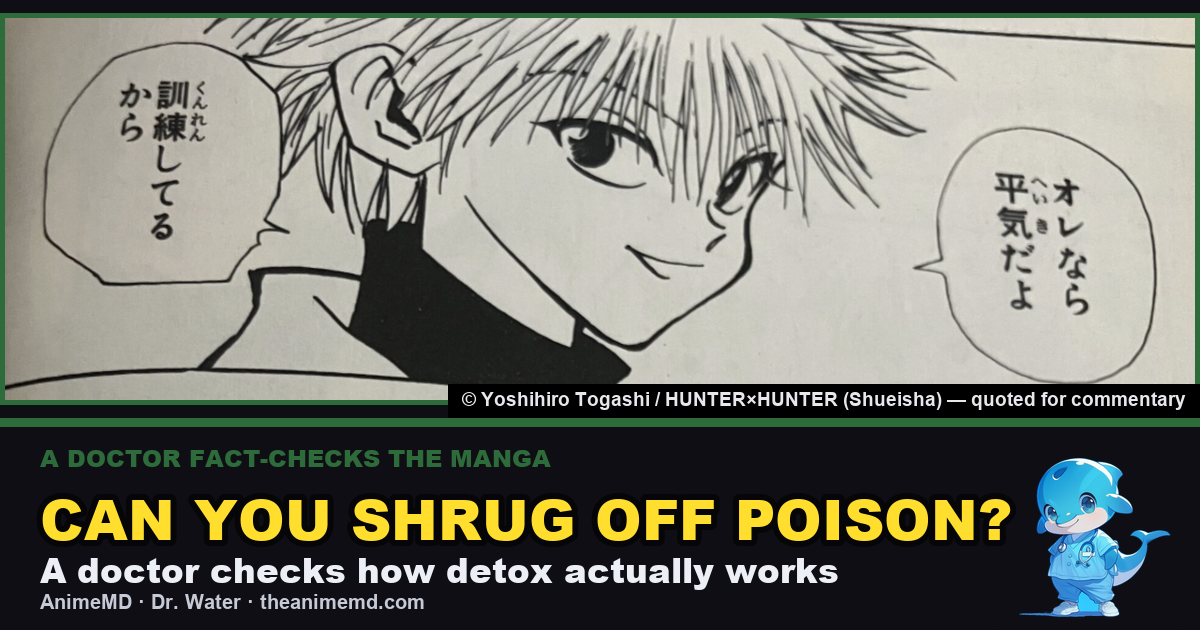
〈Monster Clinic #01〉 · a Dr. Water check-up
Hi. I’m Dr. Water 🐬. I’m a doctor — the kind who keeps working adults healthy (occupational and preventive medicine).
In power-battle stories, you see this a lot: a strong character calmly takes poison and says “this won’t work on me,” or a poison-user slowly acclimates their own body until they’re a master of it. Fans ask me: “Can you actually build tolerance to poison in real life?”
So today, not as a review of the series but as a story about your body, I’ll check the math against real toxicology. The short version up front: tolerance to poison is real “for some types, up to a point.” But behind the calm face, something is definitely breaking inside.
⚠️ First, straight-faced. This article writes nothing about how to obtain, use, or the lethal dose of any poison. It writes only “what happens in a poisoned body” and “who to contact if you’re in trouble.” That part is outside the story — it’s real life.
📺 Want to read it the legit way? HUNTER×HUNTER is available on Shueisha’s official services.
The house rules
I’m not here to judge the series. I’m here to ask, “if a human body did this, what would really happen?” — and back every medical claim with a paper. And — since this is about poison, I write no specific lethal doses, acquisition, or use. This part, unlike the story, has real, irreversible stakes.

Q1 | When you’re poisoned, what’s happening inside? — your “HP” isn’t dropping.
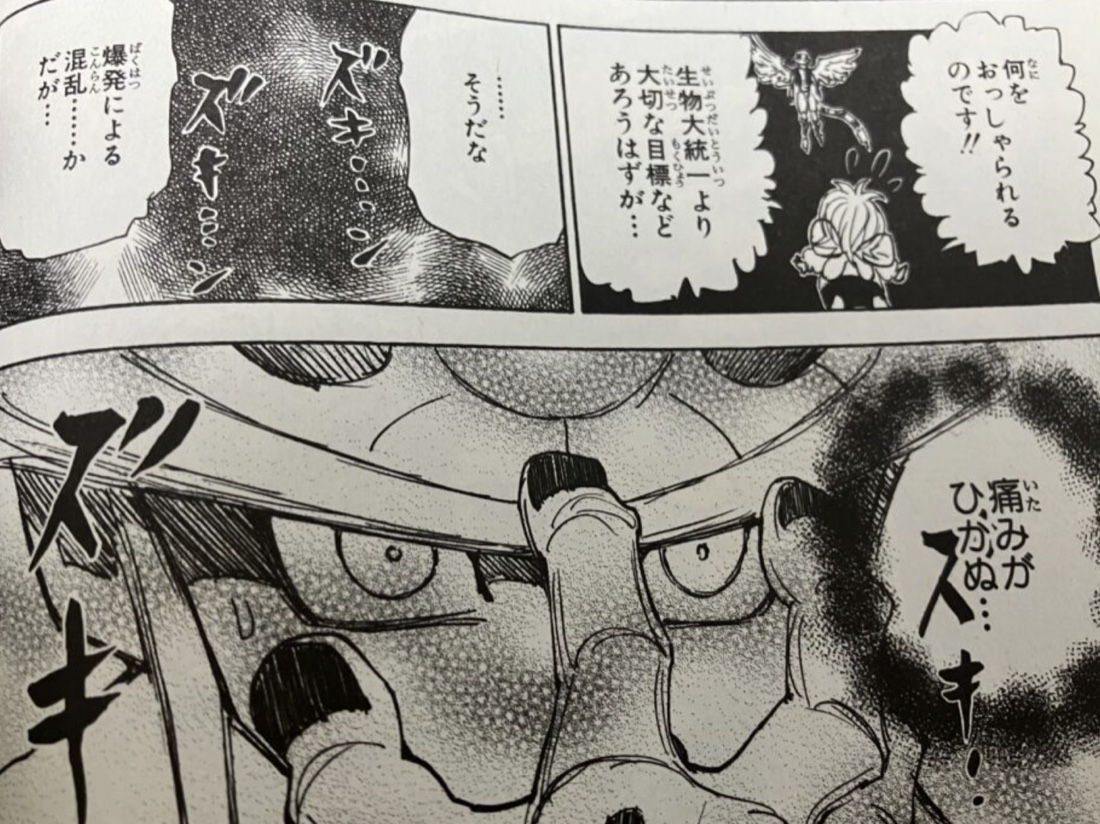
The story also shows damage that keeps hurting long after the blow itself is over — “the pain won’t fade…”. Something inside is broken, and it stays broken in the form of pain. That “keeps going” part is what poisoning does, too.
First, the setup. In these battles, an ability weakens the opponent with poison — slow-acting, contact-spreading, all kinds. It’s drawn like “HP going down,” but real poison comes to break a much more specific place.
What poisons do splits roughly in two. One is neurotoxins — the type that jams nerve transmission. The other is cytotoxins — the type that directly injures the cells themselves (that’s the basic toxicology split; the specific mechanisms are checked against real papers from the next paragraph).
A representative neurotoxin is organophosphate compounds. These stick to the enzyme (acetylcholinesterase) that breaks down the nerves’ messenger, “acetylcholine,” and stop it working. The messenger then piles up in excess — pinpoint pupils, uncontrollable drooling and sweating, seizures, and in severe cases suppressed breathing (Aroniadou-Anderjaska et al., Toxics 2023).
And the nasty part: the way the enzyme is stopped is a “firm binding” type, and over time an “aging” phenomenon makes it harder to reverse. So the sooner you act, the more likely you survive — a race against time (Aroniadou-Anderjaska et al., Toxics 2023).
The “slow-acting” staging isn’t far off, toxicologically. There’s a real time limit between “it starts working” and “you can still reverse it.”
Takeaway ①: Poison doesn’t “shave your stamina”; it “breaks a specific switch.” So the response has a deadline, too. If something feels wrong, don’t wait and watch — act early. That’s the real rule.
▶ Related check-up: Poison and forensics, for real — how a poisoned body is actually read after the fact, checked with the same care.
Q2 | How far does the body’s “detox” go? — the star is your liver, working right now.
So is being poisoned the end? Not quite. The body has a department that processes toxins by design. The star is the liver.
Most foreign substances that enter — poison or drug — undergo a two-stage process in the liver. Phase I (oxidation, reduction, hydrolysis) modifies the molecule; Phase II (attaching a water-soluble group) finishes it, and finally the kidneys dump it out as urine. That flow is the substance of “detox” (Esteves et al., Journal of Xenobiotics 2021).
The star of Phase I is an enzyme group called cytochrome P450 (CYP) — dozens of types in humans, involved in most reactions processing foreign substances, an in-body all-purpose detox plant (Esteves et al., Journal of Xenobiotics 2021).
So a poison-user in the story saying “I have detox ability” isn’t nonsense. You, too, are detoxing right this moment, in your liver. You’re just not shouting a technique name.
Takeaway ②: Detox isn’t a superpower; it’s the liver’s daily job. Which is why not overworking that plant (liver, kidneys) day to day — for example, not drinking heavily on repeat — is itself real “detox-capacity maintenance.”
Q3 | ⚠️ “Metabolized = safe” is not true. Straight-faced here.

The story treats poison the same way: not as something that “didn’t work,” but as something that works later. “I underestimated it… this ability… these conditions…” “A far more dangerous poison than I imagined…!!” — you always realise you misjudged it after it has started.
An easy misconception, said straight-faced. People assume “metabolized in the liver = detoxified,” but that isn’t necessarily right.
A clear example is arsenic. Arsenic is methylated in the liver and excreted in urine. But an intermediate metabolite formed along the way (a trivalent methylated form) can be more toxic than the original inorganic arsenic (Khairul et al., Oncotarget 2017). In other words, in the very process of “trying to detox,” the body can temporarily make a more dangerous substance. Metabolism ≠ safety.
And the efficiency of this processing has large individual variation. How well someone methylates arsenic varies by species and population, and by genetic constitution and nutritional status (folate and such metabolism) (Khairul et al., Oncotarget 2017).
What does that mean? Stories have a “he was fine, though” moment — and in reality, too, strength against the same poison differs between people. And “someone who looks fine” hasn’t necessarily succeeded at neutralizing it inside — they may be mid-way through making the dangerous intermediate.
Takeaway ③: “That person was fine, so I’ll be too” is the worst idea there is, with poison. Processing capacity differs between people, and “mid-processing” is sometimes the most dangerous. Copying it bets your life on a constitutional lottery.
Q4 | Can you “acclimate” and build tolerance to poison? — the truth of mithridatism.
This is the main event. The classic poison-user setup — take a little poison at a time, acclimate the body, and eventually become a master. It has a historical name: mithridatism (building tolerance by dosing small amounts), from the legend of an ancient king who practiced it against assassination.
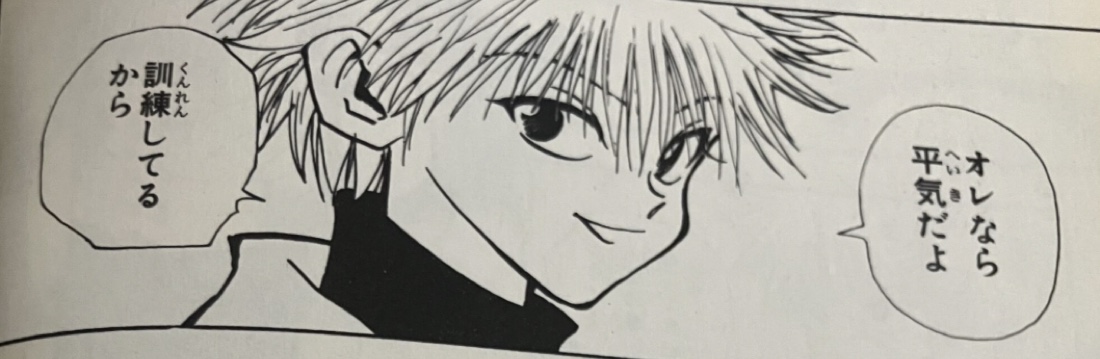
HUNTER×HUNTER puts this setup straight into a line of dialogue. A boy who has just been fed poison says it flatly: “I’m fine.” “Because I’ve been trained.” That is the hypothesis we are about to check against medicine.
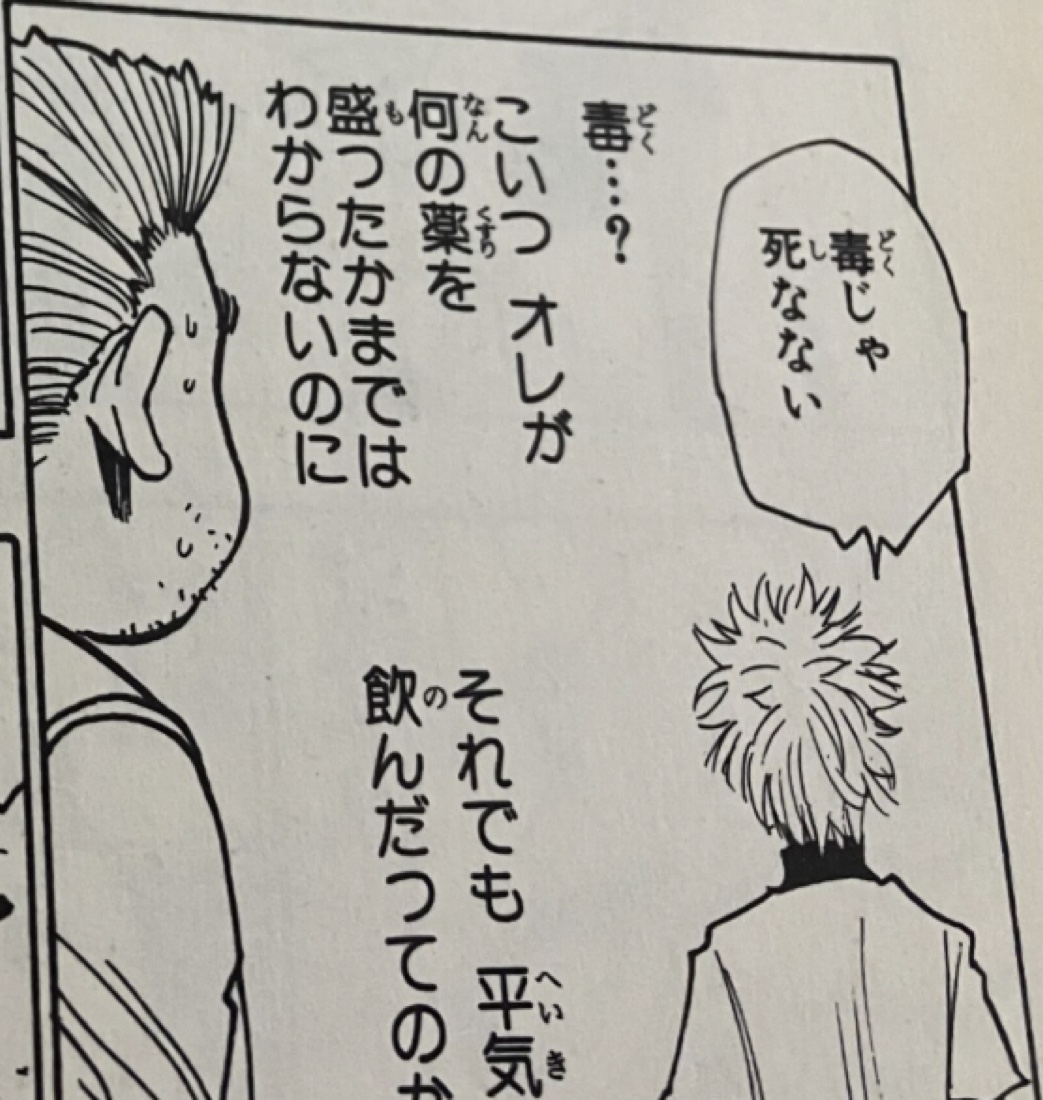
And he drank it without knowing what he had been given — enough to startle the person who did it: “…even though he doesn’t know what drug I slipped him, he drank it anyway?” So what the story depicts is not tolerance to one specific poison. It is tolerance to the whole category. That is where it parts ways with reality.
So, in reality? “Partly it happens” but “it’s not omnipotent” — that’s the honest answer.
The body has the detox plant from Q2 (liver enzymes), and repeated exposure to certain substances can “add staff” to the processing enzyme so metabolism speeds up (enzyme induction). CYP-type metabolic enzymes really are induced (increased) by exposure to specific substances, known in humans (Hakkola et al., Archives of Toxicology 2020). That far is true. But what you gain is a limited adaptation to a specific substance. The induction is selective per substance; you don’t obtain a universal immunity that works uniformly against every poison (Hakkola et al., Archives of Toxicology 2020).
And the biggest pitfall: tolerance ≠ becoming safe. Metabolism speeding up can make you “notice fewer symptoms,” but that’s just “the body getting used to it,” not proof the poison was neutralized. I’ll say this as reasoning from the mechanisms above, not from one definitive experiment — when the “alarm” of pain or nausea stops ringing, it doesn’t mean the fire went out. Handle “used to it” and “safe” as separate things.
The story’s poison master genuinely borrows part of real tolerance. But the real version isn’t cool. The more used-to-it you are, the more the danger signal dulls, and by the time you notice, you’re deeply broken. The more of a master you become, the less you can see your own limit — that’s the scariest thing about real poison tolerance.
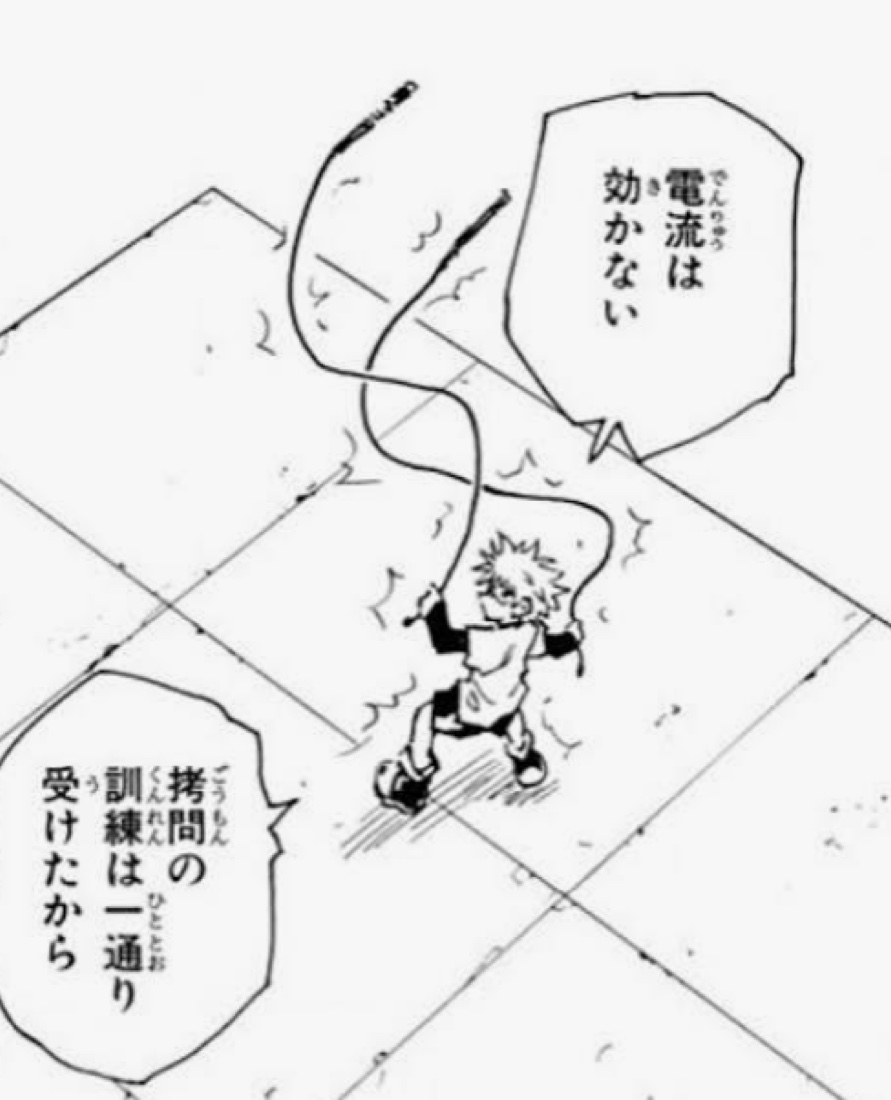
For what it’s worth, the tolerance in the story doesn’t stop at poison. Run electricity through him and he says, “Electricity doesn’t work on me. I went through the whole torture course.” It is a world where you can be conditioned to withstand anything. Real adaptation, as we just saw, is “to that one substance, up to a point.” That is the biggest place where the story and the body part ways.
Takeaway ④: “I’m used to it, so I’m fine” may just be that you switched off the body’s alarm. The alarm not ringing and the fire being out are entirely different things.
Q5 | If poisoning really happens — the real first response.
One thing from outside the story, at the end. Just in case you ever face “I may have ingested a poison or drug” in real life.
The first response to acute poisoning is, before any flashy antidote, whole-body management first. Protect the airway, breathing, and circulation (the ABCDE check) as the top priority. On that basis, as needed, decontamination (activated charcoal, etc.), enhanced elimination (hemodialysis, etc.), and specific antidotes (one matched to the agent, like naloxone for opioids) are used (Kaswa, South African Family Practice 2024). For something like organophosphate poisoning, if the cause is identified, there’s a path to treatment such as atropine (the clinical picture is laid out in a classic review — Namba 1971; see references).
What I want you to remember is the order. Don’t make someone vomit on amateur judgment, or give them something strange. First, consult the experts and get seen. That’s the real answer.
☎️ Poison control: contact a poison-control hotline in your country at the “I think I may have swallowed something” stage. If it’s a life-threatening emergency, call your local emergency number without hesitation.
Takeaway ⑤: The correct first move in a poison problem isn’t an antidote or a self-taught first-aid trick — it’s “contact the expert line.” Just knowing the number lets you use the panicked minutes correctly.
The verdict: fantasy vs. real
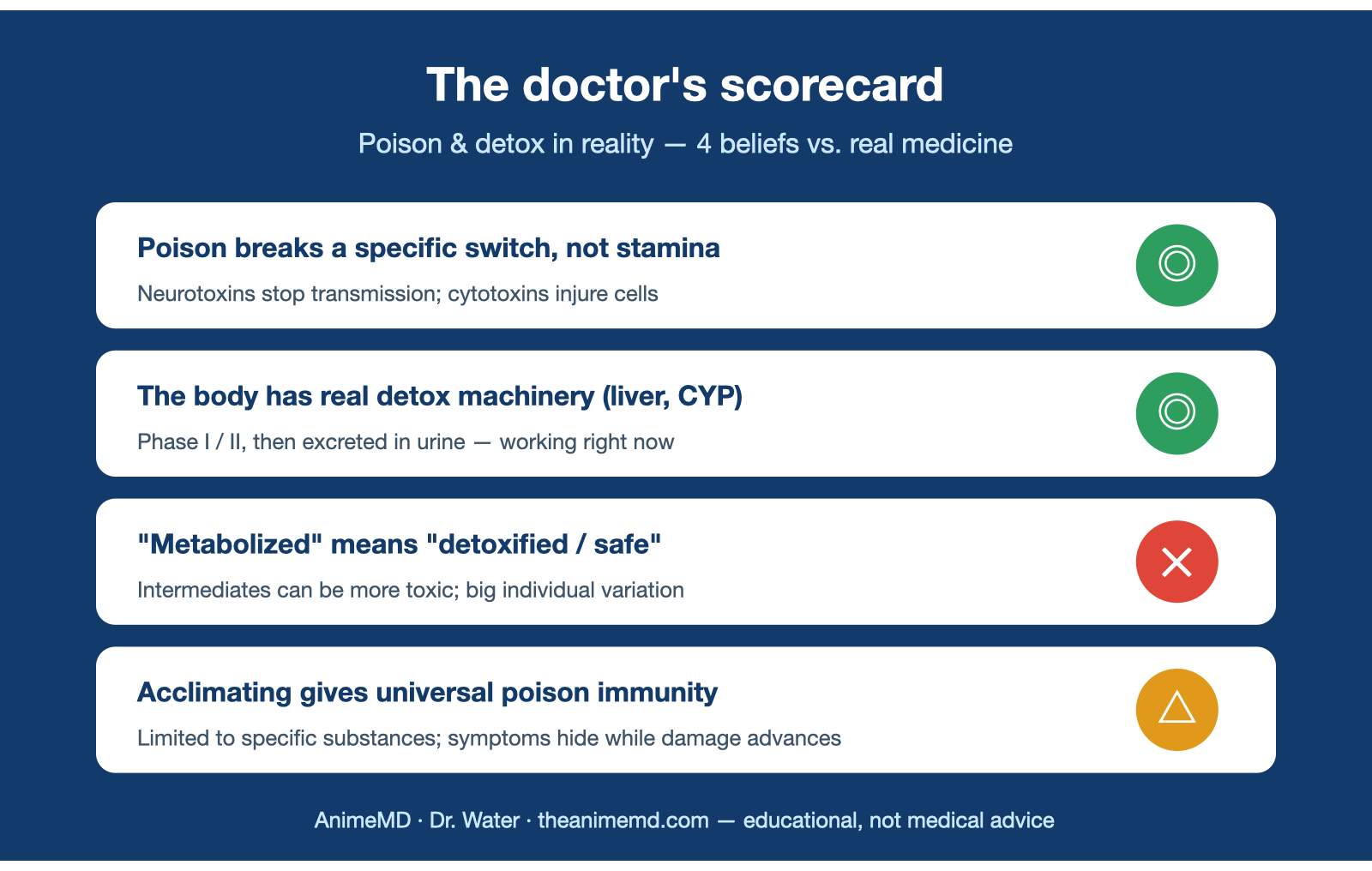
| Belief | Verdict |
|---|---|
| Poison breaks a “specific place,” not stamina | ◎ true (neurotoxins stop transmission; cytotoxins injure cells) |
| The body has detox machinery (liver, CYP) | ◎ true (Phase I/II, then excreted in urine) |
| “Metabolized” means “detoxified / safe” | ✕ fantasy (intermediates can be more toxic; big individual variation) |
| Acclimating gives universal poison immunity | △ partly true (limited to specific substances; symptoms hide while damage advances) |
Wrap-up
You can’t become a poison-proof superhuman in reality. Precisely: you can acclimate to some poisons, but acclimating is “switching off the alarm,” not “putting out the fire.” Behind the calm face, the body quietly breaks.
Meanwhile, your liver is detoxing today, too — no technique name, no effects. So the way to be strongest against poison in reality isn’t to acclimate — it’s to care for that detox plant, and, when it counts, not to gut it out your own way but to call the expert line. Plain, but it genuinely works.
Manga is a doorway into how strange the human body is. And the real body is far more interesting than you’d guess.
See you at the next check-up.
📚 Following the series? This was 〈Monster Clinic #01〉. More anime, fact-checked by a doctor, is on the way. Get each new check-up in your inbox — subscribe free.
Frequently Asked Questions
Can you really build up a tolerance to poison by taking small amounts over time, like characters do in fiction?
Partly, but not the way stories show it. Repeated exposure to a specific substance can “add staff” to the liver’s processing enzymes so they work faster (enzyme induction), and this is genuinely known in humans — but the effect is selective to that one substance, not a universal immunity that covers every poison (Hakkola et al., 2020). The bigger catch is that tolerance is not the same as safety: faster metabolism can make you notice fewer symptoms while the damage still advances, so a calm face doesn’t mean the poison was neutralized.
Is “detox” a real thing your body does, or just a wellness buzzword?
It’s real — but it’s your liver’s ordinary daily job, not a special power or a product you buy. Most substances that enter the body go through a two-stage process in the liver (Phase I modifies the molecule, Phase II makes it water-soluble), after which the kidneys clear it out in urine (Esteves et al., 2021). The main enzyme group behind this, cytochrome P450, handles most of the processing of foreign substances. So in practice, the best way to protect your “detox capacity” is to avoid putting the liver under repeated strain — heavy, frequent drinking being the classic example.
What should you actually do if you think you or someone else has swallowed something poisonous?
Get expert help before trying anything yourself — and do not induce vomiting on your own judgment. In acute poisoning, whole-body management comes first (protecting the airway, breathing, and circulation) before any specific antidote (Kaswa, 2024). At the “I think I may have swallowed something” stage, contact a poison-control hotline in your country; if it is a life-threatening emergency, call your local emergency number without delay. Knowing that number ahead of time lets you use the first panicked minutes correctly.
Disclaimer 1 | Medical
This article is general, educational medical commentary sparked by a work of entertainment. It is not medical advice and not intended to diagnose or treat. Reading it creates no doctor–patient relationship. For any health decision, consult your own physician. The author is a doctor, but these views are general and personal, and the author is not your doctor. This article does not deal with the acquisition, use, or lethal dose of any poison. Do not imitate what is depicted. If you suspect you or someone else has ingested a poison or drug, do not induce vomiting on your own judgment — contact a poison-control hotline or emergency services immediately.
Disclaimer 2 | Copyright & Non-Affiliation
This site is an independent, unofficial fan commentary/criticism work. It is not affiliated with, endorsed by, or sponsored by any anime/manga studio, publisher, author, or rights holder. All titles, characters, logos, and trademarks belong to their respective owners and are referenced here solely for identification, commentary, and criticism. This article quotes panels from HUNTER×HUNTER (Yoshihiro Togashi / Shueisha) for the purpose of criticism and commentary, with the source stated. The quoted panels are reproduced without modification, are clearly distinguished from our own text, and are kept to what is necessary for the commentary — use we believe is consistent with fair use under U.S. copyright law. All rights remain with the rights holders. Rights holders with concerns: please contact us and we will respond promptly.
References
- Aroniadou-Anderjaska V, et al. Mechanisms of Organophosphate Toxicity and the Role of Acetylcholinesterase Inhibition. Toxics. 2023;11(10):866. doi:10.3390/toxics11100866
- Esteves F, et al. The Central Role of Cytochrome P450 in Xenobiotic Metabolism. Journal of Xenobiotics. 2021;11(3):94–114. doi:10.3390/jox11030007
- Khairul I, et al. Metabolism, toxicity and anticancer activities of arsenic compounds. Oncotarget. 2017;8(14):23905–23926. doi:10.18632/oncotarget.14733
- Kaswa R. An approach to the management of acute poisoning in emergency settings. South African Family Practice. 2024;66(1):5841. doi:10.4102/safp.v66i1.5841
- Hakkola J, et al. Inhibition and induction of CYP enzymes in humans: an update. Archives of Toxicology. 2020;94(11):3671–3722. doi:10.1007/s00204-020-02936-7
- Namba T. Cholinesterase inhibition by organophosphorus compounds and its clinical effects. Bulletin of the World Health Organization. 1971;44(1–3):289–307. (No DOI; full text at PMC2428032.)
🩺 Your check-up is over — but the clinic is always open
📚 This clinic has a sequel. 14 legendary monsters — vampire, zombie, werewolf and more — properly diagnosed by a real doctor. The book this blog grew into, with new write-ups added. → Get it on Amazon — $3.99 / free on Kindle Unlimited
💌 Free newsletter — new diagnoses delivered to your inbox, no appointment needed. → Subscribe on Substack
▶️ Prefer video? Watch the diagnoses on YouTube. → The Anime MD



Comments