Body-Check · a Dr. Water check-up
Hi. I’m Dr. Water 🐬. I’m a doctor — the kind who keeps working adults healthy (occupational and preventive medicine).
I have a soft spot for Dr. STONE, because it’s a rare thing: a shonen manga that treats science itself as the hero. So I want to be clear up front — I’m not here to dunk on it. I’m here to do exactly what the series would want: check its central premise against real medicine and see how close it gets.
That premise is a wild one. Humanity is turned to stone, stays that way for thousands of years, and then — with the right fluid — comes back, healthy, memories intact, muscles ready to swing an axe. Which raises the question every doctor’s brain jumps to: can a human body actually be paused and restarted? And if it could, what would be waiting for it on the other side?
So today, not as a review but as a story about your body, I’ll check four steps of that miracle. Short version up front: the idea of pausing a body has a real, startling kernel of truth — but “thousands of years” is where biology quietly taps the brakes.
📺 Want to read it the legit way? Dr. STONE is available on Shueisha’s official Manga Plus.
The house rules
I’m not here to judge the series. I’m here to ask, “if a human body did this, what would really happen?” — and back every medical claim with a paper.
Q1 | Can a body ever really be “paused” and come back? — astonishingly, cold says sometimes yes.
Let’s start with the part that sounds most like pure fantasy — a body stopping and later restarting — because this is where real medicine is stranger than you’d expect.
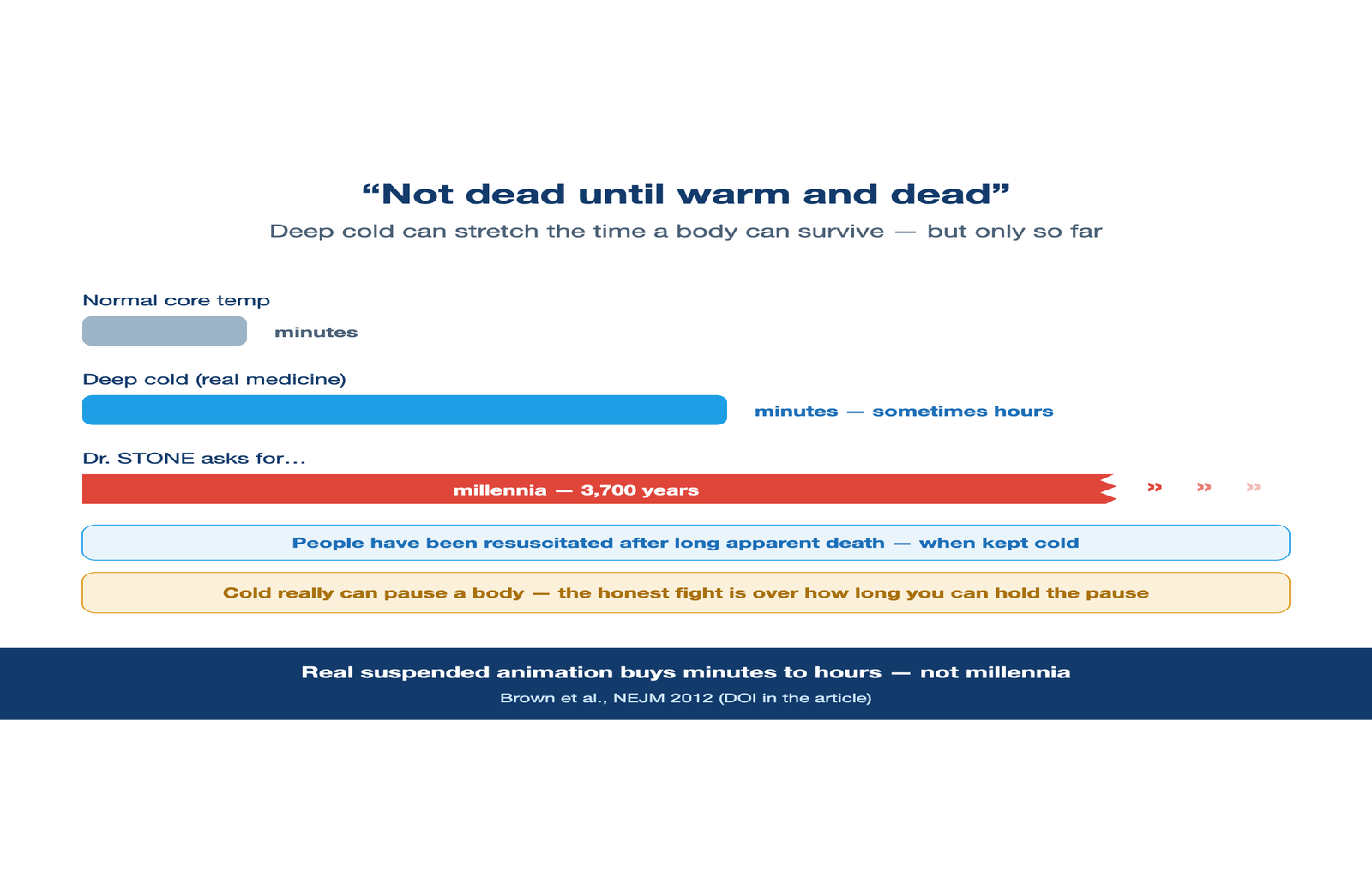
There’s a saying in emergency medicine: “you’re not dead until you’re warm and dead.” It exists because deep cold can slow the body’s need for oxygen so drastically that people have been resuscitated after long periods of apparent death — patients found cold and pulseless who were later rewarmed and walked out of the hospital. Modern hypothermia care is built around exactly this: cold can protect the brain long enough to buy a rescue that would be impossible at normal temperature (Brown et al., New England Journal of Medicine 2012).
So the seed of Dr. STONE’s premise — a body slowed almost to a stop, then restarted — is not nonsense. It’s a real, documented phenomenon. The catch is the scale. Real “suspended animation” buys minutes to hours, occasionally a bit more. Dr. STONE asks for millennia. That’s not a difference of degree; it’s a different universe. But I’ll give the series this: it started from a true idea.
Takeaway ①: Pausing a human body is genuinely possible — cold does it, and people have come back from apparent death. The honest fight is over how long you can hold the pause.
 Dr. Water
Pausing a body really is possible — deep cold does it, and people have returned from apparent death. The honest fight is only over how long you can hold that pause. 🐬
Q2 | Frozen or preserved for 3,700 years — would the body survive the storage? — this is where ice fights you.
Okay, so a short pause is real. What about a long one? Here’s the wall the series has to climb, and it’s a brutal one: keeping cells intact over time is one of the hardest problems in biology.
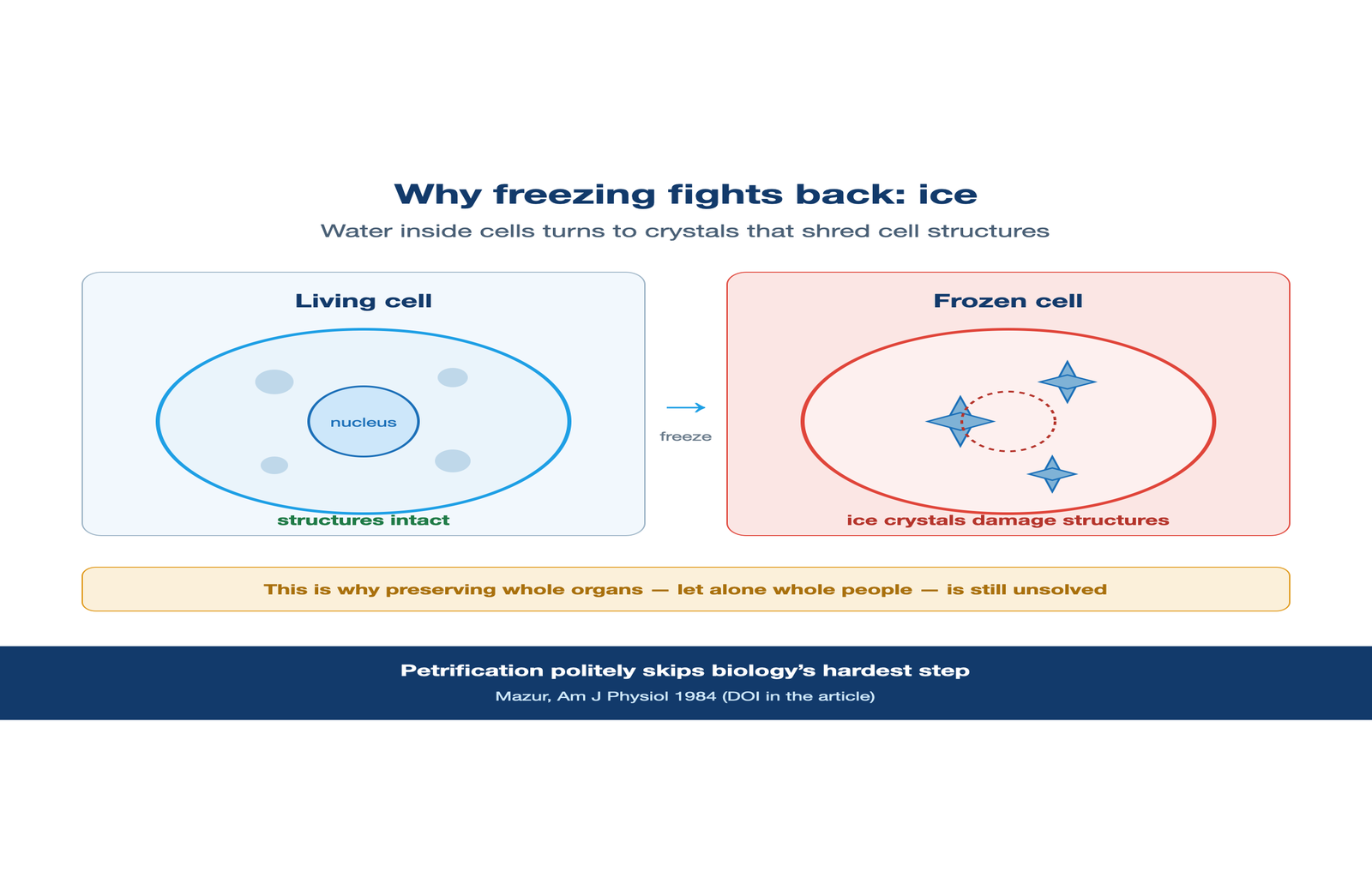
The enemy is something beautifully simple — ice. When living tissue freezes, water inside and around the cells forms crystals, and those crystals physically damage cell structures; get the freezing conditions wrong and the cell is destroyed. This is the core mechanism cryobiology has wrestled with for decades, and it’s exactly why preserving whole organs — let alone whole people — remains so difficult (Mazur, American Journal of Physiology 1984).
This is the real reason cryonics (freezing people in hopes of future revival) stays unproven: we can freeze small samples with careful chemistry, but scaling that to an intact human body without shredding it is a wall no one has cleared. Dr. STONE’s clever dodge is that petrification isn’t freezing — it’s a fictional stone state that supposedly preserves everything perfectly. That’s the creative leap. Real preservation doesn’t get a magic “pause everything” button; it has to fight physics at the level of every single cell.
Takeaway ②: A short pause is medicine; a millennia-long one is science fiction — because real preservation has to beat ice crystals in trillions of cells, and we can’t yet. Petrification is the series politely skipping the hardest step.
Dr. WaterA short pause is medicine; a thousand-year one is science fiction — real preservation has to beat ice crystals in trillions of cells, and we can’t yet. Petrification just politely skips the hardest step. 🐬
Q3 | Even if you woke up — a body that hasn’t moved for millennia. — you would not be swinging an axe.
Now suppose we grant the miracle: preservation works, and you open your eyes. Senku leaps up and starts building civilization. And here’s where the occupational doctor in me winces, because I spend my career watching what happens to bodies that simply stop moving — and it doesn’t take thousands of years.
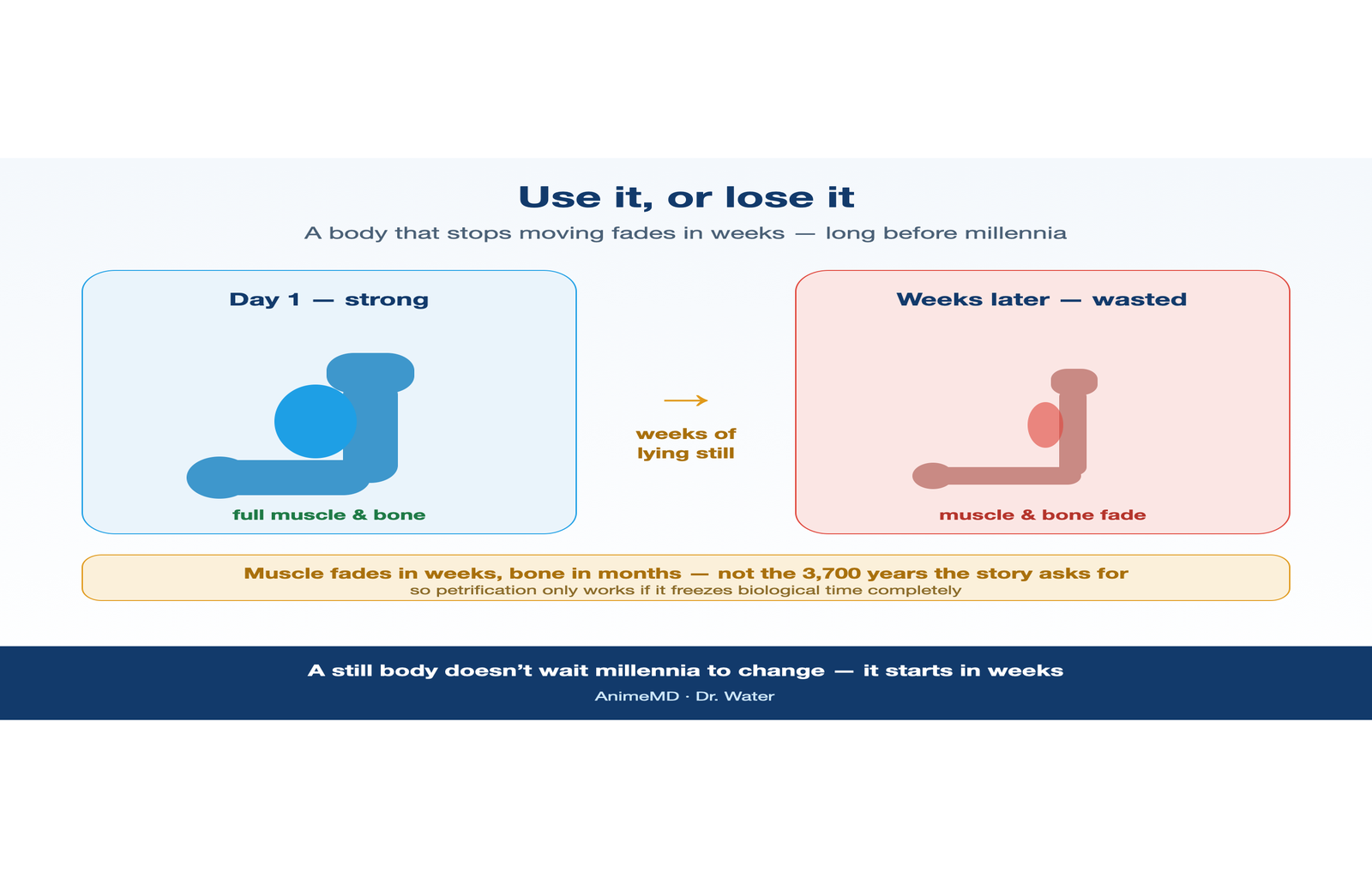
Bone needs load to maintain itself. Take that load away — long bed rest, or astronauts in the near-weightlessness of space — and bone starts to thin measurably within months, a well-documented loss that partly reverses only slowly after return (Vico & Hargens, Nature Reviews Rheumatology 2018). Muscle is even faster: disuse — bed rest, immobilization, unloading — causes real loss of muscle mass and strength over a matter of weeks (Atherton, Bodine et al., American Journal of Physiology-Endocrinology and Metabolism 2016).
Weeks and months. Not millennia. So if the body’s clock kept ticking during those thousands of stone years, a revived person would be catastrophically deconditioned — bones like chalk, muscles gone. The only way Dr. STONE works is that petrification must freeze biological time completely — no aging, no wasting, no ticking clock at all. Which is a lovely idea, and also the single biggest “here be magic” sign in the whole series. The moment a body is genuinely paused, disuse can’t touch it; the moment it’s merely stored alive and still, disuse destroys it.
Takeaway ③: Real bodies waste from disuse in weeks, not eons. For Dr. STONE to hold up, petrification has to stop biological time entirely — the true miracle isn’t the waking up, it’s the not-decaying.
Dr. WaterReal bodies waste from disuse in weeks, not eons. For the story to hold, petrification has to stop biological time completely — the real miracle isn’t the waking up, it’s the not-decaying. 🐬
Q4 | ⚠️ The revival fluid, and the line I actually respect. Straight-faced here.
Let’s talk about the fluid — because how the series handles it is exactly why I like it. The revival formula in Dr. STONE leans on real reagents (nitric acid, alcohol) and real-sounding chemistry, and that grounding is a big part of the show’s charm. But I want to draw the honest line, the way the series itself would.
There is no known substance that reverses a body from solid stone to living flesh, restarts a stopped brain, and restores memory — full stop. That’s the creative leap, and it’s a fine one; fiction is allowed leaps. What matters is that Dr. STONE builds a believable-feeling ladder of real chemistry up to that leap, instead of hand-waving from the start. As a doctor, I’d rather a story earn its magic with real science than skip the science entirely.
And here’s the part that genuinely humbles me. The spirit of the premise — pausing a body to save it — is real medicine we use today. Deliberately cooling a body to protect the brain, and rewarming it carefully, is an established tool; controlled temperature is one of the few things that can stretch survivable time when the clock is against us (Brown et al., NEJM 2012). We can’t pause someone for 3,700 years. But we can, in a real hospital, slow a dying body just enough to steal back the minutes that save a life. That’s not as flashy as a stone statue springing to life — but it’s real, and honestly it’s miracle enough for me.
So — enjoy the revival fluid as the beautiful leap it is, and respect the real chemistry underneath it. Senku’s motto is that science is worth doing carefully, step by step. Couldn’t agree more.
— Confession: the first time I saw a patient cooled deliberately as part of their care, some childish part of my brain went “…suspended animation, for real?” It’s not, of course — it’s careful, evidence-based medicine with clear limits. But that flash of wonder is the exact feeling Dr. STONE is built to give you. I just get to feel it at work sometimes.
Takeaway ④: The revival fluid is fiction’s leap; the idea beneath it — buying time by pausing the body — is real medicine, with real, humbling limits.
Dr. WaterThe revival fluid is fiction’s leap. But the idea beneath it — buying time by pausing a body — is real medicine we use today, within real and humbling limits. 🐬
The verdict: fantasy vs. real
| Belief | Verdict |
|---|---|
| A human body can be paused and later restarted | ○ partly true (deep cold buys minutes–hours; people revive from apparent death) |
| You could stay preserved, intact, for thousands of years | ✕ fantasy (ice crystals shred cells; long whole-body preservation is unsolved) |
| Wake up after millennia and be ready to move | ✕ fantasy — unless time is fully frozen (real bodies waste from disuse in weeks) |
| A revival fluid could restore flesh, brain, and memory | ✕ fantasy (no such substance) — but built on genuinely real chemistry |
| “Pause the body to save it” is pure fiction | ✕ fantasy — controlled cooling is real, limited, working medicine |
Wrap-up
Dr. STONE gets something profoundly right that flashier stories miss: it starts from a true idea — that a body can, briefly, be slowed almost to a stop and brought back — and then builds honestly toward its one big leap. Real medicine can pause a body for minutes, sometimes longer, with cold. It cannot hold that pause for millennia, because ice and disuse are relentless, and biological time is hard to truly stop.
But the dream underneath — buying back time when the clock is against a body — isn’t a dream at all. It’s something doctors do, carefully, within real limits, right now. Which is maybe the most Dr. STONE lesson of all: the real science is quieter than the fiction, and somehow even cooler.
Manga is a doorway into how strange the human body is. And the real body, it turns out, guards its “off switch” very, very carefully.
See you at the next check-up.
📚 Following the series? This was a 〈Body-Check〉. More anime, fact-checked by a doctor, is on the way. Get each new check-up in your inbox — subscribe free.
Dr. Water — physician in occupational and preventive medicine, and a die-hard anime/manga fan (a double insider).
Frequently Asked Questions
Is there a real medical basis for pausing the human body and reviving it later, like in Dr. STONE?
Yes — deep cold can slow the body’s oxygen needs so drastically that people have been resuscitated after long periods of apparent death, which is the basis of modern hypothermia care. This is real and documented, but the scale in Dr. STONE (thousands of years) is nothing like what medicine can achieve, which is minutes to hours, occasionally a bit more.
Could a human body actually survive being frozen or turned to stone for thousands of years?
No — freezing living tissue for a long time is one of the hardest unsolved problems in biology, because ice crystals form inside and around cells and physically destroy their structure. This is exactly why preserving whole organs, let alone an entire body, remains unsolved, and why cryonics (freezing people for future revival) is still unproven. Dr. STONE’s “petrification” sidesteps this by inventing a stone state that magically preserves everything perfectly.
If a body stopped moving for a very long time, could it really just wake up and function normally right away?
No — in real life, bodies that simply stop moving deteriorate far faster than people expect. Bone starts thinning measurably within months of disuse, and muscle mass and strength are lost within weeks of bed rest or immobilization. Since real disuse damage happens on a timescale of weeks to months, a person “paused” for thousands of years would need their body’s clock fully stopped, not just held still, to avoid catastrophic deconditioning.
Disclaimer 1 | Medical
This article is general, educational medical commentary sparked by a work of entertainment. It is not medical advice and not intended to diagnose or treat. Reading it creates no doctor–patient relationship. For any health decision, consult your own physician. The author is a doctor, but these views are general and personal, and the author is not your doctor. Nothing here is a guide to inducing hypothermia, “suspended animation,” or handling chemical reagents; do not attempt any of it. Therapeutic cooling is a hospital procedure with strict limits, performed only by trained clinicians.
Disclaimer 2 | Copyright & Non-Affiliation
This site is an independent, unofficial fan commentary/criticism work. It is not affiliated with, endorsed by, or sponsored by any anime/manga studio, publisher, author, or rights holder. All titles, characters, logos, and trademarks belong to their respective owners and are referenced here solely for identification, commentary, and criticism. This site does not reproduce copyrighted works (panels, screenshots, or text) without authorization; this article uses no manga panels. Rights holders with concerns: please contact us and we will respond promptly.
🩺 Your check-up is over — but the clinic is always open
📚 This clinic has a sequel. 14 legendary monsters — vampire, zombie, werewolf and more — properly diagnosed by a real doctor. The book this blog grew into, with new write-ups added. → Get it on Amazon — $3.99 / free on Kindle Unlimited
💌 Free newsletter — new diagnoses delivered to your inbox, no appointment needed. → Subscribe on Substack
▶️ Prefer video? Watch the diagnoses on YouTube. → The Anime MD





Comments