Body-Check · a Dr. Water check-up
Hi. I’m Dr. Water 🐬. I’m a doctor — the kind who keeps working adults healthy (occupational and preventive medicine).
The Anywhere Door might be the most quietly incredible gadget in all of Doraemon. Open it, step through, and you’re anywhere on Earth — the top of a mountain, a beach on the far side of the world, a snowfield — in a single stride. As a kid I wanted one more than any flying gadget. No airports, no walking, just there.
And that’s exactly why, as a grown-up occupational doctor, I flinched a little re-reading it. Because the thing an airplane trip does slowly — climb, cool, cross time zones — the Anywhere Door does instantly. And your body, it turns out, is a machine that runs almost entirely on the assumption that big changes arrive gradually.
So today, not as a review of the series but as a story about your body, I’ll check what one casual step through that door would really ask of you. Short version up front: the door itself is harmless — it’s the arrival that would knock a real body flat.
📺 Want to read it the legit way? Doraemon is available through Shogakukan’s official channels.
The house rules
I’m not here to judge the series. I’m here to ask, “if a human body did this, what would really happen?” — and back every medical claim with a paper.
Q1 | Step from your living room onto a mountaintop — could you breathe? — your body needs days for that, not one step.
Nobita opens the door onto a high peak and just walks out. Beautiful. But here’s the first thing an occupational doctor notices: altitude isn’t only about the view — it’s about oxygen.
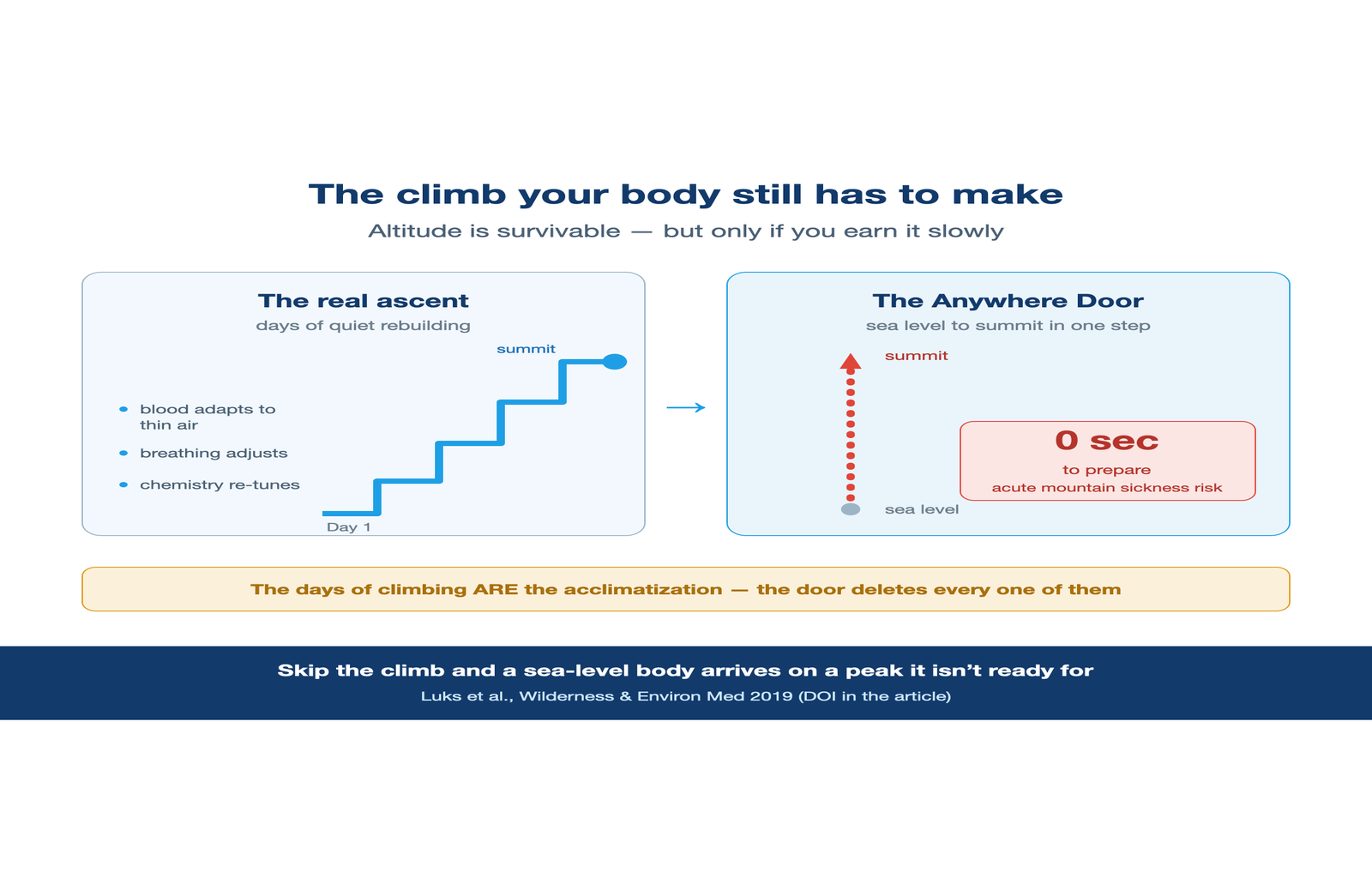
The higher you go, the lower the air pressure, and the less oxygen each breath actually delivers to your blood. Go high enough, fast enough, and you get acute mountain sickness — headache, nausea, dizziness, exhaustion — with the risk, at real altitude, of dangerous fluid building up in the lungs or brain. The single biggest driver of who gets sick is how fast you ascend, which is why the standard medical advice for mountains is to climb slowly and give the body time (Luks et al., Wilderness & Environmental Medicine 2019).
That word — slowly — is the whole problem. A hiker takes days to reach a high summit, and those days are the body quietly rebuilding: making more red blood cells, adjusting breathing, re-tuning its chemistry to thin air. The Anywhere Door deletes every one of those days. You’d arrive on that peak with a sea-level body that has had zero seconds to prepare.
Takeaway ①: Altitude is survivable — but only if you earn it slowly. A door that skips the climb also skips the acclimatization your lungs and blood were counting on.
 Dr. Water
Altitude is survivable — but only if you earn it slowly. Skip the climb and you skip the acclimatization your lungs and blood were quietly counting on. 🐬
Q2 | Step from a summer bedroom straight into a snowfield — what does the cold do first? — it hijacks your breathing before you think.
Say the destination is a polar snowfield instead. In the manga, our heroes step from a warm room into deep snow and mostly just shiver comically. In a real body, the first few seconds are the dangerous ones — and not for the reason people expect.
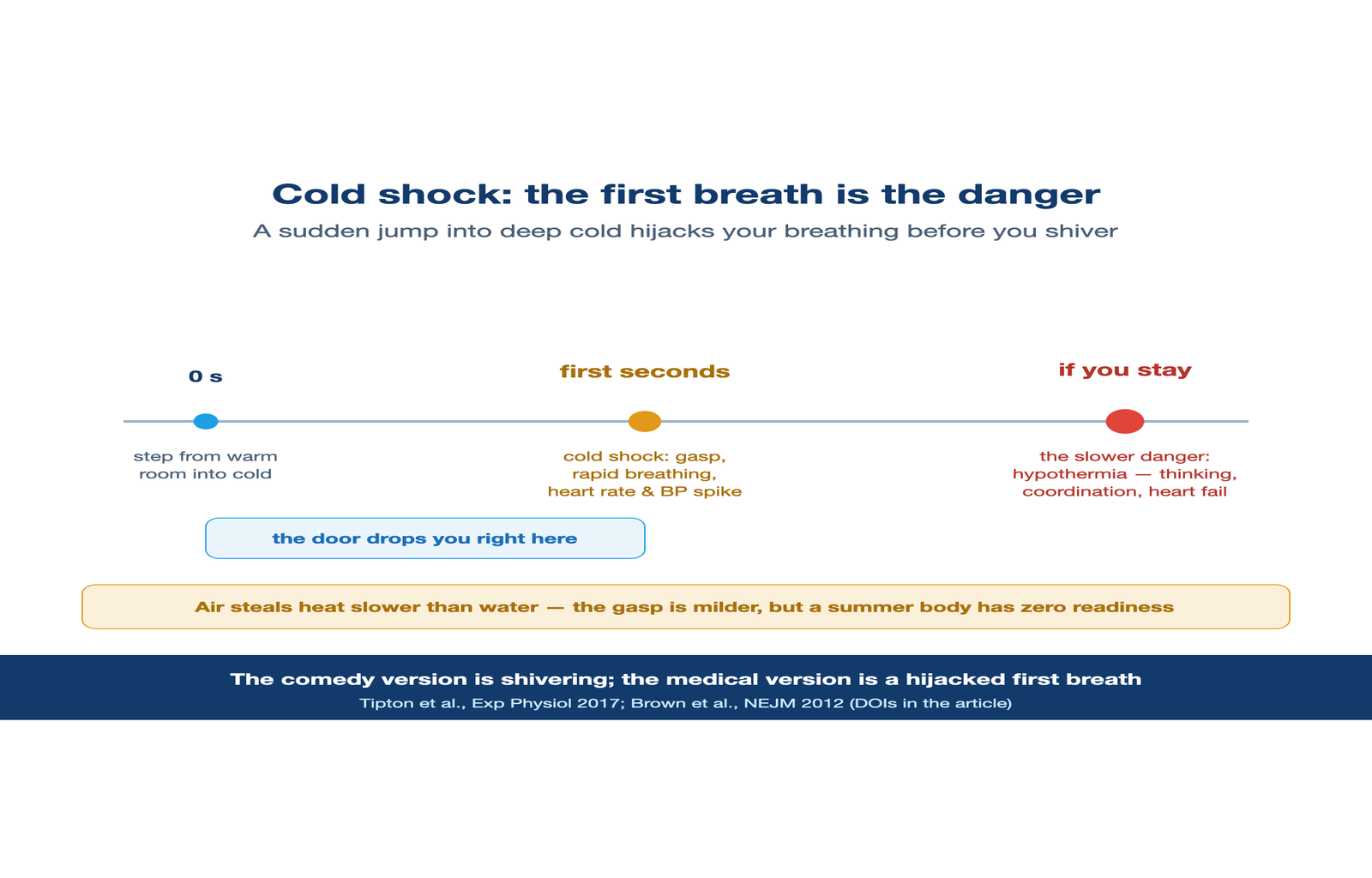
When a warm body is plunged into sudden, severe cold, the immediate threat isn’t slow freezing — it’s the cold shock response: an involuntary gasp, a burst of rapid breathing you can’t fully control, and a spike in heart rate and blood pressure. It’s studied most dramatically in cold-water immersion, where the skin is chilled almost instantly and the body’s alarm fires all at once (Tipton et al., Experimental Physiology 2017) — which is exactly why falling into icy water can be deadly in seconds. Stepping through a door into an Arctic blast is the milder, airborne cousin: air steals heat far slower than water, so the gasp is less violent — but a body still set to “summer,” dressed for it, is being slammed with a cold load it has zero readiness for.
Stay out there and the slower danger takes over: accidental hypothermia, where the core temperature drops and, as it falls, thinking, coordination, and eventually the heart itself begin to fail (Brown et al., New England Journal of Medicine 2012). A body that was sweating a moment ago, dressed for summer, has no reserve for that.
Takeaway ②: The comedy version is shivering. The medical version is a hijacked first breath, then a core that cools faster than a summer-dressed body can defend. Wild temperature swings are not a gag — they’re a genuine emergency.
Dr. WaterIn the manga it’s just comic shivering. In a real body it’s a hijacked first breath, then a core cooling faster than a summer-dressed you can defend. A wild temperature swing is a real emergency, not a gag. 🐬
Q3 | Step to the far side of the world in an instant — what happens to your clock? — you’d land with the worst jet lag physically possible.
Here’s the sneaky one. Even if the destination is perfectly comfortable — same altitude, same mild weather — the door still hands you a problem an airplane can’t: it moves you across time zones with no travel time to soften the blow.
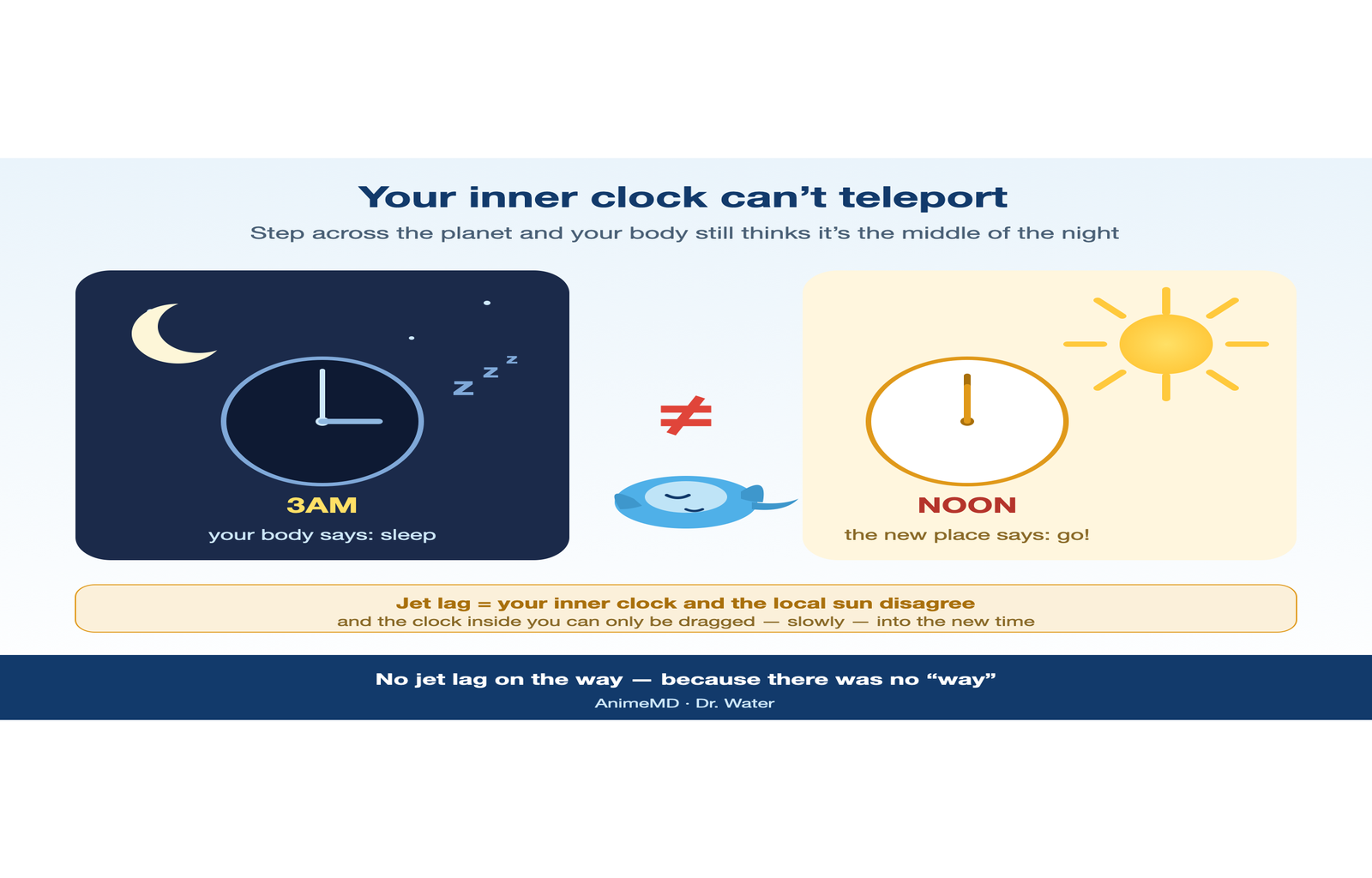
Your body runs on an internal clock, and that clock expects daylight, meals, and sleep to line up. Yank yourself to the opposite side of the planet in one step and it’s suddenly bright when your body swears it’s the middle of the night. That mismatch is jet lag — poor sleep, fog, gut upset, flattened performance — and it comes specifically from your internal clock being out of sync with the new local time (Waterhouse et al., Lancet 2007).
And it isn’t just feeling groggy. Even short spells of your body clock being misaligned with your sleep and meals measurably worsen blood sugar, insulin, and blood pressure (Scheer et al., PNAS 2009). A long flight at least lets the clock start nudging over as you cross zones. The Anywhere Door gives it the maximum possible jump with zero head start — arguably the purest, harshest jet lag a human could experience.
Takeaway ③: Instant travel means instant, maximal jet lag. The clock inside you can’t teleport — it has to be dragged, slowly, into the new time.
Dr. WaterEven if the weather’s perfect, the door still hands you the worst jet lag possible. Your inner clock can’t teleport — it has to be dragged, slowly, into the new time. 🐬
Q4 | ⚠️ You never travel alone — and “travel time” was quietly protecting you. Straight-faced here.
The first three were about the outside changing too fast. This last one is subtler, and it’s the part I actually find beautiful. Whenever you step through that door, you don’t arrive alone. You bring an entire living ecosystem with you — and you walk straight into a new one, with no buffer.
Your body is home to a vast community of microbes — trillions of them, a whole functioning organ of bacteria that varies enormously from person to person and place to place (Human Microbiome Project Consortium, Nature 2012). You are, in a real sense, a moving habitat, and every region has its own microbial fingerprint — its own local bugs in the water, the food, the air. Now, to be fair: most travelers’ tummy troubles abroad come down to what you eat and drink — unfamiliar food and water carrying microbes your gut has never met — not to the speed of the trip itself. But the Anywhere Door still makes the underlying point vivid: it drops you into a completely foreign microbial world in a single stride, with none of the gentle, incidental exposure that a slower approach to a place tends to bring.
And that’s the quiet lesson hiding in all four questions. We think of a flight’s long hours as pure waste — the boring part between “here” and “there.” But physiologically, that travel time is the medicine. It’s the hours your blood spends making room for thin air, your thermostat spends re-setting, your clock spends creeping toward local noon, your gut spends meeting the new neighborhood one microbe at a time. The Anywhere Door’s magic is that it deletes the journey. Its hidden cost is that the journey was doing something for you the whole time.
So — envy the door all you like, but respect the trip. Doraemon’s gadgets are fiction; your lungs, your thermostat, your body clock, and your gut are real, and every one of them is built for a world you reach gradually.
— I’ll confess: I once flew red-eye across nine time zones for a conference, marched straight from the gate into a morning session, and delivered a talk convinced I was crisp and clear. Watching the recording later, I was a man narrating his own dream. That was the Anywhere Door problem in miniature — my body arrived, my clock stayed home. So, learned my lesson: give the trip its due.
Takeaway ④: The best part of the Anywhere Door — no journey — is also its most expensive part. Your body was using that journey to survive the destination.
Dr. WaterThe best part of the door — no journey — is also its most expensive. All those boring travel hours were your body quietly getting ready to survive the other side. 🐬
The verdict: fantasy vs. real
| Belief | Verdict |
|---|---|
| Step onto a mountaintop and breathe just fine | ✕ fantasy (altitude needs slow acclimatization; instant = acute mountain sickness risk) |
| A sudden jump into the cold just means shivering | ✕ fantasy (cold shock hijacks breathing first, then hypothermia) |
| If the weather’s nice, instant travel is free | ✕ fantasy (maximal jet lag; clock misalignment hits sleep and metabolism) |
| You travel through the door all by yourself | ✕ fantasy (you carry a whole microbiome into a foreign one, with no buffer) |
| The long trip an airplane makes is wasted time | ✕ fantasy — that time is your body’s acclimatization |
Wrap-up
The Anywhere Door isn’t dangerous because of anything it does to you in the doorway. It’s dangerous because of what it skips. Every slow, boring hour of real travel is your body doing invisible work — thickening the blood for altitude, resetting the thermostat, dragging the clock forward, greeting a new world’s microbes one at a time.
Take that time away, and a perfectly healthy body arrives somewhere it isn’t ready to be. Which, honestly, makes me love the gadget even more — because it accidentally reveals just how much quiet engineering a human body pours into the simple act of getting somewhere.
Manga is a doorway into how strange the human body is. And the real body, it turns out, likes to take the scenic route.
See you at the next check-up.
📚 Following the series? This was a 〈Body-Check〉. More anime, fact-checked by a doctor, is on the way. Get each new check-up in your inbox — subscribe free.
Dr. Water — physician in occupational and preventive medicine, and a die-hard anime/manga fan (a double insider).
Frequently Asked Questions
If you could instantly teleport to a high mountaintop, could you breathe normally right away?
No — your body needs days, not a single step, to adjust to high altitude. Going up in elevation reduces the oxygen your blood actually receives per breath, and ascending too fast risks acute mountain sickness (headache, nausea, dizziness, exhaustion) or, at extremes, dangerous fluid buildup in the lungs or brain. Normally, the days spent climbing let your body gradually make more red blood cells and adjust to thin air — a process instant travel would skip entirely.
If the weather at your destination is comfortable, is instant long-distance travel basically free of any physical cost?
No — even with perfect weather, instantly crossing time zones would hand your body the worst possible jet lag. Your internal body clock expects daylight, meals, and sleep to line up gradually, and a sudden jump to the opposite side of the planet creates poor sleep, mental fog, and gut upset. Even short spells of this kind of misalignment measurably worsen blood sugar, insulin, and blood pressure — a flight at least gives the clock a head start that instant travel wouldn’t.
Since instant travel skips the days a normal trip takes, what is that travel time actually doing for your body, and what should you keep in mind?
That travel time is essentially your body doing invisible preparation work, not wasted time. During a normal trip, your blood makes room for thinner air, your thermostat resets for new temperatures, your internal clock creeps toward the new local time, and your gut is gradually introduced to a new region’s microbes instead of being dropped into a foreign microbial environment all at once. If planning real high-altitude, cold-weather, or long-haul travel, prepare properly in advance and seek qualified medical or travel-health advice rather than assuming quick adjustment is automatic.
Disclaimer 1 | Medical
This article is general, educational medical commentary sparked by a work of entertainment. It is not medical advice and not intended to diagnose or treat. Reading it creates no doctor–patient relationship. For any health decision, consult your own physician. The author is a doctor, but these views are general and personal, and the author is not your doctor. If you are planning real high-altitude, cold-environment, or long-haul travel, prepare properly and, where relevant, seek qualified medical or travel-health advice beforehand; do not treat this entertainment article as a substitute.
Disclaimer 2 | Copyright & Non-Affiliation
This site is an independent, unofficial fan commentary/criticism work. It is not affiliated with, endorsed by, or sponsored by any anime/manga studio, publisher, author, or rights holder. All titles, characters, logos, and trademarks belong to their respective owners and are referenced here solely for identification, commentary, and criticism. This site does not reproduce copyrighted works (panels, screenshots, or text) without authorization; this article uses no manga panels. Rights holders with concerns: please contact us and we will respond promptly.
🩺 Your check-up is over — but the clinic is always open
📚 This clinic has a sequel. 14 legendary monsters — vampire, zombie, werewolf and more — properly diagnosed by a real doctor. The book this blog grew into, with new write-ups added. → Get it on Amazon — $3.99 / free on Kindle Unlimited
💌 Free newsletter — new diagnoses delivered to your inbox, no appointment needed. → Subscribe on Substack
▶️ Prefer video? Watch the diagnoses on YouTube. → The Anime MD







Comments