Hair all over the body, a person who believes they are turning into a wolf, and a bite that spreads rage and dread — every piece of the werewolf myth maps onto a real, documented human condition. A doctor opens the Monster Clinic and takes the wolf’s history.
Hi. I’m Dr. Water 🐬. I’m a doctor — the kind who keeps working adults healthy (occupational and preventive medicine).
Welcome to a new room in this practice. I’m calling it the Monster Clinic (怪物外来): the door where a monster shows up not as a threat, but as a patient — and I do what a doctor does. I take a history. I examine. I ask, gently, what is actually going on with this body?
Today’s patient is the oldest of them all. Full moon, fur, a howl, a bite that turns the bitten into the next monster. The werewolf. And here’s what unsettled me the first time I really looked: the werewolf isn’t one fantasy stitched from nothing. It’s three real medical stories that pre-scientific people had no other words for. A body covered head to toe in hair. A mind that genuinely believes it is becoming a wolf. And an illness spread by a bite that fills a person with rage, dread, and a horror of water. Each one is documented. Each one has real patients — living, suffering, treated with dignity, right now.
So today, as a story about the human body and mind, I’ll take the werewolf’s history in four questions. Short version up front: nearly every brushstroke of the legend is a real condition seen through candlelight and fear — and understanding that makes the folklore more haunting, not less.
The house rules
I’m not here to mock a monster, and I am absolutely not here to mock the real people whose conditions built this myth. I’m here to ask, “what real thing was folklore trying to describe?” — and to back every medical claim with a paper. These are actual diagnoses carried by actual human beings. I write about them the way I’d want a doctor to write about me.

Q1 | The hair: is there really a condition that covers a body in fur? — yes, and its own nickname is “werewolf syndrome.”
Start with the most literal piece of the legend: a person whose whole body sprouts thick hair. Surely that one is pure invention?
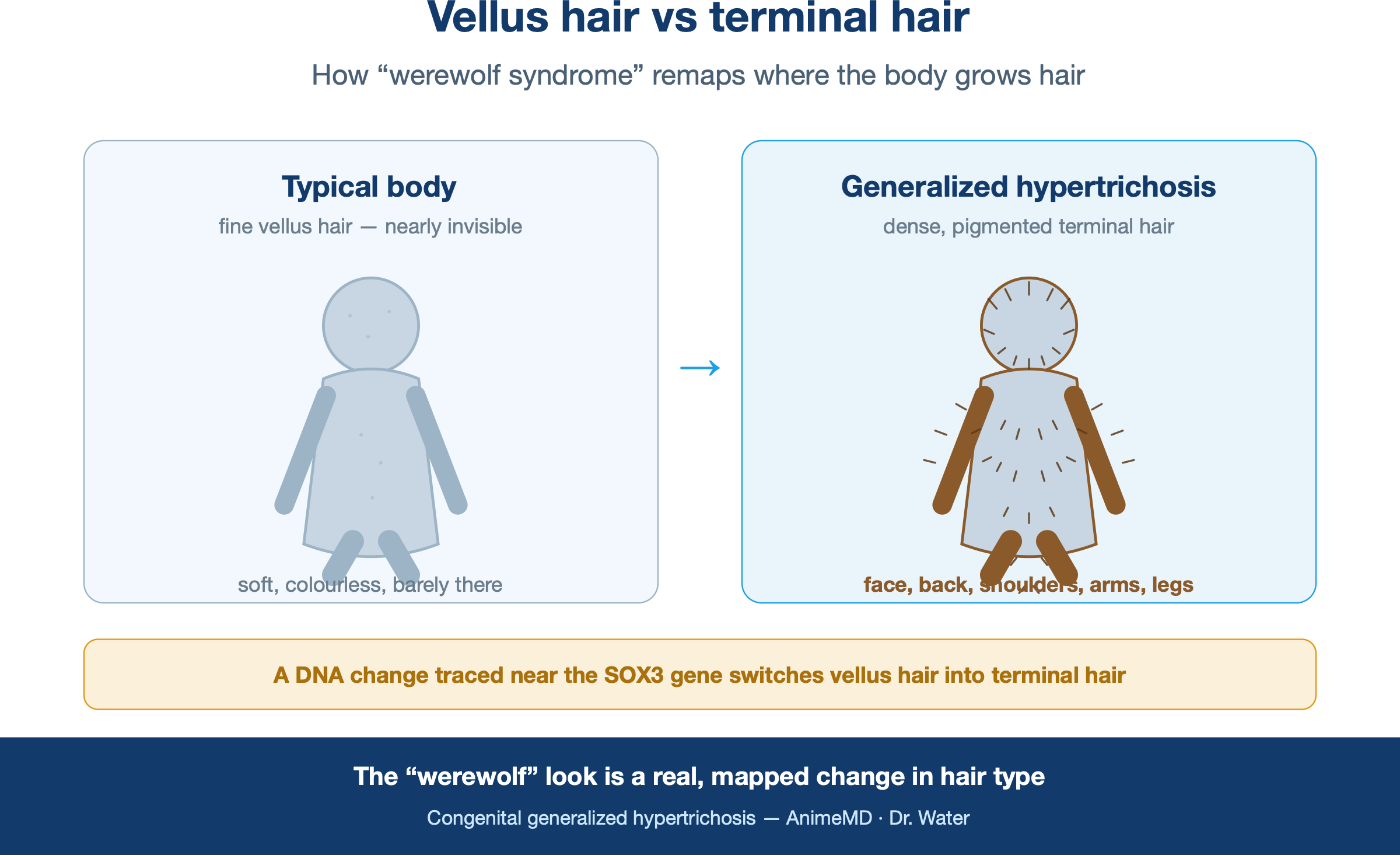
It isn’t. There is a real, extraordinarily rare condition called congenital generalized hypertrichosis — excessive hair growth all over the body, present from birth, including the face — and clinicians have long, informally, called it “werewolf syndrome.” Instead of the fine, nearly invisible vellus hair most of us carry on our cheeks and forehead, affected individuals grow dense, pigmented terminal hair across the face, back, shoulders, arms, and legs.
And here’s the part I find genuinely beautiful, because it’s so specific. In one form of the X-linked condition, researchers traced the cause down to the actual genetics: a piece of DNA from another chromosome had inserted itself into the X chromosome, near a gene called SOX3, mediated by a rare human-specific palindromic sequence (Zhu et al., American Journal of Human Genetics 2011). Read that again: the “monster” is a single, precise, traceable rearrangement of the genome. Not a curse. Not the moon. A sentence in the body’s own instruction manual, copied into the wrong place.
Historically, some of the very few documented families with generalized hypertrichosis were displayed in courts and circuses as “wolf-men” and “dog-faced” performers — real people, turned into spectacle for a trait they never chose. When I read those histories, the horror I feel isn’t at the hair. It’s at how they were treated. The condition is medically harmless in itself; the cruelty was entirely ours.
Takeaway: The head-to-toe fur of the werewolf is real — congenital generalized hypertrichosis, informally “werewolf syndrome,” down to a precisely mapped change in the DNA near SOX3. It is rare, harmless in itself, and its real history is a lesson about how badly we treat what we don’t understand.
Q2 | The transformation: can a person truly believe they are becoming a wolf? — yes. It has a name, and it’s been described since antiquity.
Now the eerier piece. Forget the fur — what about the turning? The person who is convinced, from the inside, that they are ceasing to be human and becoming a wolf?
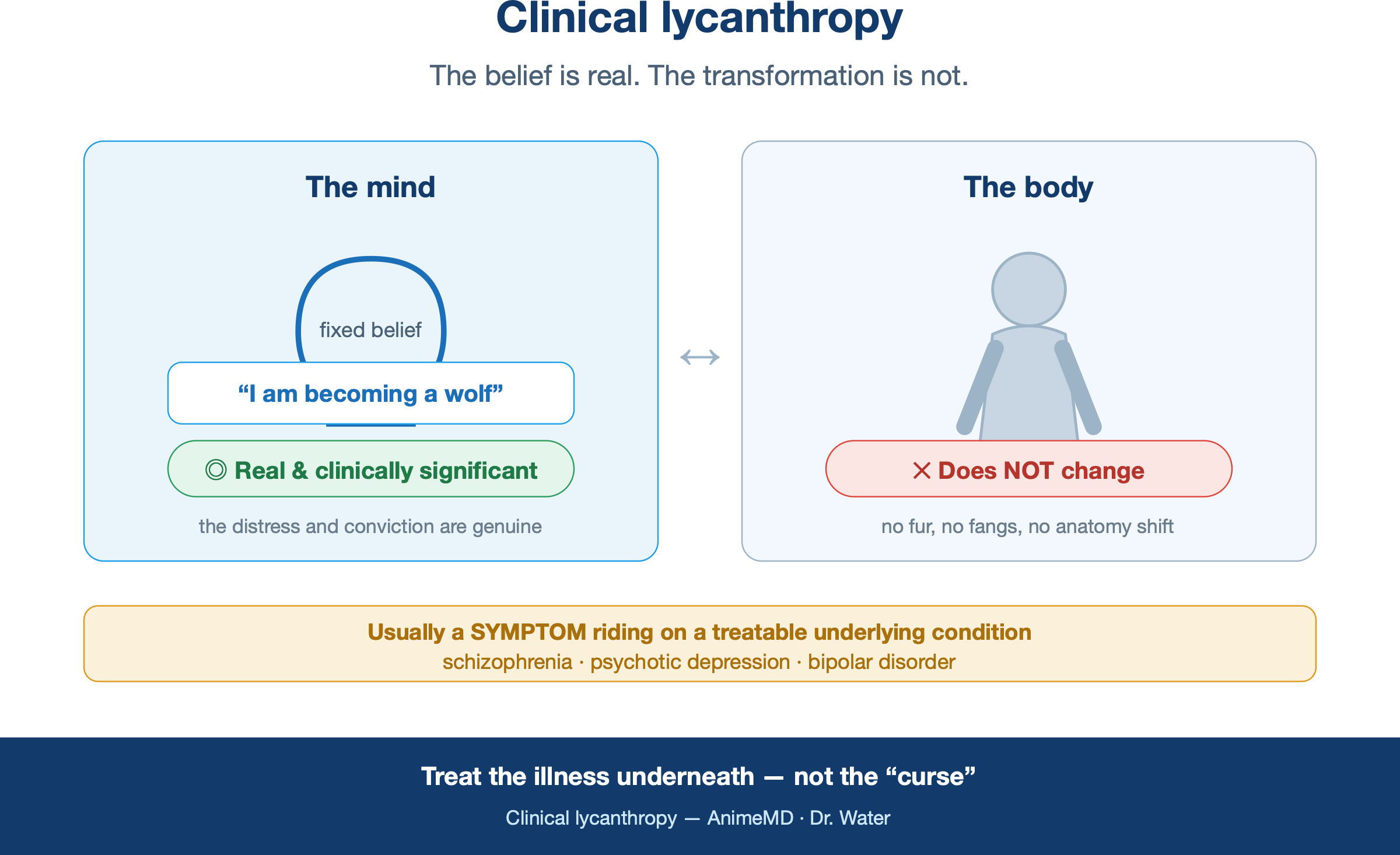
This is real too, and it lives in my colleagues’ world, psychiatry. It’s called clinical lycanthropy: a rare delusional syndrome in which a person holds the fixed, unshakeable belief that they are transforming — or have transformed — into an animal, classically a wolf. The word “clinical” is doing careful work there: it does not mean the person’s body changes. It means the belief is real and clinically significant, even though the transformation never physically happens.
How real is it? A systematic review combed the medical literature all the way back to 1850 and found 56 original case descriptions of people who believed they were metamorphosing into an animal, of which 13 met the strict criteria for clinical lycanthropy proper (Blom, History of Psychiatry 2014). It is genuinely rare — but it is documented, again and again, across centuries and countries. And crucially, it is almost always a symptom of an underlying condition rather than a disease of its own: the belief tends to appear on top of disorders like schizophrenia, psychotic depression, or bipolar disorder (Blom 2014; see also the more recent review by Guessoum et al., Frontiers in Psychiatry 2021).
Sit with what that means for the legend. Somewhere, centuries ago, there was a real person in genuine anguish, telling everyone around them — with total conviction — that they were becoming a wolf. Their neighbors had no diagnosis, no MRI, no word for a delusion. They had folklore. So the suffering became a story about monsters, when it was really a story about a mind in crisis that desperately needed care.
Takeaway: “Turning into a wolf” is a documented psychiatric phenomenon — clinical lycanthropy — where the belief is real even though the body never changes. It’s rare, it’s usually a symptom of a treatable underlying condition, and every historical “werewolf” of this kind was a person who needed a doctor, not a mob.
Q3 | The bite: what real illness turns a person into a raging, water-fearing creature — and spreads by biting? — this is the engine of the whole myth.
Here’s the piece that ties the legend together, and it’s the one that gives me chills as a doctor: the werewolf’s defining mechanic. It bites. The bitten person becomes the next werewolf. The afflicted are seized by rage, they can’t bear water, they shun the light. Is there a single real disease that does all of that?
There is. It’s rabies — and once you know its clinical picture, the werewolf (and the vampire, and half the world’s biting monsters) reads like folklore trying to describe an outbreak.
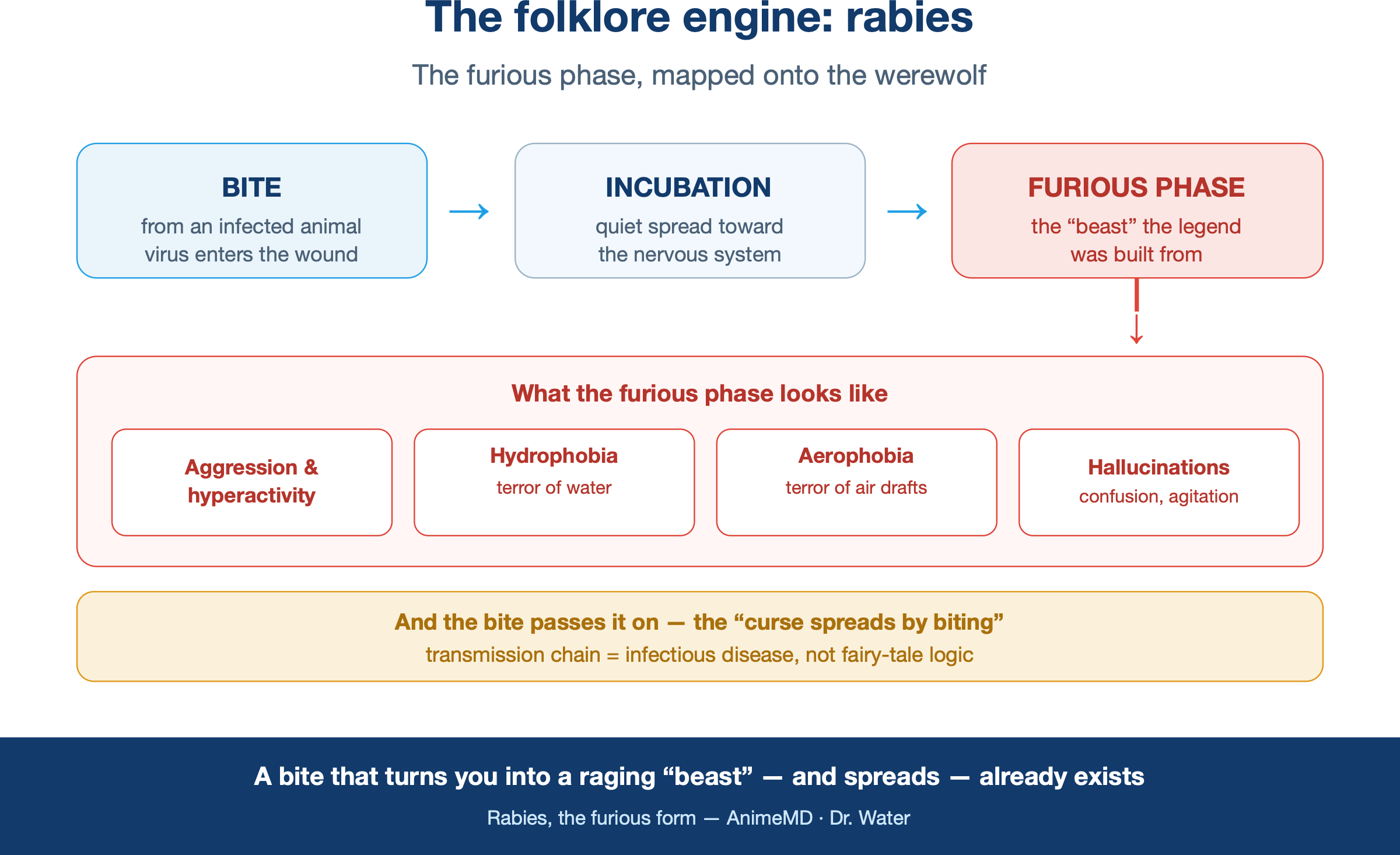
Rabies is a viral infection of the nervous system, spread overwhelmingly through the bite of an infected animal. In its “furious” form, the World Health Organization describes exactly the symptoms the legend obsesses over: hyperactivity, excitable and aggressive behaviour, hallucinations, and — the two most haunting — hydrophobia (a terror of water) and aerophobia (a terror of drafts of air) (World Health Organization, Rabies fact sheet). A person dying of rabies can recoil in genuine panic at the sight of water, snap and lash out, and lose control of their own body. To a village with no germ theory, watching a bitten neighbor descend into rage and animal terror — and knowing that their bite could pass it on — the werewolf isn’t a metaphor. It’s a field report.
This isn’t just my pattern-matching. A neurologist made the formal case decades ago, arguing that rabies — with its aggression, its biting transmission, and its sensory horrors — could explain much of the vampire and beast-legend tradition, noting that historical rabies outbreaks in animals lined up with waves of monster folklore (Gómez-Alonso, Neurology 1998). The bite that curses you; the curse that spreads by biting; the victim who becomes the monster. That’s not a fairy tale’s logic. That’s an infectious disease’s transmission chain, retold by people who could see the effect and never the cause.
And the sobering footnote: rabies is not history. It still kills tens of thousands of people a year worldwide, almost all from dog bites, almost all preventable with prompt wound care and vaccination (WHO, Rabies fact sheet). The monster that built our oldest myth is still, quietly, out there.
Takeaway: The werewolf’s core machinery — a bite that transmits, followed by rage, aggression, and a horror of water — is rabies, described before anyone knew what a virus was. It’s the folklore engine behind the whole beast-legend family, and unlike the myth, it’s real, still deadly, and still preventable today.
Q4 | ⚠️ The line I actually respect — real conditions, real patients, told with real care. Straight-faced here.
Let me set the dry humor down for a moment, because this article touches living people, and I won’t be cute about that.
The werewolf is public-domain folklore, and it’s fun — a full moon, a howl, a great campfire scare. Enjoy it completely. But underneath the costume are three things that are not costumes at all. Congenital hypertrichosis is carried by real people who, within living memory, were caged and exhibited for a harmless trait. Clinical lycanthropy is genuine psychological anguish, a mind in a state that deserves compassion and treatment, not a torch-lit crowd. And rabies is a real, still-lethal disease that ends thousands of human lives every year.
So here’s the leap I’m happy to name: no one turns into a wolf. Hair doesn’t make a monster; a delusion isn’t a curse; and a virus is not a moral failing. That’s the honest medicine. But the reason the werewolf has haunted us for a thousand years isn’t ignorance — it’s that our ancestors were sharp observers of real human suffering who simply lacked the words. They saw the hair, the transformation-belief, the biting rage, and they built the best explanation their world allowed. The myth is a monument to real conditions we can finally, at last, name and treat.
That’s what the Monster Clinic is for. Not to debunk the monster — to find the patient inside it, and to give that patient the thing every version of this story was really crying out for: a diagnosis, and some dignity.
— Confession: I still get a delicious chill from a good werewolf transformation on screen. Knowing exactly which real condition each beat came from doesn’t ruin it for me. It makes me quietly protective of the people history turned into monsters — and grateful I get to hand out names instead of pitchforks.
Takeaway: Turning into a wolf is fiction’s leap. The hair, the transformation-belief, and the biting rage are three real conditions carried by real people — and the only right response to all three is care, not fear.
The verdict: legend vs. real medicine
| Werewolf myth element | Verdict |
|---|---|
| A body covered head-to-toe in thick hair | ✓ real — congenital generalized hypertrichosis (“werewolf syndrome”), traced to a specific DNA change |
| A person who believes they are turning into a wolf | ✓ real — clinical lycanthropy, a documented delusional syndrome |
| That belief means the body physically changes | ✕ fantasy — the belief is real; the transformation never happens |
| A bite that spreads the condition to the victim | ✓ real — this is exactly how rabies transmits |
| Rage, aggression, and a horror of water after the “curse” | ✓ real — the furious phase of rabies (hydrophobia, aerophobia, aggression) |
| The full moon causes any of it | ✕ fantasy — no medical link; pure folklore |
| An actual human-to-wolf metamorphosis | ✕ fantasy — beautiful, and thankfully not how bodies work |

Wrap-up
Here’s what stays with me after taking the werewolf’s history. We tend to think of old monster legends as the opposite of medicine — superstition on one side, science on the other. But the werewolf is the reverse. It’s a very early draft of a case file, written by people who could see real symptoms with piercing clarity and just didn’t have the vocabulary yet. The hair was real. The transformation-belief was real. The biting, spreading rage was real. They got the observations right and the explanation wrong, because the explanation — genes, delusions, a virus — was still centuries away.
Real medicine can’t turn anyone into a wolf. But it can do something better: it can look at the three frightening things that built the legend and say, calmly, I know what this is, and I know how to help. That’s the whole arc of this practice, and honestly the whole arc of medicine — turning monsters back into patients.
The human body and mind are stranger, and more worthy of care, than any monster we invented to explain them. That’s the real magic, and it’s the kind I get to practice.
See you at the next check-up — the Monster Clinic door stays open.
If this was fun — the Monster Clinic takes a new patient each time: I look at the medicine hiding inside a classic monster, through a doctor’s eyes. Get the next one via the [free newsletter].
This patient already has a chart. He’s Chapter 3 of my book Monster Clinic — “The Werewolf: on the night of the full moon, does a human become a beast?”, which is the exact question we’ve spent today’s appointment on — filed alongside thirteen other patients: the vampire, the zombie, the mummy, and the rest of the waiting room. (Kindle, $3.99, free to read on Kindle Unlimited.)
[Author box] Dr. Water — physician in occupational and preventive medicine, and a die-hard anime/manga fan (a double insider). [Water ① normal as avatar]
[Related / next] Monster Clinic file 02 (coming) · “Could you really come back after 3,700 years as stone?” (Dr. STONE, Article 22)
Frequently Asked Questions
Is there a real medical condition that makes someone’s whole body grow thick hair, like a werewolf?
Yes — it’s called congenital generalized hypertrichosis, an extremely rare condition present from birth that causes dense, pigmented hair to grow across the face, back, shoulders, arms, and legs, and it has even been informally nicknamed “werewolf syndrome.” In one form, researchers traced the cause to a specific, traceable piece of DNA that inserted itself near a gene called SOX3. The condition itself is medically harmless.
Can a person genuinely believe they are turning into a wolf or another animal?
Yes, this is a real, documented psychiatric phenomenon called clinical lycanthropy — a rare delusion in which someone holds the fixed belief that they are transforming into an animal, even though their body never actually changes. A review of medical literature back to 1850 found dozens of case descriptions, and the belief is almost always a symptom of an underlying condition like schizophrenia or bipolar disorder rather than a disease on its own.
What should you actually do if you’re bitten by an animal that might have rabies?
Wash the wound and seek medical care immediately, because post-exposure treatment is highly effective but time-sensitive. The werewolf legend’s biting curse maps closely onto real rabies, a viral infection spread through an infected animal’s bite that causes aggression, hallucinations, and a terror of water in its “furious” form. Rabies still kills tens of thousands of people worldwide each year, almost all from dog bites, and is almost entirely preventable with prompt care.
Disclaimer 1 | Medical
This article is general, educational medical commentary sparked by folklore and entertainment. It is not medical advice and not intended to diagnose or treat. Reading it creates no doctor–patient relationship. For any health decision, consult your own physician. The conditions described here — hypertrichosis, clinical lycanthropy, and rabies — are real diagnoses affecting real people, described here with respect and never to mock any patient. Rabies is a medical emergency: if you are bitten or scratched by an animal that could carry rabies, wash the wound and seek medical care immediately — post-exposure treatment is highly effective but time-sensitive.
Disclaimer 2 | Copyright & Non-Affiliation
The werewolf is public-domain folklore; this article references no copyrighted anime or manga work, and reproduces no panels, screenshots, or character art. All medical claims are attributed to the cited sources. Any brand, character, or title mentioned in passing belongs to its respective owner and is referenced solely for identification and commentary.
🩺 Your check-up is over — but the clinic is always open
📚 This clinic has a sequel. 14 legendary monsters — vampire, zombie, werewolf and more — properly diagnosed by a real doctor. The book this blog grew into, with new write-ups added. → Get it on Amazon — $3.99 / free on Kindle Unlimited
💌 Free newsletter — new diagnoses delivered to your inbox, no appointment needed. → Subscribe on Substack
▶️ Prefer video? Watch the diagnoses on YouTube. → The Anime MD









Comments