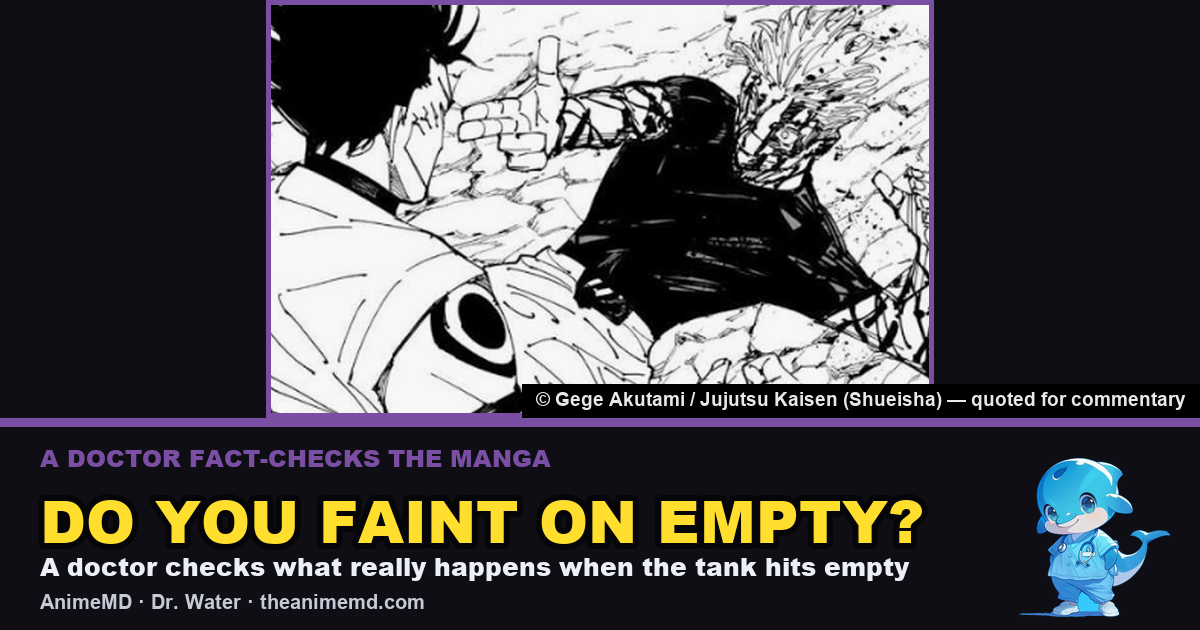
〈The Doctor at Work #01〉 · a Dr. Water check-up
Hi. I’m Dr. Water 🐬. I’m a doctor — the kind who keeps working adults healthy (occupational and preventive medicine).
Read any story about exorcising curses and one scene always shows up: someone unleashes an enormous technique, then drops to their knees. Cast one too many times and the lights go out. A person stalls, like a car out of gas. Fans ask me: “What’s actually happening there, medically? Do people really pass out from running out of energy?”
Good question. And for me it isn’t only a fiction question. I see people who run themselves out of fuel and can’t move — in real workplaces. No technique names, no cursed energy, just quietly, like a battery going flat.
So today, not as a review of the series but as a story about your body, I’ll check the math against real medicine. The short version up front: “you spend all your power and collapse” is startlingly true — it’s just that there’s more than one way to go down.
📖 Want to read it the legit way? Jujutsu Kaisen is available on Shueisha’s official Manga Plus.
The house rules
I’m not here to judge the series. I’m here to ask, “if a human body did this, what would really happen?” — and back every medical claim with a paper. Cursed energy isn’t real, so I’ll read it as “spend a huge amount of the body’s energy all at once” and check that.
Q1 | “Spend all your power and you ‘run out of gas’ and can’t move” — real? Your muscles keep a stockroom.

In these stories, a technique-user who overdoes it suddenly finds their body won’t obey and drops to a knee — drawn as an energy gauge hitting zero.
Inside the body, this is surprisingly consistent. Muscle also runs on a sugar reserve called glycogen, and when that runs dry you can’t produce force. Here’s the fun part: even when whole-body blood sugar is still fine, force falls just from the muscle’s own glycogen running out. Even with ATP — the energy “currency” — still present in the muscle, once glycogen is depleted the muscle stops releasing calcium properly, the contraction command doesn’t get through, and it fatigues (Ørtenblad et al., The Journal of Physiology 2013).
Finer still: glycogen is stored in compartments within the muscle by location, and a small compartment that’s a tiny fraction of the total gets used up first. When that “key-location stock” empties, a local energy shortage hits the very machinery that produces force — even though, by quantity, sugar remains (Ørtenblad et al., The Journal of Physiology 2013).
So “gauge hits zero, suddenly can’t move” is less a fantasy exaggeration than close to how muscle actually works. That buckling knee is a good shot.
Takeaway ①: Not running low on carbs before a long haul actually matters. It’s inventory management, not willpower.
 Dr. Water
That “gauge hits zero, can’t move” scene? Basically real muscle physiology. Your muscles keep a glycogen stockroom — and when a key shelf empties, force drops even with sugar still in the tank. 🐬

Q2 | When they pass out from exhaustion, what’s happening? — the culprit is the brain running out of gas.

Sometimes a character who’s spent everything doesn’t just kneel — they lose consciousness and collapse. That’s actually a different mechanism from the muscle story.
The key is the brain. The brain runs almost solely on glucose, and can’t instantly switch to another fuel if it suddenly runs short (Mergenthaler et al., Trends in Neurosciences 2013). So if blood sugar drops too far (hypoglycemia), the brain stalls — consciousness clouds, or goes out. And this isn’t armchair theory: hypoglycemia can genuinely cause a transient loss of consciousness (fainting) that looks clinically just like a common dizzy-spell faint, as documented in a case report (Wester et al., Journal of Medical Case Reports 2021). Things like skipping meals — disrupting supply — can be the trigger.
The tricky bit: this kind of faint is hard to tell apart from an ordinary faint, and easy to miss (Wester et al., Journal of Medical Case Reports 2021). So part of “spends everything and drops flat” is literally the brain’s real fuel-shortage disorder.
Takeaway ②: A work style of skipping meals and gritting through long hours nudges the brain toward a fuel shortage. Noticing after you’ve collapsed is too late.
Q3 | ⚠️ Fighting on, drenched in sweat, until you drop — is that real? Straight-faced here.

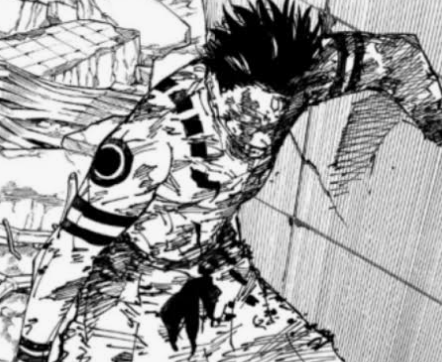
In these stories, characters burn out in fierce, prolonged combat outdoors or in the heat. Here, “running out of energy” layers onto another real-world threat — heat and dehydration.
Keep moving hard, let heat build in the body, and once thermoregulation and circulation can’t keep up, you get exertional heat stroke. Its essence is described as severe hyperthermia followed by a body-wide inflammatory response and multi-organ injury (Garcia et al., BMJ Medicine 2022). Add dehydration and blood volume falls and thickens, the heart works harder, brain blood flow drops, and it can contribute to fainting. And notably, exertional heat stroke can occur even without dehydration (Garcia et al., BMJ Medicine 2022). “I was drinking water, so I’m fine” is not a guarantee.
Heat and dehydration also erode your very capacity to move, primarily through cardiovascular strain (Cheuvront et al., Journal of Applied Physiology 2010). A sweat-soaked character flagging isn’t just staging; it’s physiologically quite reasonable.
From here I write straight-faced. Exertional heat stroke is a medical emergency that can be fatal as it progresses. If you’re active in heat or humidity and get dizziness, a pounding headache, nausea, clouding consciousness, a sudden stop in sweating, or a body that’s abnormally hot — that is not a wall you push through on guts. Move to a cool place immediately, cool the body, and don’t hesitate to call emergency services and get care. With hypoglycemia too, cold sweat, trembling hands, a fuzzy mind, or seizures are danger signs, and delay is dangerous. (For both exertional heat stroke and hypoglycemia, the danger of these warning signs and the need for fast action are established basics of emergency and clinical medicine.) Characters recover by the power of story; a real body has no continue.
— I’ll confess: years ago, in high summer, I kept up field work while skipping lunch, figuring “I’m sipping water constantly, so I’m fine,” and by afternoon the scenery lurched. What I’d taken in was only water — sugar close to zero. I’d neatly checked every box above. Doctors are the worst at underestimating their own bodies. So — don’t copy it.
Takeaway ③: Neither heat stroke nor hypoglycemia is a wall you cross on guts. Don’t run out of sugar — not just water. And when a warning sign shows up, don’t tough it out: stop, cool down, get seen. This part, straight-faced.
Dr. WaterI’ll say this one straight-faced: heat stroke and hypoglycemia aren’t walls you push through on guts. Warning signs = stop, cool down, get seen. A real body has no continue. 🙏
Q4 | “Pass out once, sleep, and you’re fully restored” — it doesn’t quite work like that.

In stories, a character who’s fainted wakes up good as new. Sleep it off and you’re back — that’s the picture. Reality is a little different here.
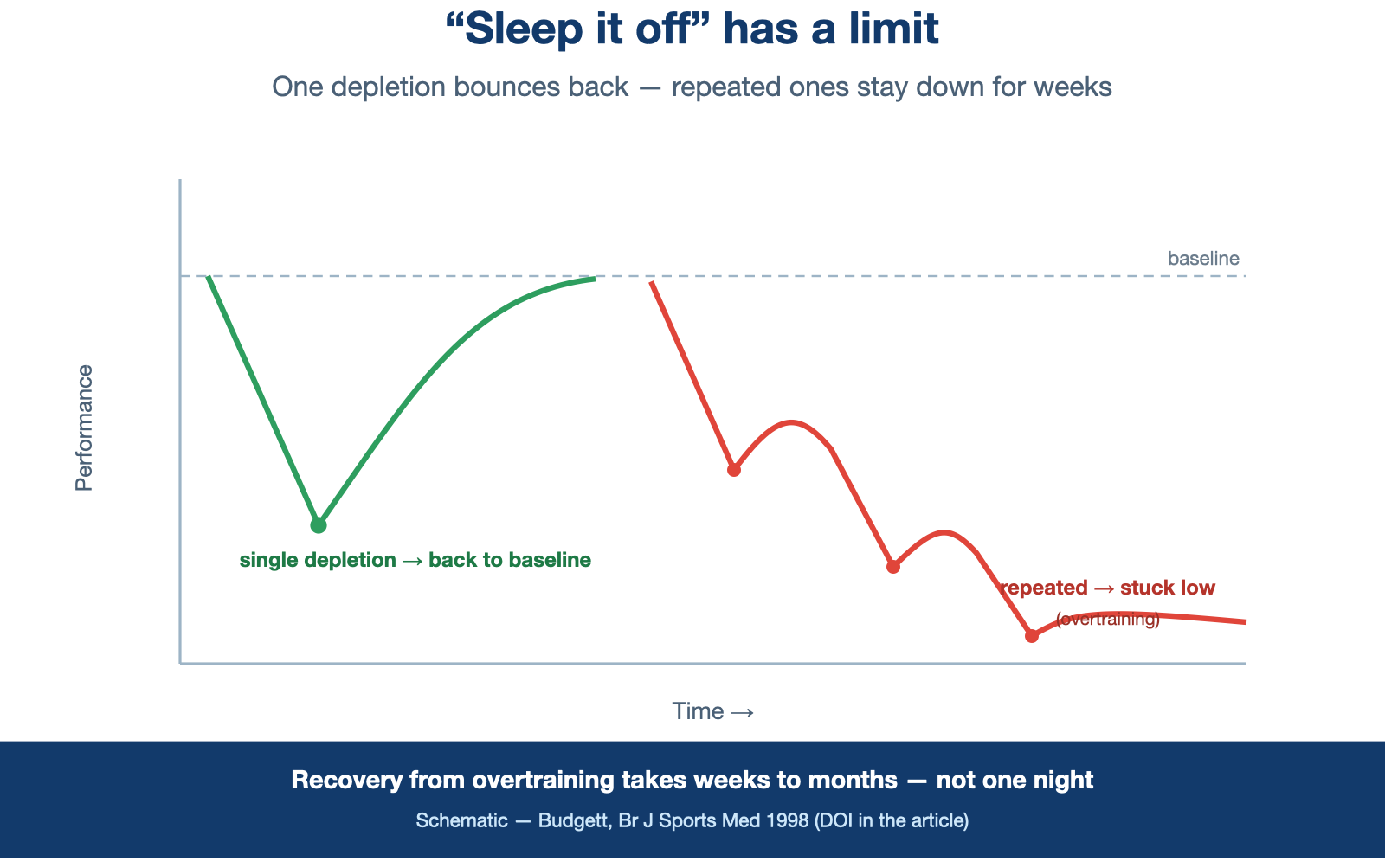
A single hard bout of depletion does come back fairly quickly with sugar, fluids, and rest. The problem is repeating the depletion before recovery catches up. Keep overusing and under-resting and you can land in a state of chronic fatigue and sustained underperformance — what sports medicine calls overtraining syndrome. And here’s the point: recovery from that state takes weeks to months, sometimes longer (Budgett, British Journal of Sports Medicine 1998). Not one night.
As an occupational doctor, this is almost continuous with workplace burnout. All-out back-to-back battles, next mission before you’ve rested — that work style stops people less with a one-punch KO than with this slow failure to recover. Because there’s no dramatic collapse, it’s easy to miss.
Takeaway ④: What’s really scary isn’t one moment of running out — it’s repeating it without recovery. Rest isn’t slacking; it’s resupply for the next move.
 Dr. Water
The scary part isn’t one moment of running out — it’s repeating it before you recover. Rest isn’t slacking; it’s resupply for the next move. 🐬
▶ Related check-up: Are heroes overworked? — the same slow failure to recover, but this time I put the hero life on the occupational-health scales.
The verdict: fantasy vs. real
| Belief | Verdict |
|---|---|
| Spend all your power and you “run out of gas” and can’t move | ◎ true (muscle-glycogen depletion drops force even with sugar left) |
| You faint on the spot from total exhaustion | ○ partly true (hypoglycemia really can cause fainting; causes vary) |
| Fighting on in the heat makes you collapse | ◎ true (exertional heat stroke + dehydration is an emergency) |
| Faint once, sleep, and you’re fully restored | ✕ fantasy (repeated under-recovery drags on for weeks or more) |
Wrap-up

Cursed energy isn’t real. But the machinery of “spend your power and collapse” is startlingly real. Muscle sugar runs out and force fails; brain sugar runs out and consciousness goes; heat and dehydration pile on. And what’s truly frightening is repeating it without letting yourself recover.

So today’s one line: rather than “empty the tank to the limit,” “refuel before you run dry, and actually recover.” Not flashy — but it’s the single finishing move for keeping up back-to-back battles in a real body.
Manga is a doorway into how strange the human body is. And the real body is far more interesting than you’d guess.
See you at the next check-up.
📚 Following the series? This was 〈The Doctor at Work #01〉. More anime, fact-checked by a doctor, is on the way. Get each new check-up in your inbox — subscribe free.
Dr. Water — physician in occupational and preventive medicine, and a die-hard anime/manga fan (a double insider).
Frequently Asked Questions
Do people really collapse or “run out of gas” from intense physical overexertion, like characters in Jujutsu Kaisen?
Yes, largely true — muscles store a sugar reserve called glycogen, and when key local stores within the muscle run out, it can lose the ability to produce force even with overall blood sugar and ATP still present, because it can’t properly release the calcium needed for contraction. A sudden inability to move after intense, prolonged effort closely matches how muscle fatigue actually works.
Is fainting from complete exhaustion actually caused by running out of energy, or is it something else?
It can genuinely be caused by running low on fuel, but the mechanism involves the brain, not the muscles. The brain runs almost entirely on glucose and can’t quickly switch fuel sources, so if blood sugar drops too far (hypoglycemia), consciousness can cloud or go out — a documented cause of fainting that looks just like an ordinary faint and is easy to miss. Skipping meals during long exertion is a real trigger.
What should you actually do if you or someone else shows warning signs of heat stroke or low blood sugar during intense activity?
Stop pushing through it — these are medical emergencies, not walls you cross with willpower. Warning signs include dizziness, a pounding headache, clouding consciousness, a sudden stop in sweating, or an abnormally hot body (heat stroke), or cold sweat, trembling hands, or seizures (hypoglycemia). If these appear, move to a cool place, cool the body, and call emergency services — exertional heat stroke can occur even without dehydration, so drinking water alone doesn’t guarantee safety.
Disclaimer 1 | Medical
This article is general, educational medical commentary sparked by a work of entertainment. It is not medical advice and not intended to diagnose or treat. Reading it creates no doctor–patient relationship. For any health decision, consult your own physician. The author is a doctor, but these views are general and personal, and the author is not your doctor. Do not imitate the acts depicted; the author is not responsible if you harm your health. In particular, if you have signs that suggest hypoglycemia or heat stroke (clouding consciousness, cold sweat, seizures, an abnormally hot body, a sudden stop in sweating, etc.), do not push on — stop activity promptly, get care, and call emergency services if needed.
Disclaimer 2 | Copyright & Non-Affiliation
This site is an independent, unofficial fan commentary/criticism work. It is not affiliated with, endorsed by, or sponsored by any anime/manga studio, publisher, author, or rights holder. All titles, characters, logos, and trademarks belong to their respective owners and are referenced here solely for identification, commentary, and criticism. This article reproduces a limited number of manga panels from Jujutsu Kaisen (Gege Akutami / Shueisha) as quotation for the purpose of criticism and commentary. Each panel is reproduced unaltered, attributed to its source, and used only to the extent necessary to support the surrounding analysis, which is the substance of this piece. No unauthorized scans or fan translations are used. Rights holders with concerns: please contact us and we will respond promptly.
🩺 Your check-up is over — but the clinic is always open
📚 This clinic has a sequel. 14 legendary monsters — vampire, zombie, werewolf and more — properly diagnosed by a real doctor. The book this blog grew into, with new write-ups added. → Get it on Amazon — $3.99 / free on Kindle Unlimited
💌 Free newsletter — new diagnoses delivered to your inbox, no appointment needed. → Subscribe on Substack
▶️ Prefer video? Watch the diagnoses on YouTube. → The Anime MD





Comments