〈The Doctor at Work #02〉 · a Dr. Water check-up
Hi. I’m Dr. Water 🐬. I’m a doctor — the kind who keeps working adults healthy (occupational and preventive medicine).
Watching hero stories, I always snag on the same spot: when do these people rest? Out on the streets, called the moment something happens, rushing in at any hour, back on the scene before the wounds have closed. It’s a dream job, no argument. But through the lens of workplace-health management, it’s a fairly worrying way to work.
So today, not to put any one series on trial but to ask “if a human actually worked this way, what would happen to body and mind,” I’ll check it against real occupational medicine. The short version up front: a hero, if the job existed for real, is a workplace an occupational physician would absolutely put on the inspection round.
📺 Want to read it the legit way? My Hero Academia is available on Shueisha’s official services.
The house rules
I’m not here to judge the series. I’m here to ask, “if a human body and mind did this, what would really happen?” — and back every medical claim with a paper. An occupational physician’s actual job is to “walk the floor” and find hazards. Today I’m walking one fictional workplace.
Q1 | “You get stronger the more you work.” — the body isn’t saying that.
In these stories, heroes fight in streaks. One incident isn’t wrapped before the next starts; there may be scenes of rest, but nothing that reads like managed working hours. In short: chronic long hours plus on-call standby, normalized. A workplace, if you translate it.
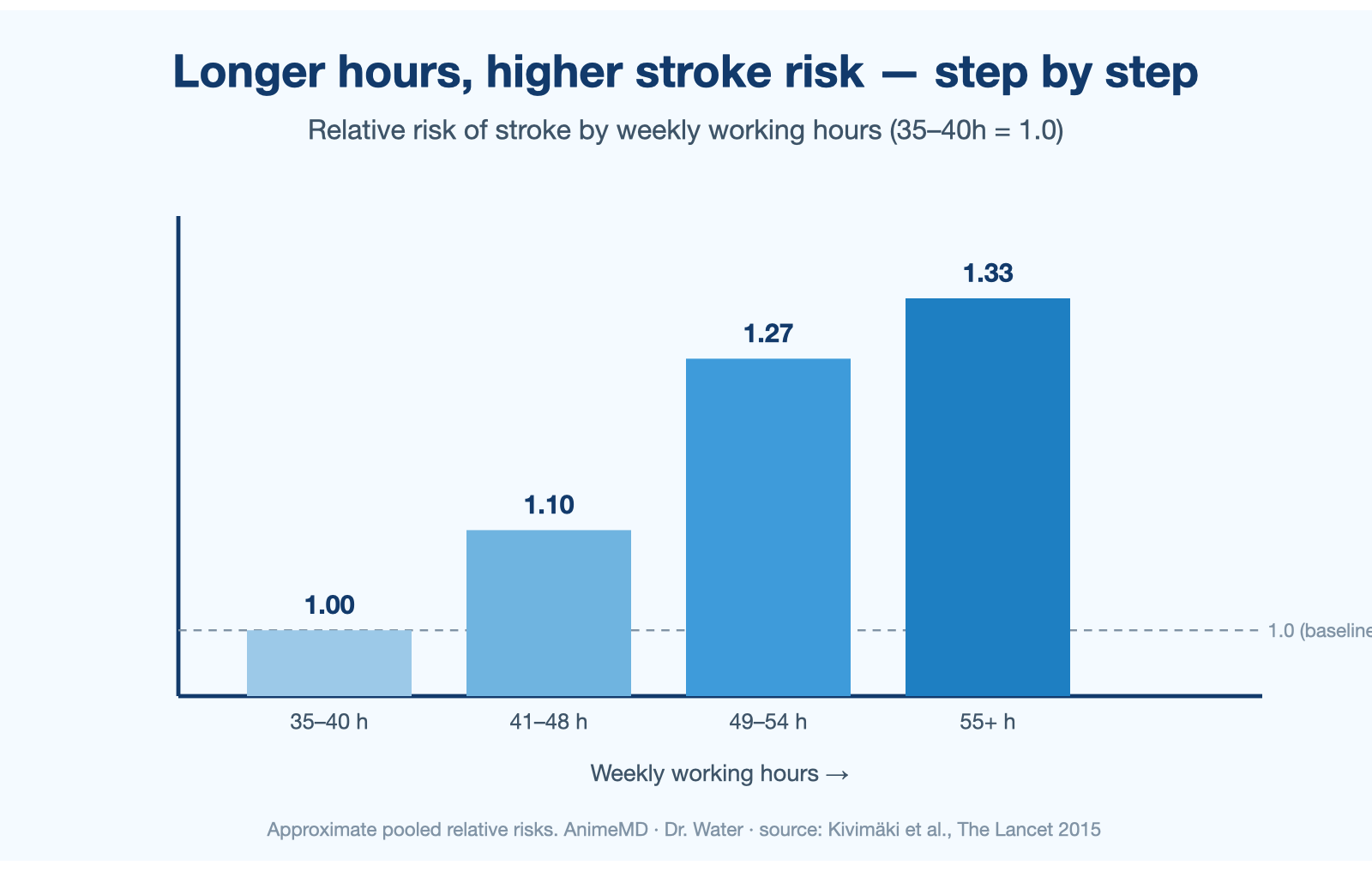
Put that into a real body and the first thing out is cardiovascular and cerebrovascular risk. Working 55 hours a week or more carries about 1.3× the risk of stroke compared with a standard 35–40-hour week, shown in a meta-analysis of over 600,000 people (Kivimäki et al., The Lancet 2015). The same work found ischemic heart disease risk up about 1.1×, and — importantly — the longer the hours, the higher the risk, step by step (a dose-response relationship).
So it isn’t “the more you work, the stronger you get.” It’s the more you work, the more debt piles up in your blood vessels — that’s the body’s side of the story.
Takeaway ①: “Longer work makes you stronger” is a weight-training line. Blood vessels do the opposite: as hours stretch, stroke and heart-disease risk stack up step by step. “A load you can push through on spirit” and “a load the body quietly banks” are different things. Today’s one move: pick one hard boundary — a single on-call-free evening, a real lunch away from the desk — and treat it as non-negotiable as any medical order. One protected edge is where the banking stops.
 Dr. Water
“Work more, get stronger” is a gym line — your blood vessels do the opposite. The longer the hours, the more debt they quietly bank. One protected evening is where the banking stops. 🐬
Q2 | “You collapse because you lack grit.” — no, the numbers point at the workplace.
This is the part I most want to say as an occupational physician. Long hours aren’t a story of gritless people falling over; looked at across a population, people are actually dying — it’s a public-health risk.
A joint estimate by the WHO and ILO (International Labour Organization) put it that in 2016, about 745,000 people worldwide died of stroke or ischemic heart disease attributable to long working hours (55+ hours/week) (Pega et al., Environment International 2021). And that figure is up about 29% versus 2000.
So long hours aren’t a “just be careful yourself” personal problem; they’re an occupational-health problem where the design of the workplace itself is on the line. If hero society had a labor-standards authority, the first thing to tackle wouldn’t be individual heroes’ willpower — it’d be rules for deployment and rest. Having strong individuals and having a safe workplace are two different things.
Takeaway ②: If you’re exhausted, it may not be your personality or your grit. Long hours are a public-health risk that accrues deaths at the population level, and the primary responsibility for fixing it sits with workplace design, not “your spirit.” Suspect the hours before you suspect your own weakness. Today’s one move: write down last week’s actual hours — the real number, door to door. Seeing it on paper is the first step that turns a private grind into something a workplace has to answer for.
▶ Related check-up: the same “run the tank dry and you don’t just get tired” logic drives “When cursed energy runs out” — burnout, in fiction’s clothes.
Q3 | ⚠️ “Strong people don’t break mentally.” — let me deny this one straight-faced.
It isn’t only the body. A hero’s work means repeatedly standing in high-stress scenes — disaster, accident, violence. The real-world parallel is emergency responders: ambulance crews, firefighters, rescue teams.
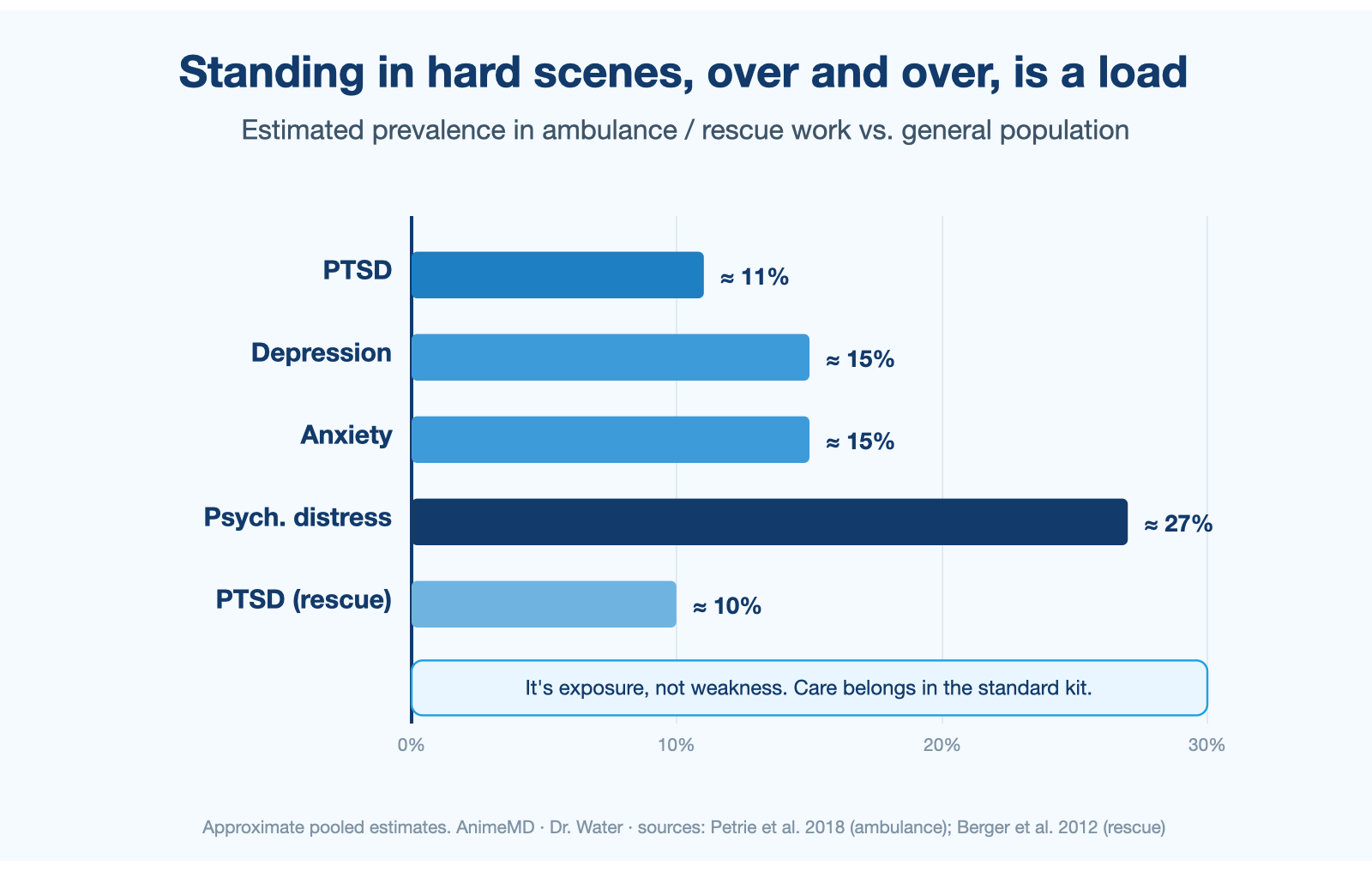
This isn’t a place for a joke, so I’ll write it head-on. In a systematic review of ambulance personnel, estimated prevalence was about 11% for PTSD, 15% for depression, 15% for anxiety, and 27% for general psychological distress — higher than the general population (Petrie et al., Soc Psychiatry Psychiatr Epidemiol 2018). A worldwide meta-regression of rescue workers likewise estimated current PTSD prevalence around 10%, with repeated exposure to traumatic events as a risk factor (Berger et al., Soc Psychiatry Psychiatr Epidemiol 2012). For firefighters, between-study variation is large, but the mental-health load of emergency-response work is observed consistently as a feature of the occupation.
Strong people tend to say “I’m fine.” But repeatedly standing in traumatic scenes is itself an independent health risk. That’s not weakness; it’s a matter of exposure dose. Which is exactly why real fire and ambulance services are building critical-incident-stress care (debriefing, counseling lines). If hero society had occupational-health machinery, post-scene mental care should be as standard as checking your gear — that’s my read.
Takeaway ③: Mental wear-down is a matter of “exposure,” not “weakness.” The more your job puts you in hard scenes over and over, the more that reaching a counseling line or a professional — rather than gutting it out — is necessary kit, like inspecting your equipment. If you’re in emergency-response work or anything near it, take this one personally.
 Dr. Water
Straight-faced: minds wear down from exposure, not weakness. Standing in hard scenes over and over is its own health risk. Reaching for support is kit, not defeat. 🙏
Q4 | “They’re young, so upside covers it.” — the statistics say the reverse.
One of the big draws of hero stories is young protagonists training while stepping onto the real battlefield. As a story, it’s rousing. Through occupational-health eyes, though, this is where I get most careful.
US official statistics show workers aged 15–24 have an emergency-department visit rate for work injuries about 1.2–2.3× that of workers aged 25–44 (Guerin et al. (CDC/NIOSH), MMWR 2020). The cited reasons: less experience, training, and hazard awareness — plus being in a position where it’s hard to speak up about safety concerns (the new person can’t say it).
This is not that young people are inferior. It’s that if you put young workers on the front line, the workplace bears a heavier duty to train, supervise, and protect them. Real labor law restricts hazardous work for minors and young workers for exactly this reason. That stories show training and mentors is, to an occupational physician, actually sound design. The one problem to avoid: don’t let enthusiasm paper over the gaps.
Takeaway ④: Youth is the flip side of inexperience, and young workers’ injury risk is statistically higher, not lower. Younger staff are also the ones who find it hardest to say “this is dangerous,” so thickening the protection is the workplace’s job. If you’re the new person, don’t hold back safety worries — that’s not whining, it’s correct safety behavior.
The verdict: fantasy vs. real (a workplace check)
| Belief | Verdict |
|---|---|
| Deploy nonstop and the body’s fine | ✕ fantasy (long hours raise cardio/cerebrovascular risk step by step) |
| Overwork is a matter of personal effort | ✕ fantasy (a real public-health risk at the population level) |
| Minds don’t wear out even on life-or-death scenes | ✕ fantasy (emergency responders show high rates of PTSD/depression) |
| Putting young staff up front needs protection | ◎ true (young workers carry higher injury risk; they need heavier supervision) |
Wrap-up
I won’t knock the dream of being a hero at all. Rushing to people in trouble is genuinely noble, in real life too. But the one thing I can say as an occupational physician is this: preparing strong individuals and preparing a safe workplace are two different jobs.
Long hours hit the vessels; repeated crucibles hit the mind; the young need more cover. None of that is unique to heroes — it holds, unchanged, in your workplace too. So today’s takeaway is one line: “don’t make people fill the gap with grit.” If what’s short is hands, or rest, or training, what fills it isn’t individual spirit — it’s the design of the workplace.
Dr. WaterThe one line I’d underline: don’t make people fill the gap with grit. If what’s short is hands, rest, or training — that’s the workplace’s job to fix, not your spirit. 🐬
Manga can be a doorway into thinking about how we work. And real workplaces have far more room to protect people than you’d guess.
See you at the next check-up.
📚 Following the series? This was 〈The Doctor at Work #02〉. More anime, fact-checked by a doctor, is on the way. Get each new check-up in your inbox — subscribe free.
Frequently Asked Questions
If heroes (or real workers) put in extremely long hours nonstop, does that make them stronger, or does it harm their health?
It harms health — long hours don’t build strength, they build cardiovascular risk. People working 55+ hours a week have about 1.3 times the stroke risk and roughly 1.1 times the ischemic heart disease risk of those working a standard 35-40 hour week, with risk rising step by step the longer the hours go, according to a meta-analysis of over 600,000 people.
Is collapsing from overwork mainly a matter of an individual lacking grit or willpower?
No — it’s a measurable public-health risk, not a personal failing. A joint WHO/ILO estimate found that in 2016, about 745,000 people worldwide died of stroke or ischemic heart disease attributable to long working hours (55+/week), up about 29% from 2000. This points to workplace design and scheduling as the responsible factor, not individual willpower.
What can someone actually do to protect themselves from the health effects of chronic overwork?
Set one concrete, protected boundary and take mental strain seriously, since both cardiovascular and psychological effects are real. A practical starting move is picking a non-negotiable boundary, like an on-call-free evening or a real lunch break, and writing down your actual weekly hours to see the true picture. For repeated exposure to high-stress situations, reaching out to a counseling line or professional support is necessary maintenance, not weakness — emergency responders show notably elevated rates of PTSD, depression, and anxiety from repeated exposure alone.
Disclaimer 1 | Medical
This article is general, educational medical commentary sparked by a work of entertainment. It is not medical advice and not intended to diagnose or treat. Reading it creates no doctor–patient relationship. For any health decision, consult your own physician. The author is a doctor, but these views are general and personal, and the author is not your doctor. If you suspect strain from long hours or heavy stress, don’t try to gut it out on willpower — talk to your workplace’s occupational physician / occupational-health staff, or a medical provider.
Disclaimer 2 | Copyright & Non-Affiliation
This site is an independent, unofficial fan commentary/criticism work. It is not affiliated with, endorsed by, or sponsored by any anime/manga studio, publisher, author, or rights holder. All titles, characters, logos, and trademarks belong to their respective owners and are referenced here solely for identification, commentary, and criticism. This site does not reproduce copyrighted works (panels, screenshots, or text) without authorization; this article uses no manga panels. Rights holders with concerns: please contact us and we will respond promptly.
References
- Kivimäki M, et al. Long working hours and risk of coronary heart disease and stroke: a systematic review and meta-analysis of published and unpublished data for 603,838 individuals. The Lancet. 2015;386(10005):1739–1746. doi:10.1016/S0140-6736(15)60295-1
- Pega F, et al. Global, regional, and national burdens of ischemic heart disease and stroke attributable to exposure to long working hours for 194 countries, 2000–2016 (WHO/ILO Joint Estimates). Environment International. 2021;154:106595. doi:10.1016/j.envint.2021.106595
- Petrie K, et al. Prevalence of PTSD and common mental disorders amongst ambulance personnel: a systematic review and meta-analysis. Social Psychiatry and Psychiatric Epidemiology. 2018;53(9):897–909. doi:10.1007/s00127-018-1539-5
- Berger W, et al. Rescuers at risk: a systematic review and meta-regression analysis of the worldwide current prevalence and correlates of PTSD in rescue workers. Social Psychiatry and Psychiatric Epidemiology. 2012;47(6):1001–1011. doi:10.1007/s00127-011-0408-2
- Guerin RJ, et al. Nonfatal Occupational Injuries to Younger Workers — United States, 2012–2018. MMWR Morbidity and Mortality Weekly Report. 2020;69(35):1204–1209. doi:10.15585/mmwr.mm6935a3
🩺 Your check-up is over — but the clinic is always open
📚 This clinic has a sequel. 14 legendary monsters — vampire, zombie, werewolf and more — properly diagnosed by a real doctor. The book this blog grew into, with new write-ups added. → Get it on Amazon — $3.99 / free on Kindle Unlimited
💌 Free newsletter — new diagnoses delivered to your inbox, no appointment needed. → Subscribe on Substack
▶️ Prefer video? Watch the diagnoses on YouTube. → The Anime MD



Comments