A Dr. Water check-up
Hi. I’m Dr. Water 🐬. I’m a doctor — the kind who keeps working adults healthy (occupational and preventive medicine), and, off the clock, a lifelong manga reader.
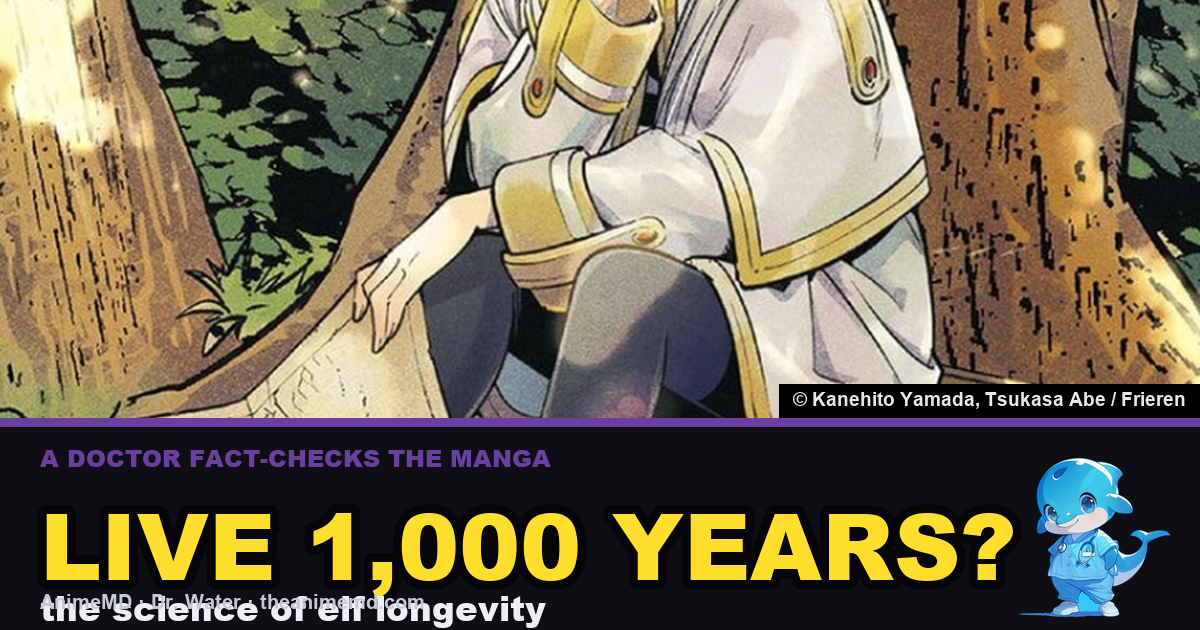
The wish to never grow old is probably one of the oldest human wishes there is. And lately there’s a story that keeps pressing on it, very quietly: an elf mage who outlives her human companions by lifetimes, walking through the “after” once the friends who ran their short, bright lives are gone. Again and again, the series shows how the sense of time in someone who lives for centuries simply doesn’t line up with a human one.
Readers ask me all the time: “If you could live that long, does your body just stay young?” I get it. If I had a body that kept moving for centuries, I wouldn’t have to sweat my own check-up results either.
So today, not as a review of the series but as a story about your body, I’ll check the math against real aging biology. The short version up front: “young forever” is fantasy — but “how you feel time changes how you live” is startlingly true.
📺 Want to read it the legit way? Frieren: Beyond Journey’s End is a Shogakukan title.
The house rules
I’m not here to judge the series. I’m here to ask, “if a human body lived for centuries, what would actually happen?” — and back every medical claim with a paper. And because today’s theme (anti-aging, life extension) is a genuinely sensitive one (YMYL), I’ll be even more careful than usual: no absolute promises, no product recommendations.
Q1 | “Aging runs on one clock, right — stop it and you stop aging?” — turns out there isn’t one clock.

The elves in the series keep living, nearly unchanged in looks and ability, long after humans have aged and passed. Their “aging clock” seems to run extremely slow — or to have nearly stopped. So what is that clock actually made of, in real life?
Straight answer: there is no single master clock for aging.
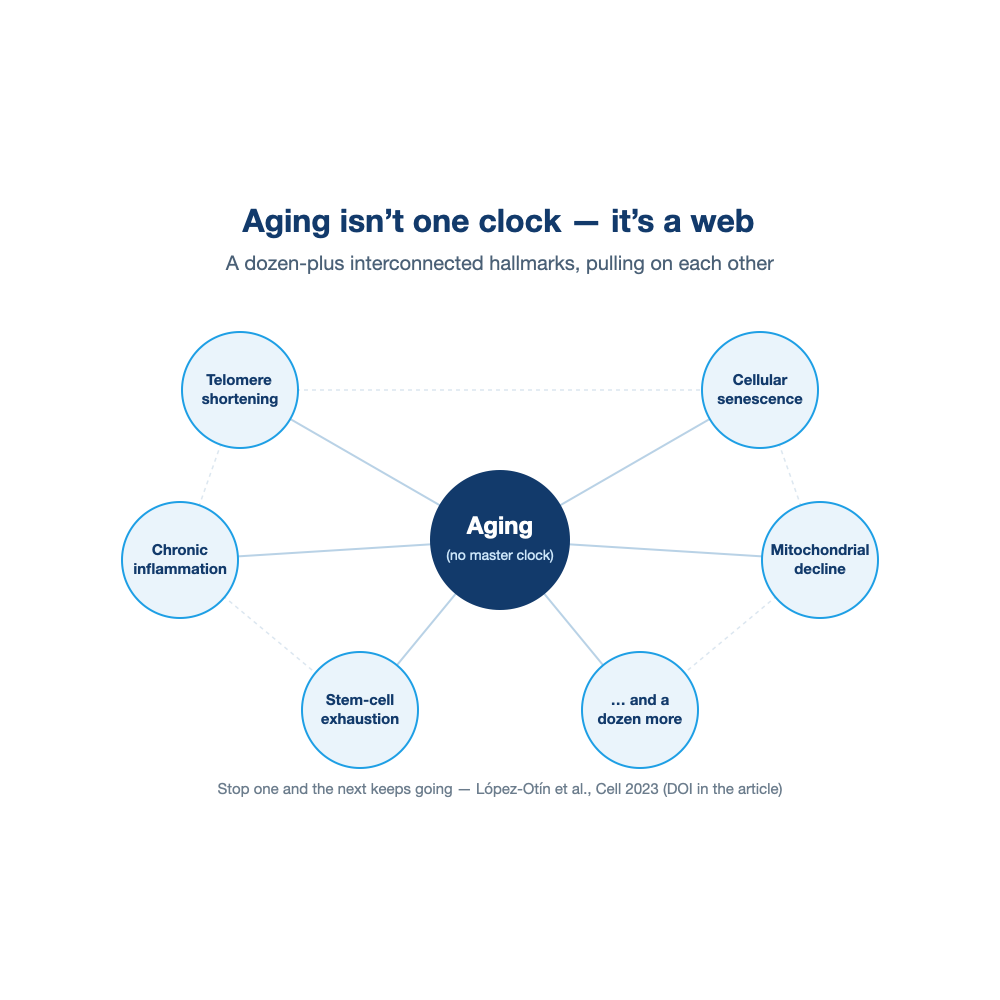
In current aging biology, aging is understood not as one cause but as the accumulation of multiple biological features (hallmarks). A major 2023 review laid out a dozen-plus interconnected hallmarks — telomere shortening, cellular senescence, chronic inflammation, mitochondrial decline, and more (López-Otín et al., Cell 2023). And they don’t sit in separate lanes; they pull on each other. Stop one, and the one next to it keeps going.
So “loosen a single screw and aging halts” doesn’t hold up well in a real body — that’s the takeaway of a review in which the hallmarks accumulate in a linked web (López-Otín et al., Cell 2023). An elf, with all of it paused at once, is — physiologically — quite the feat.
Takeaway: Aging isn’t one thing that breaks; it’s many small changes stacking up. Which is exactly why you can be skeptical of the idea that one spell (or one supplement) rewinds the whole thing.
 Dr. Water
Fun fact from the clinic: there’s no single “aging switch.” So no, you can’t flip one and stay young — sorry, Frieren. ⏳
Q2 | “Just protect your telomeres and you’re immortal” — nope, not by themselves.

Talk longevity and telomeres always come up: the protective caps on the ends of your chromosomes that shorten a little with every cell division. Maybe you’ve pictured the elves as “a species whose telomeres don’t shrink.”
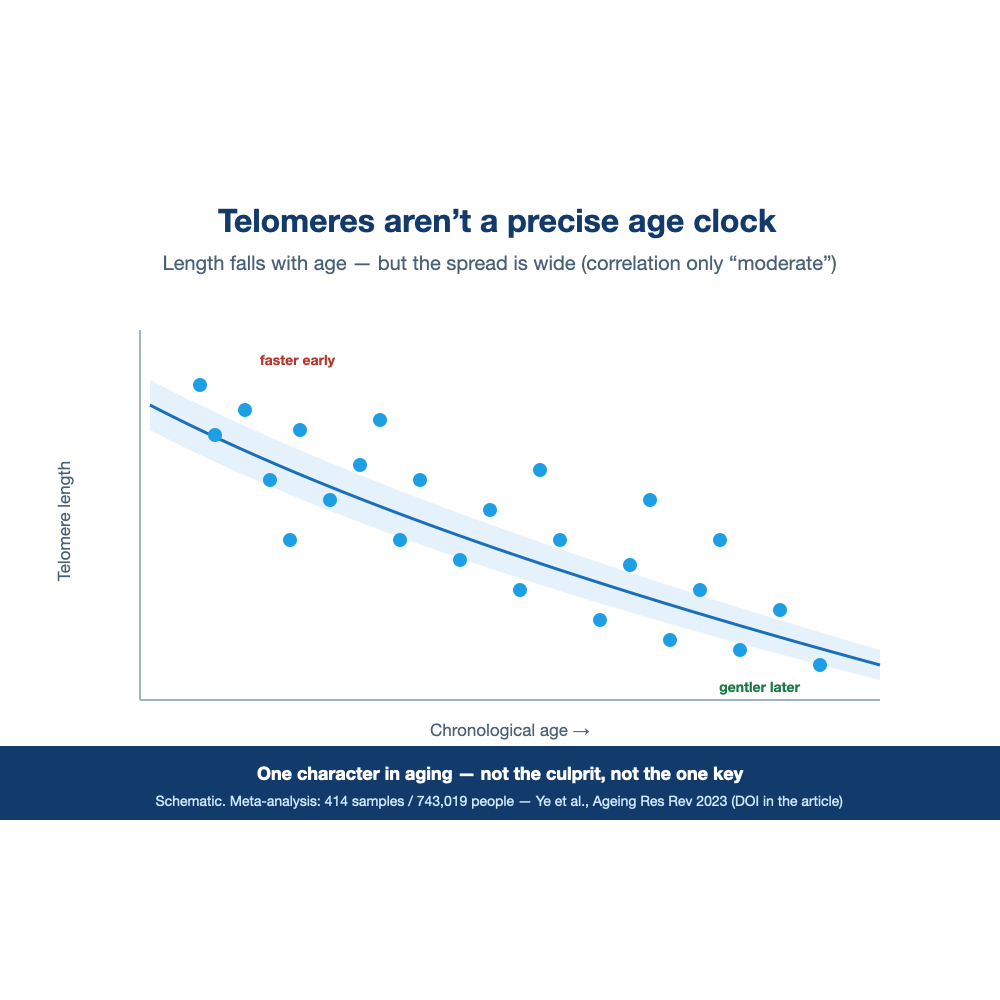
Careful here. Telomeres do relate to aging, but they are not a complete ruler for age (Ye et al., Ageing Research Reviews 2023).
A systematic review / meta-analysis pooling 414 study samples across more than 743,000 people found the correlation between telomere length and chronological age was only moderate (Ye et al., Ageing Research Reviews 2023). And the pace of shortening isn’t constant — it tends to be faster early in life and gentler at older ages (same).
So “read the telomeres and you’ll know someone’s exact age, or how long they have left” is nowhere near that simple. Telomeres are one character in a multi-layered story of aging — not the culprit, and not the one key (which follows from that moderate correlation: Ye et al., 2023).
— And by the way, plenty of products cheerfully promise “lengthen your telomeres, turn back time.” Look at how weak the correlation above is, and you’ll want to take a breath before reaching for that. I’m not recommending any of them here.
Takeaway: Telomeres are one important marker. But “protect these and you’ll never age” isn’t it. You can keep your distance from any story about buying youth back with a single number.
Q3 | ⚠️ “Living long = staying healthy.” Not the same thing. Straight-faced here.
The thing longevity stories most often skip is that “living long” and “staying healthy” are not the same. I’ll write this part plainly.
With age, a chronic, low-grade inflammation called “inflammaging” creeps forward inside the body. This quiet smolder is described as a shared foundation under many age-related problems — cardiovascular disease, frailty, cognitive decline (Ferrucci & Fabbri, Nature Reviews Cardiology 2018).
So even if you could force lifespan longer, leave that inflammatory foundation untouched and what you extend isn’t “healthy time” — it’s “time dragged out while unwell.” What longevity research is really chasing isn’t lifespan; it’s healthspan — the years you can still stand on your own two feet.
Which is exactly why I’ll add the safety line: there is currently no proven shortcut in any treatment, supplement, or procedure that claims to “reverse aging” or “extend lifespan.” The more absolute the promised effect, the more caution it deserves. Decide with your own physician. This part, I say without smiling.
Takeaway: The goal is not length but healthy length. Rather than flashy rejuvenation, the plain habits that don’t stoke inflammation — sleep, exercise, not smoking, a healthy weight — are, for now, your surer allies. In fact, a large cohort showed that people with more of these healthy-lifestyle factors spent more years free of cancer, cardiovascular disease, and diabetes (Li et al., BMJ 2020).
Dr. WaterLiving long and living well aren’t the same subscription. Nobody’s selling the “extend lifespan” pill yet — I checked. 🧾
Q4 | “With enough effort, could humans live for centuries too?” — there’s a wall in view.

So could medicine push a human toward an elf? Extend life without a ceiling?
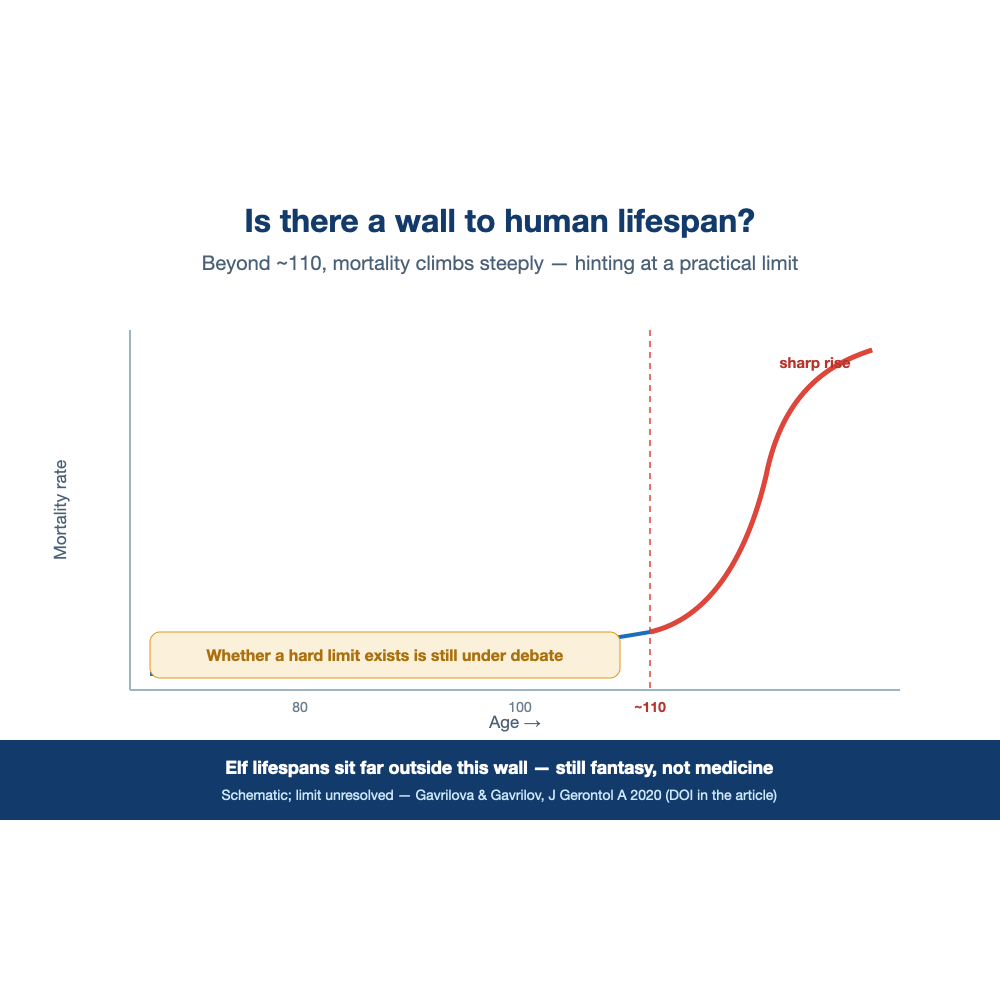
There’s some stubborn data suggesting “there may be a limit.” Studies of the very oldest people report that beyond about 110, mortality climbs even further, and the growth of longevity records themselves has slowed — which hints that human lifespan may have a practical limit (Gavrilova & Gavrilov, The Journals of Gerontology: Series A 2020).
That said — whether a limit exists is not scientifically settled. There’s data and interpretation on the “no hard limit” side too, and the debate continues among researchers. So I won’t declare it either. The honest read: “for now, there’s something like a wall visible in a certain range, and it hasn’t been easily crossed.”
The elves’ lifespans sit far outside that visible wall — still the territory of fantasy, not medicine. But “how healthily and how long you walk the stretch before the wall” is a grounded challenge real medicine takes seriously.
Takeaway: The upper limit of lifespan is unresolved. But “using well the years short of the ceiling” beats “breaking through the ceiling” — it’s more realistic, and probably far richer.
Q5 | “Live for centuries, and how does the mind change?” — here even the science gets a little tender.

I’ve been talking about the body, but what this series presses on most quietly may be the time of the mind. Someone with a long lifespan, chewing over — again and again, afterward — the time spent with short-lived friends. A lot of readers got caught right there.
There’s an interesting psychology theory here. Socioemotional selectivity theory holds that the more you perceive your remaining time as limited, the more you prioritize emotionally meaningful relationships over “new learning and expanding your network” (Carstensen, The Gerontologist 2021).
The key point: what sets those priorities is not chronological age itself, but how you perceive time (same). Which is to say — someone who feels time is infinite tends to let each individual connection in front of them thin out. On paper, that overlaps neatly with the ache of the story: a long-lived being coming to take time with companions too lightly.
Flip it around, and the “finiteness of time” we humans carry isn’t only something we lose. It can be read as the very engine that makes us treasure the people we love. It’s probably no accident that stories about long life keep arriving, somehow, at an affirmation of the finite one.
Takeaway: The feeling that “time is limited” isn’t just a painful constraint — it’s also an engine for cherishing the person in front of you. Before you envy length, deepen this one round. That’s a technique you can use starting today.
Dr. WaterHere’s the twist I love: feeling that time is short is exactly what makes it precious. So maybe don’t envy the elf. 🌙
The verdict: fantasy vs. real
| Belief | Verdict |
|---|---|
| Aging runs on one cause; stop it and you’re ageless | ✕ fantasy (aging is a bundle of hallmarks — López-Otín 2023) |
| Protect your telomeres and you keep your youth | ✕ fantasy (correlation only weak (about r = -0.19), not a full age ruler — Ye 2023) |
| Live long and you’ll automatically stay healthy | ✕ fantasy (inflammaging underlies age-related disease — Ferrucci 2018) |
| Human lifespan can be extended without limit | △ unresolved (a possible wall at the extremes; under debate — Gavrilova 2020) |
| “How you sense time” changes how your mind works | ◎ true (socioemotional selectivity theory — Carstensen 2021) |
Wrap-up
“Young forever, for centuries,” like an elf, is still fantasy for a real body. Aging is a bundle of changes; one telomere won’t buy youth back; even the ceiling of lifespan isn’t settled.
But what this series is really talking about probably isn’t the length of a life. It’s how you feel finite time, and who you spend it with. And there — surprisingly — sits a solid core of science.
Not “live long,” but “live well, and live full.” Rather than hunting a shortcut to youth, the plain habits that don’t stoke inflammation, and time spent treasuring the people in front of you, are — for now — your surer allies (Li et al., 2020).
Manga is a doorway into how strange the body — and a life — can be. And the real body, and real time, are far more interesting than you’d guess.
See you at the next check-up.
📚 This was a Dr. Water check-up. More anime, fact-checked by a doctor, is on the way. Get each new check-up in your inbox — subscribe free.
Dr. Water — a physician in occupational and preventive medicine, and a die-hard anime/manga fan (a double insider).
If the question of living far past a human lifespan pulls at you, there’s a related patient in my book Monster Clinic: Chapter 11, “The Seeker of Immortality — can young blood make you young again?” It’s one of fourteen workups where I look at the real medicine hiding inside a legend. (Kindle, $3.99, free to read on Kindle Unlimited.)
Frequently Asked Questions
If you lived for centuries like an elf, would your body just stay young forever?
No — “young forever” is fantasy for a real body. Aging isn’t caused by one single mechanism you could switch off; current research describes it as the buildup of more than a dozen interconnected biological changes — including telomere shortening, cellular senescence, chronic inflammation, and mitochondrial decline — that all pull on each other. Stopping just one of these processes wouldn’t stop the others, so pausing aging entirely has no real biological counterpart.
If telomeres shorten as we age, wouldn’t protecting them keep you young?
Not by themselves — telomere length is related to aging but is only a loose predictor of it. A large analysis pooling data from over 743,000 people found just a moderate correlation between telomere length and a person’s actual age, and the rate of shortening isn’t even constant throughout life. Claims promising to “lengthen your telomeres and turn back time” are overselling what a single marker can do.
If living longer isn’t automatically the same as living healthier, what should you actually focus on?
Focus on healthy years, not just more years — living long and staying healthy are not the same thing. Chronic low-grade inflammation (“inflammaging”) builds with age and underlies many age-related problems, so extending lifespan alone just stretches out unhealthy time. There is currently no proven treatment, supplement, or procedure that reverses aging; the more realistic approach is the plain stuff — enough sleep, exercise, not smoking, a healthy weight — linked to more years free of major disease.
Disclaimer 1 | Medical
This article is general, educational medical commentary sparked by a work of entertainment. It is not medical advice and not intended to diagnose or treat. Reading it creates no doctor–patient relationship. For any health decision, consult your own physician. The author is a doctor, but these views are general and personal, and the author is not your doctor. In particular, there is currently no proven shortcut among treatments, supplements, or procedures that claim to reverse aging, extend lifespan, or prevent aging. This article recommends no specific product and endorses no claim of guaranteed effect. Discuss any such choice with your own physician first.
Disclaimer 2 | Copyright & Non-Affiliation
This site is an independent, unofficial fan commentary/criticism work. It is not affiliated with, endorsed by, or sponsored by any anime/manga studio, publisher, author, or rights holder. All titles, characters, logos, and trademarks belong to their respective owners and are referenced here solely for identification, commentary, and criticism. Manga panels are used under the fair use doctrine (17 U.S.C. §107) for criticism and commentary only, in the minimum necessary amount, each with its source cited and each because the depicted scene is itself the subject of medical analysis. Rights holders with concerns: please contact us and we will respond promptly and, if appropriate, remove the material.
🩺 Your check-up is over — but the clinic is always open
📚 This clinic has a sequel. 14 legendary monsters — vampire, zombie, werewolf and more — properly diagnosed by a real doctor. The book this blog grew into, with new write-ups added. → Get it on Amazon — $3.99 / free on Kindle Unlimited
💌 Free newsletter — new diagnoses delivered to your inbox, no appointment needed. → Subscribe on Substack
▶️ Prefer video? Watch the diagnoses on YouTube. → The Anime MD





Comments