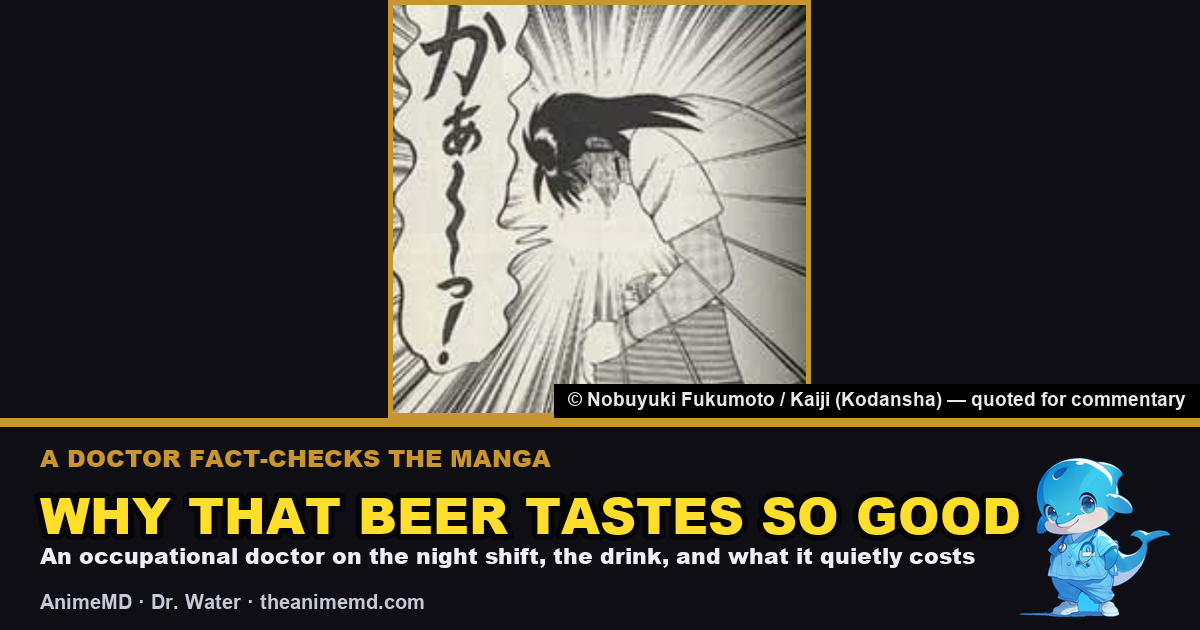
A man who has been worked half to death underground buys one can of beer with almost the last of his pay, drinks it, and screams. Readers remember it as the best-looking beer in manga. An occupational physician explains why that beer really does taste better — and why the same physiology is quietly taking something from you.
Hi. I’m Dr. Water 🐬 — a doctor, the kind who keeps working adults healthy (occupational and preventive medicine).
There is a drink in Kaiji that people do not forget. Our hero has been dropped into an underground forced-labour facility. He works, he sweats, and out of the small pay he is allowed he buys a single beer. He grips the can. He drinks. And he howls.
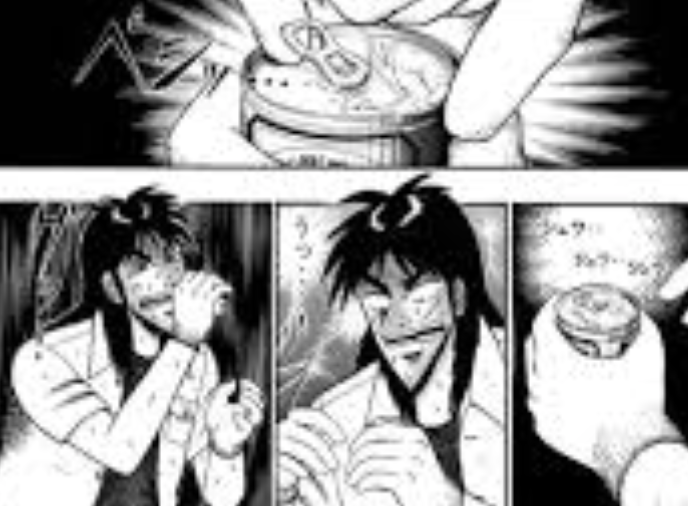
Readers file that away as the most delicious-looking beer they have ever seen on a page. I don’t think that’s only because the art is good.
That taste has a medical explanation. And the interesting part is what comes after it: the reason that beer tastes so good and the reason a night shift is quietly costing your body turn out to be the same reason.
There’s a second thing. Kaiji, every single time, gets cornered and then makes a terrible decision. Readers wince and think this guy has no nerve. But — is “mental toughness” really a fact about a person’s character? There’s some genuinely good research there too.
Let me say up front: this is not an article where I hand you the medically correct answer. A lot about the human body and mind is still unsettled. I’d like you to enjoy the not-knowing as part of the meal.
The rules of this article
I don’t grade the story. I look at one question — if this happened to a human body, how would medicine explain it? — using real evidence, with links. Where the science hasn’t settled, I say so plainly.
And this is not an article telling you to quit drinking. I’ll give the pleasure its due, then lay out fairly what the drink is doing to you. The judgement is yours.
Q1 | Why is the beer after a night shift that good?
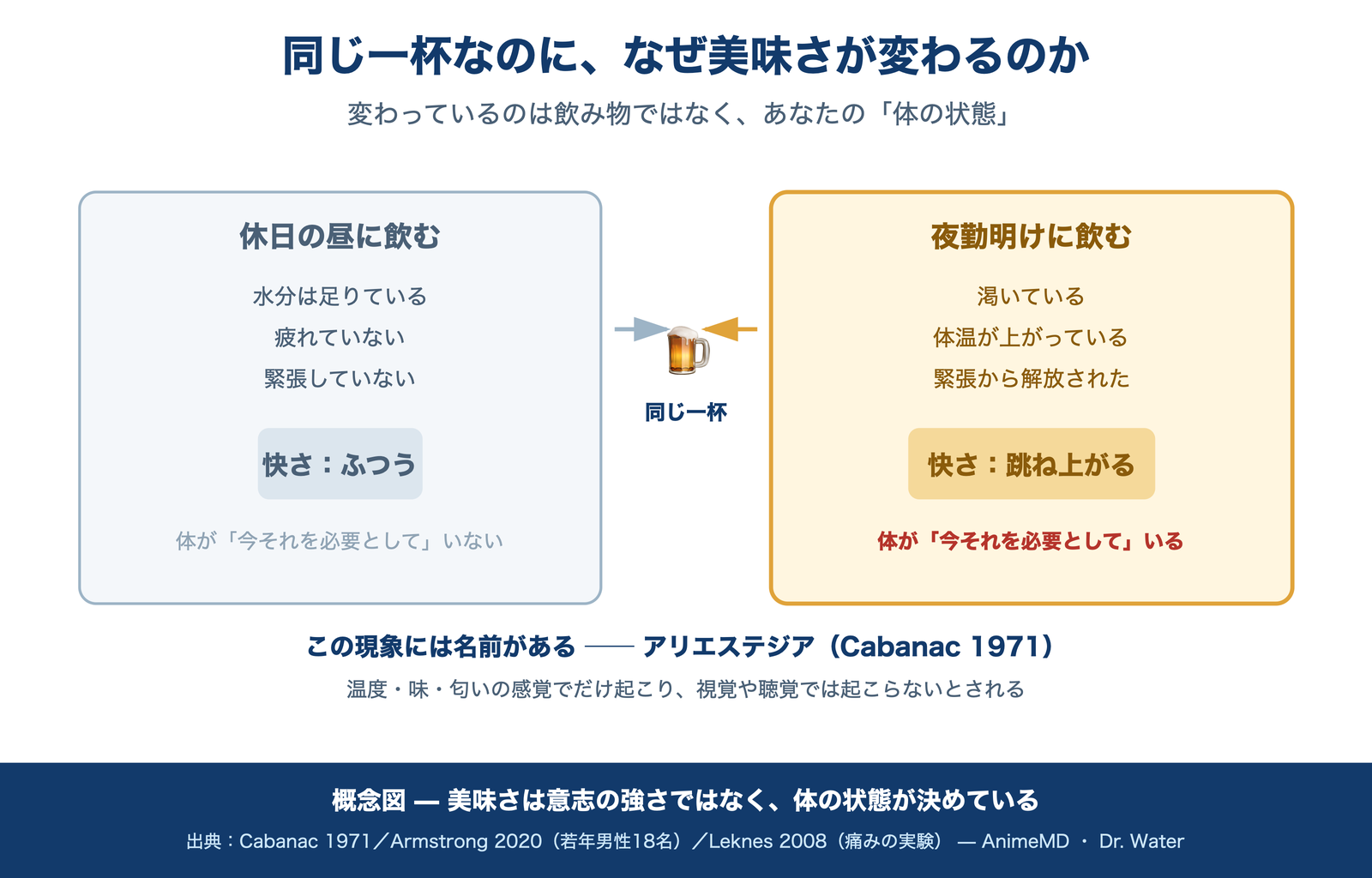
Start with the good news: it is not entirely in your head. Same brand, same can — it really can be more pleasant after a shift, and the reason is in your body, not your willpower.
The tempting explanation is “I earned it.” That one is surprisingly hard to support. In adult experiments, people did not prefer the thing they met under higher mental effort; effort was treated as a cost, not as something that inflated the reward’s value. So much for humans being noble.
The state of your body rewrites the pleasure itself
The same stimulus can feel good or unpleasant depending on the internal state of the body. Physiology has a name for this: alliesthesia. The word is a mouthful; the phenomenon is something everyone knows. Cold water on a hot day is sublime. Cake when you’re already full is not.
What I find lovely is where it applies. The physiologist Michel Cabanac, who described it, argued that it shows up in temperature, taste and smell — but not in sight or hearing. The pleasure meter seems to be attached to the things that actually enter and leave the body.
The thirstier you are, the more pleasant drinking becomes
Somebody tested this with drinks. Young men were put on 24 hours of fluid restriction, and the rated pleasantness of drinking began to climb at around the four-hour mark and kept rising as they got thirstier (18 young men — a small study).
And people do dry out at work. In a study of UK hospital staff, 36% were already dehydrated at the start of the shift and 45% by the end (this covers shifts including on-call generally, not a night-shift-versus-day-shift comparison).
The release of “it’s over” is probably doing work too
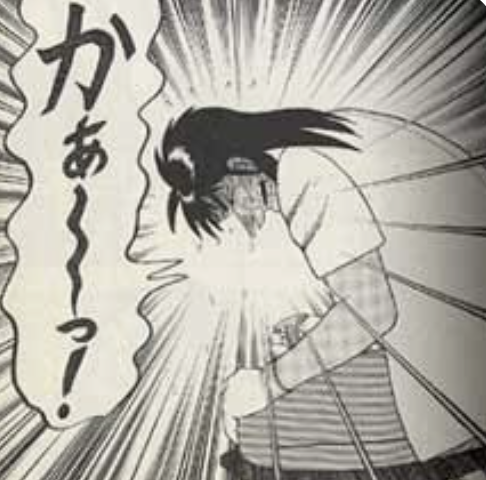
Read this next one as half-romance. In human experiments using pain, the stronger the pain immediately beforehand, the greater the pleasure of being released from it. What was studied was physical pain, so I can’t hand that straight over to “relief from work stress.” But — that climb out of the underground, and that beer. You want to read them together, don’t you.
Takeaway 1: The beer after a night shift tastes good because your body is dehydrated, overheated and coming down off tension — it is genuinely built to find that drink more pleasant. That’s physiology, not weak character. Enjoy it without the guilt tax.
Q2 | Is “mentally strong or weak” a personality you’re born with?
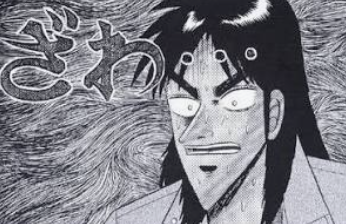
Kaiji misjudges at the decisive moment. You want to shout at the page. But line up the conditions he’s actually under: sleep deprivation. Extreme fatigue. Time pressure. No exit. And one all-or-nothing bet with his life on it. How many people keep a level head through that combination?
This field does not say “stress equals worse decisions” in a straight line. Reviews conclude that whether stress helps or hurts depends on the situation. A more recent systematic review starts to separate it out: stress shows up more in decisions under uncertain, gamble-like conditions, and less in decisions modelled on realistic everyday scenarios.
Which means the kind of thing Kaiji is thrown into — a life-or-death gamble — is precisely the category of decision where stress bites hardest. You can read his “weakness” as something the stage set arranged for him.
One more, and this one should cheer you up. Pool the studies that follow people after severe events and the most common trajectory is the one where the person does not come apart — roughly two thirds (that’s the proportion within groups who experienced traumatic events, not a statement about ordinary workplace stress). The picture of resilience as a rare gift held by special people is the part that doesn’t match the data.
Takeaway 2: If you’ve decided you’re “mentally weak,” the least science can tell you is that the same person decides and reacts differently depending on the situation they’re placed in. Whether you are weak, or the conditions are brutal, are two separate questions. You’re allowed to separate them.
Q3 | What happens to judgement when you gamble on no sleep?
“You get reckless after an all-nighter” sounds exactly right. And there is a report of riskier choices after two full days without sleep.
But chase that claim and it gets slippery. The direction flips between gain and loss framings, flips between men and women, and two nights of about four hours didn’t move it at all. Human judgement does not tip neatly one way. Honestly: unsettled.
But this part is genuinely chilling
One thing is solid. When you’re short on sleep, you cannot tell that your own performance has dropped. In studies where sleep is restricted day after day, performance keeps sliding while the person’s sense of sleepiness barely increases — the objective line and the subjective line come apart and stay apart.
And in experiments using a stimulant, alertness and reaction speed came back while the quality of “which option do I choose” did not. Being awake and being able to choose well are, it turns out, different things.
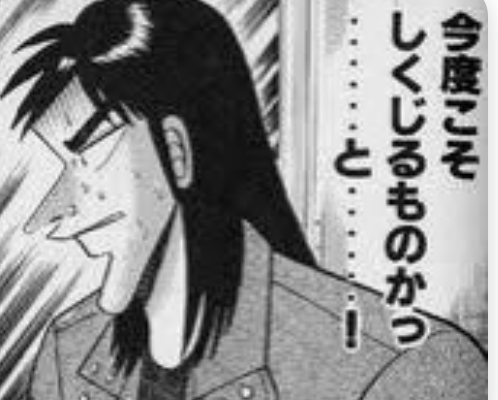
That is Kaiji exactly. He is not being bold — he is playing his last card without noticing that he can no longer judge properly. And you, at the end of a night shift, thinking “nah, I’m fine” — you’re sitting in the same chair.
Takeaway 3: Don’t make heavy decisions coming off a night shift. Contracts, big purchases, arguments, and driving. The feeling of “I can still handle this” is at its least trustworthy precisely then. Push the decision to after you’ve slept.
Q4 | ⚠️ So what is that ice-cold beer actually doing to you?
Straight face for this part — though I’m not here to frighten anyone.
“It reduces deep sleep” is half a bad rap
You’ve heard that a nightcap cuts deep sleep. Read the research and the first half of the night is the opposite: alcohol shortens the time to fall asleep and, in most studies, deep sleep in the first half actually increases. The problem is the back half — from there you wake more easily.
So “I slept well” is not an illusion. You really did drop like a stone. It’s just quietly collected back from you later in the night.
Coming off a night shift, the deck is already stacked
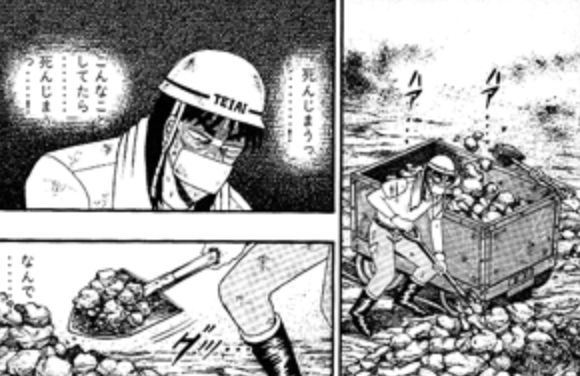
Sleeping after a night shift means sleeping at the hour your body clock is shouting get up. That alone makes it fragile. There’s a diagnosis for the sleep problems that come with rotating shifts — shift work disorder — and roughly 1 in 10 shift workers (reports range about 5–10%) meet the criteria (that’s within night and rotating shift workers, not the whole workforce). Put alcohol on top and the already-fragile second half gets another wave through it.
To be honest with you: I could not find a study on drinking specifically after a night shift. So this section is me adding “post-night-shift sleep is fragile” to “alcohol disturbs the second half” and drawing an inference. I’m not stating it as established.
Takeaway 4: I’m not telling you to stop. Four mild suggestions:
- Drink after you’re home. Coming off nights, sleepiness alone raises crash risk. Add alcohol and it needs no comment. Make it “a drink at home,” not “a drink on the way.”
- Not right before sleep. The easy sleep onset is real; the bill arrives in the second half.
- Check whether it has become “drinking in order to sleep.” A drink for pleasure and a drink as a sleeping pill are heading to different places.
- Water first. Your body is dry after a shift. Since thirst is inflating the pleasure, water first is simply rational.
🔴 One thing, for safety
First the plain version: a nightly drink to fall asleep is a habit worth reducing if you can. It erodes the second half of your sleep, and tolerance and dependence build with repetition. Cutting down is entirely the right direction.
With one caution about how. If a nightly drink has become a fixed habit, stopping abruptly can cause withdrawal — including severe insomnia and feeling physically unwell. So not “zero from tomorrow”: taper over weeks, or work with a clinician. This isn’t about willpower; it’s about physical safety.
Where to get help: in the United States, SAMHSA’s National Helpline is free, confidential and available 24/7 (1-800-662-4357). In the United Kingdom, the NHS “Alcohol support” pages list national services. Wherever you are, your own doctor is a reasonable first door. You’re allowed to ask at the stage where you think it isn’t bad enough to ask. That’s my honest position as an occupational physician.
Wrap-up | It isn’t that Kaiji is weak. But it isn’t only that, either.
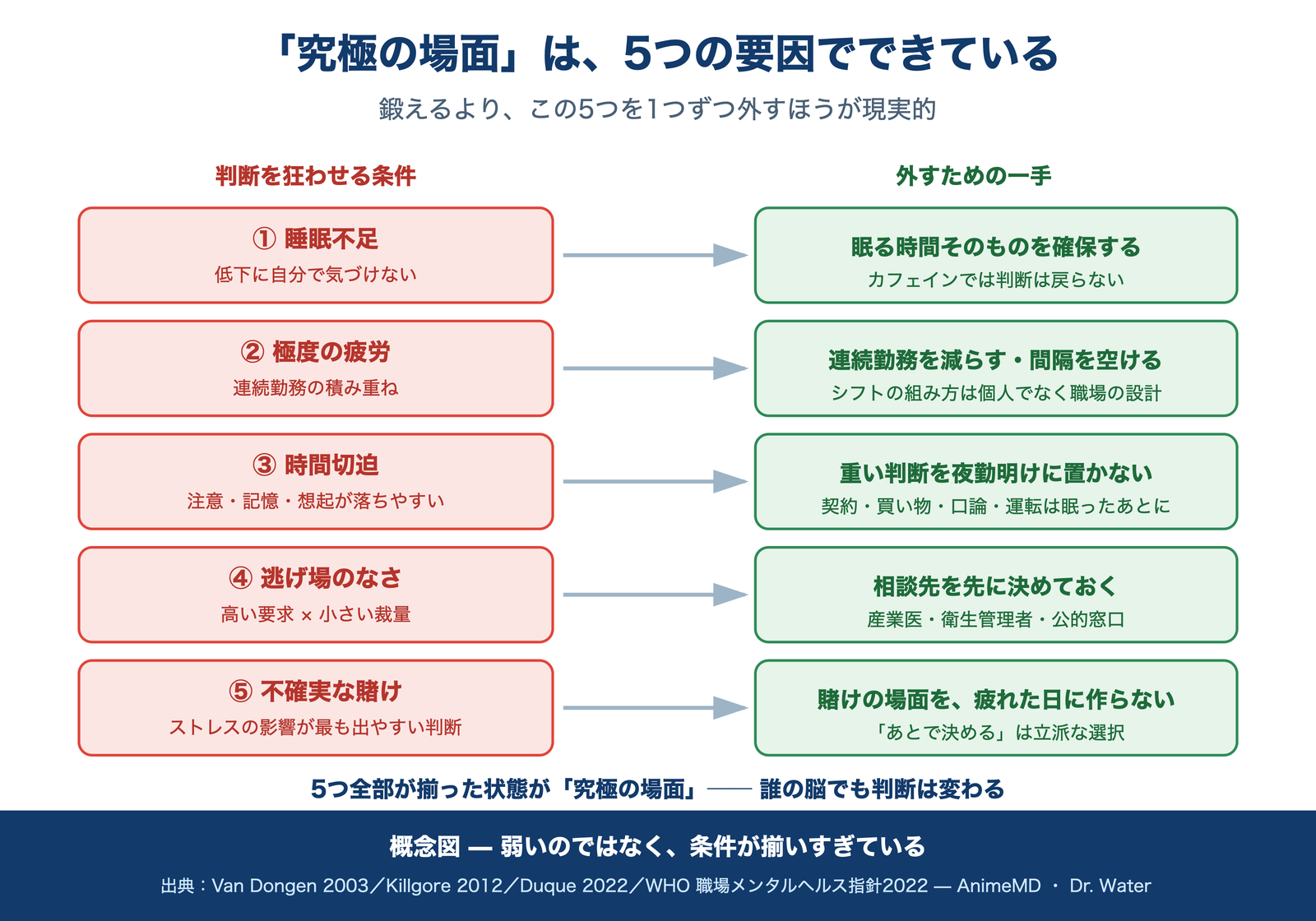
Line it up and a picture appears:
- The beer after a night shift tastes good because of the state of the body, not the state of your willpower
- Kaiji misjudges perhaps not because he is bold, but because he cannot detect his own decline
- And the pleasure side and the damage side are continuous with each other — both are about bodily state rather than character
Which is why my practical conclusion as an occupational physician is the opposite of a pep talk. Individual effort is not enough. So you go after the “ultimate moments” too: protect sleep, cut back-to-back shifts, don’t schedule heavy decisions right after nights, build in an exit. Unglamorous — and workplaces that can shave this down are the strong ones.
And here’s the thing: the manga said all of this first.
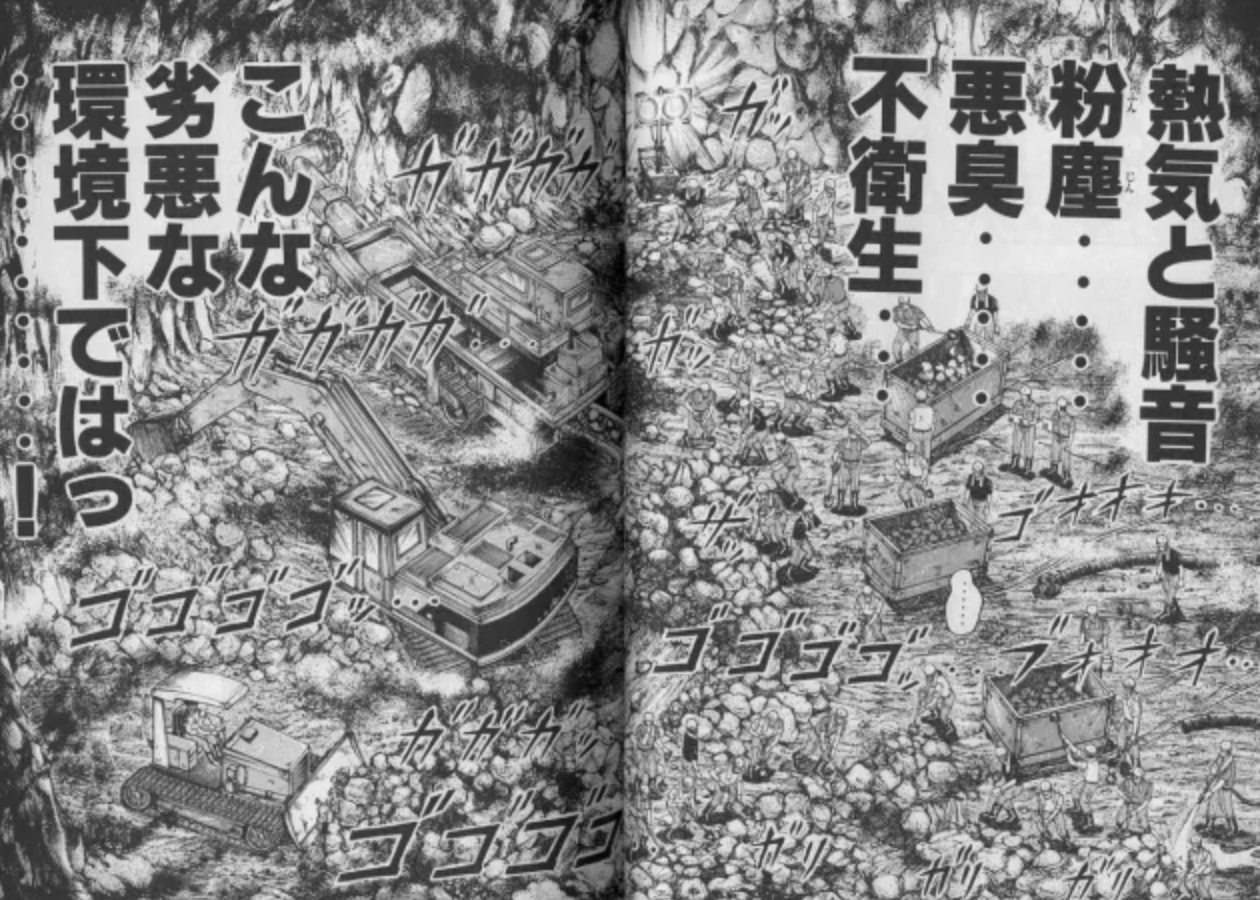
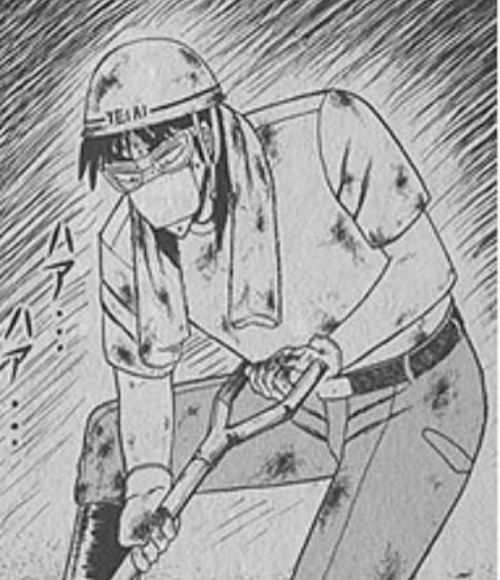
Heat. Noise. Dust. Stench. Poor hygiene. That is, almost item for item, the checklist an occupational physician runs when walking a worksite. These men are not deteriorating because of their attitude. The environment was built to do it. And the work draws it as a picture of the environment, not as a lecture about spirit.
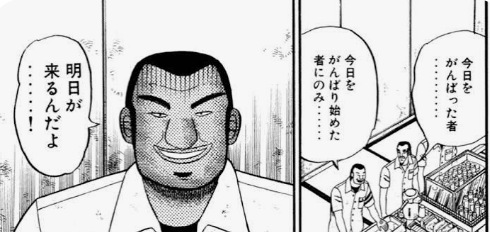
Inside that environment, this is the line that gets spoken. It sounds good. It genuinely lands.
But read it with an occupational physician’s eyes and it’s also a cold one. Leave the terrible conditions exactly as they are, and encourage the individual to “give today everything” — that sentence can also function as a way of never changing the conditions.
There are places where “get stronger” does not work. In those places you don’t change the strength. You change the conditions.
And now the confession
Having spoken in the language of science this whole time, I should admit: science does not read human behaviour all the way to the bottom.
Say “stress bites hardest in uncertain gambles” — and somebody gets strangely sharp at exactly that moment. Say “sleep loss changes judgement” — and the direction differs person to person. Kaiji himself plays a string of foolish hands and then, when it counts, produces something no common sense accounts for.
That gap is the most interesting thing about people. Medicine can tell you, at best, “under these conditions, this is the way it tends to fall.” The moment somebody vaults over that probability is the moment we get chills. That’s probably why this story has its hooks in so many of us.
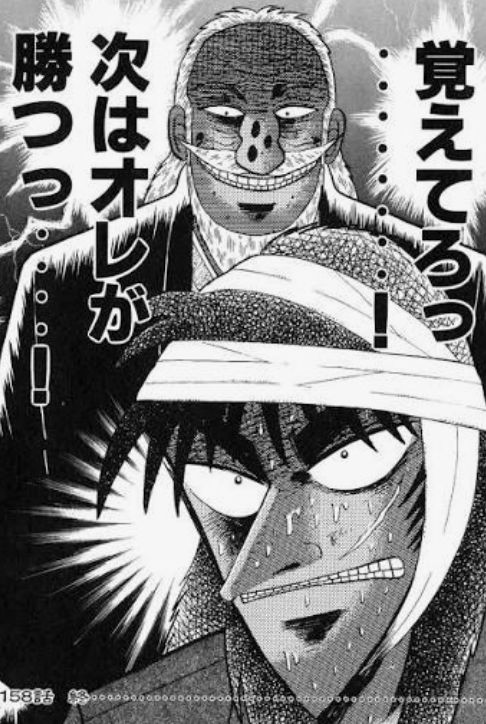
So today isn’t about fitting you into a mould. Knowing a few of your body’s habits might just stop you falling over needlessly when it counts. A charm, roughly that size.
And with luck, your next beer after a night shift tastes a little richer for it.
See you at the next examination. 🐬
Frequently Asked Questions
Why does beer taste so much better after a night shift?
Because the state of your body has changed. The phenomenon where the same stimulus feels more or less pleasant depending on your internal state is called alliesthesia. In an experiment with young men under fluid restriction, the rated pleasantness of drinking began rising at around four hours and kept climbing as thirst increased. It isn’t weak willpower — a dehydrated, overheated body coming down off tension is built to find that drink more pleasant.
Is it true that alcohol reduces deep sleep?
For the first half of the night it’s the opposite. Reviews of studies in healthy people find that alcohol shortens the time to fall asleep and increases deep sleep in the first half. The problem is the second half, where you wake more easily. So “I slept well” is not an illusion — it’s just partly collected back later in the night.
What should I be careful about if I drink after a night shift?
Drink after you get home: coming off nights, sleepiness alone raises crash risk, and alcohol on top needs no explanation. Avoid drinking immediately before sleep, and check whether it has quietly become “drinking in order to sleep.” A nightly drink is a habit worth reducing — but if it has become a daily habit, do not stop abruptly, because withdrawal can cause severe insomnia and feeling unwell. Taper over weeks or work with a clinician.
Disclaimer 1 | Medical
This article is entertainment commentary and general education, not medical advice, diagnosis, or treatment. I am not your physician, and reading this creates no doctor–patient relationship. Please take health decisions with your own clinician.
- Never drive after drinking. Coming off a night shift, sleepiness alone raises crash risk; alcohol on top needs no explanation.
- If low mood or distress persists, please see a professional rather than self-diagnosing from this article.
- If a nightly drink has become a habit, do not stop abruptly. Withdrawal can cause severe insomnia and physical symptoms. Taper over weeks, or reduce with clinical support.
- Sleepiness on shift work is not a question of grit. For driving or hazardous work it causes accidents. Raise it with your occupational health service.
- Alcohol use disorder, gambling disorder, depression and shift work disorder are real medical conditions. Nothing here diagnoses any real person or any fictional character.
Disclaimer 2 | Copyright & Non-Affiliation
This site is an independent, unofficial fan commentary/criticism work. It is not affiliated with, endorsed by, or sponsored by any anime/manga studio, publisher, author, or rights holder. All titles, characters, logos, and trademarks belong to their respective owners and are referenced here solely for identification, commentary, and criticism. This article reproduces a limited number of manga panels from Kaiji (Nobuyuki Fukumoto, Kodansha) as quotation for the purpose of criticism and commentary under fair use, using no more of the work than the commentary requires. Each panel is reproduced unaltered — including all original Japanese text within speech bubbles, with English translations provided only in the captions outside the image — is attributed to its source, and is used only to support the surrounding analysis, which is the substance of this piece. No pirated scans are used; panels are taken from purchased volumes. Where English dialogue appears in a caption, it is my own translation, provided outside the image for the reader’s comprehension; the panels themselves retain their original Japanese text. Rights holders with concerns: please contact us and we will respond promptly.
Sources (DOI)
- Q1 · effort is treated as a cost, not a bonus: Collins AG, et al. Interactions among working memory, reinforcement learning, and effort in value-based choice. Biological Psychiatry. 2017;82(6):431–439. https://doi.org/10.1016/j.biopsych.2017.05.017
- Q1 · alliesthesia: Cabanac M. Physiological role of pleasure. Science. 1971;173(4002):1103–1107. https://doi.org/10.1126/science.173.4002.1103
- Q1 · pleasantness of drinking rises with thirst: Armstrong LE, et al. Progression of human subjective perceptions during euhydration, mild dehydration, and drinking. Physiology & Behavior. 2021;229:113211. https://doi.org/10.1016/j.physbeh.2020.113211
- Q1 · 36% at start / 45% at end of shift: El-Sharkawy AM, et al. Hydration amongst nurses and doctors on-call (the HANDS on prospective cohort study). Clinical Nutrition. 2016;35(4):935–942. https://doi.org/10.1016/j.clnu.2015.07.007
- Q1 · pain relief as pleasure: Leknes S, et al. Pain relief as an opponent process: a psychophysical investigation. European Journal of Neuroscience. 2008;28(4):794–801. https://doi.org/10.1111/j.1460-9568.2008.06380.x
- Q2 · stress helps or hurts depending on the situation: Starcke K, Brand M. Decision making under stress: a selective review. Neuroscience & Biobehavioral Reviews. 2012;36(4):1228–1248. https://doi.org/10.1016/j.neubiorev.2012.02.003
- Q2 · gamble-like vs realistic decisions: Duque A, et al. Effects of psychological stress and cortisol on decision making and motivational processes. European Journal of Neuroscience. 2022;56(2):3889–3920. https://doi.org/10.1111/ejn.15721
- Q2 · roughly two thirds follow a resilient trajectory: Galatzer-Levy IR, et al. Trajectories of resilience and dysfunction following potential trauma. Clinical Psychology Review. 2018;63:41–55. https://doi.org/10.1016/j.cpr.2018.05.008
- Q3 · riskier choices after 49 h without sleep: Killgore WDS, et al. Impaired decision making following 49 h of sleep deprivation. Journal of Sleep Research. 2006;15(1):7–13. https://doi.org/10.1111/j.1365-2869.2006.00487.x
- Q3 · direction differs by known-risk vs ambiguous: McKenna BS, et al. The effects of one night of sleep deprivation on known-risk and ambiguous-risk decisions. Journal of Sleep Research. 2007;16(3):245–252. https://doi.org/10.1111/j.1365-2869.2007.00591.x
- Q3 · sex moderates the effect; restriction differs from total deprivation: Lim JYL, et al. Sex moderates the effects of total sleep deprivation and sleep restriction on risk preference. Sleep. 2022;45(9). https://doi.org/10.1093/sleep/zsac120
- Q3 · framing and probability distortion without feedback: Sundelin T, et al. Framing effect, probability distortion, and gambling tendency without feedback are resistant to two nights of experimental sleep restriction. Scientific Reports. 2019;9:44237. https://doi.org/10.1038/s41598-019-44237-9
- Q3 · performance falls while subjective sleepiness barely moves: Van Dongen HP, et al. The cumulative cost of additional wakefulness: dose-response effects on neurobehavioral functions and sleep physiology. Sleep. 2003;26(2):117–126. https://doi.org/10.1093/sleep/26.2.117
- Q3 · stimulants restore alertness but not decision quality: Killgore WDS, et al. Gambling when sleep deprived: don’t bet on stimulants. Chronobiology International. 2012;29(1):43–54. https://doi.org/10.3109/07420528.2011.635230
- Q4 · alcohol and sleep, first half vs second half: Ebrahim IO, et al. Alcohol and sleep I: effects on normal sleep. Alcoholism: Clinical and Experimental Research. 2013;37(4). https://doi.org/10.1111/acer.12006
- Q4 · shift work sleep disorder prevalence: Drake CL, et al. Shift work sleep disorder: prevalence and consequences beyond that of symptomatic day workers. Sleep. 2004;27(8):1453–1462. https://doi.org/10.1093/sleep/27.8.1453
- Q4 · shift work disorder overview: Reid KJ, Abbott SM. Jet lag and shift work disorder. Sleep Medicine Clinics. 2015;10(4):523–535. https://doi.org/10.1016/j.jsmc.2015.08.006
Bibliographic details for every entry above were retrieved from the Crossref record for each DOI, and each is mapped to the specific claim it supports in the Japanese original, which passed a three-layer citation audit (DOI resolves · bibliography matches · the paper actually says what it is cited for).
🩺 Your check-up is over — but the clinic is always open
📚 This clinic has a sequel. 14 legendary monsters — vampire, zombie, werewolf and more — properly diagnosed by a real doctor. The book this blog grew into, with new write-ups added. → Get it on Amazon — $3.99 / free on Kindle Unlimited
💌 Free newsletter — new diagnoses delivered to your inbox, no appointment needed. → Subscribe on Substack
▶️ Prefer video? Watch the diagnoses on YouTube. → The Anime MD

Comments