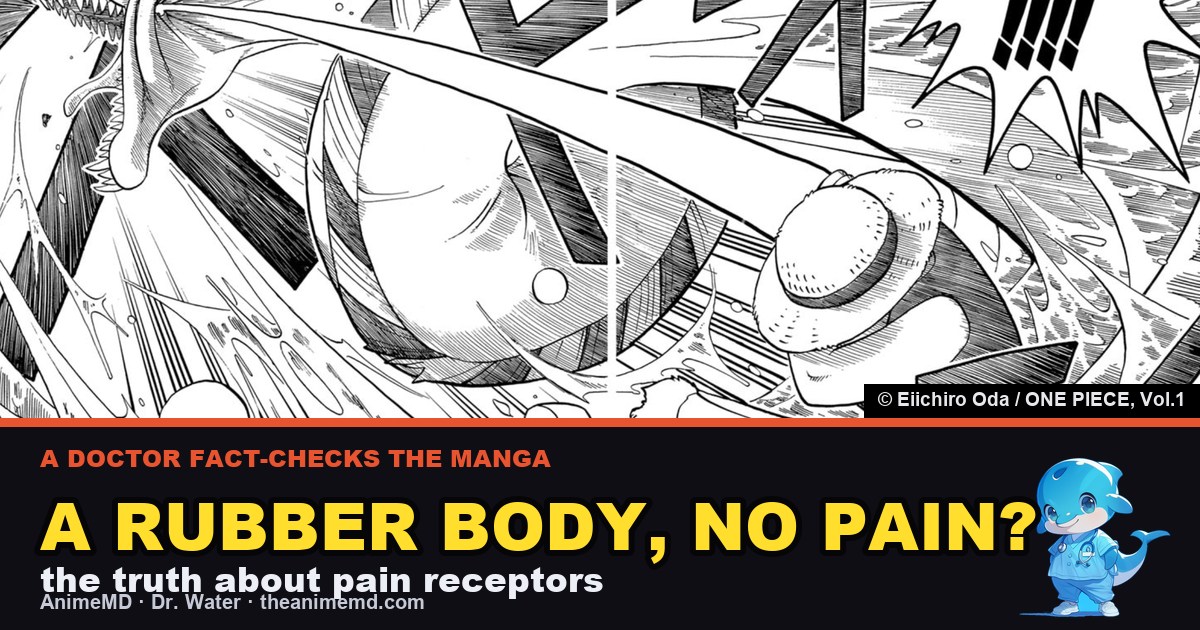
〈Body-Check #02〉 · a Dr. Water check-up
Hi. I’m Dr. Water 🐬. I’m a doctor — the unglamorous kind who spends his days keeping working adults healthy. Today, though, I’d like to talk about manga instead of blood pressure.
It started simply. I reopened Volume 1 of ONE PIECE for the first time in ages, and from the first chapter on, one question kept jamming up in my head: “Okay, but what would actually happen to a human body here?” Bullets bouncing off a body. A boy who won’t flinch in pain. Eat a strange fruit and you can never swim again. An arm bitten clean off — and its owner standing there, smiling. A kid cutting open his own face. Every bit of it — the body. And if it’s about the body, a doctor has no excuse not to check the math.
So here’s today’s plan: I read Volume 1 from the top and fact-check five scenes against real medicine. One scene, one verdict. Some land on “huh — actually kind of true,” some on “yeah, that’s fantasy,” and two on “in real life, this is genuinely dangerous.”
📚 Today’s “patient”: Eiichiro Oda, ONE PIECE Vol. 1 (Shueisha). Read it the legit way on the official Manga Plus (VIZ).
The house rules
I’m not here to dunk on the manga. I’m here to ask, “if a human body did this, what would really happen?” — and back every medical claim with a paper (DOI, so I can’t quietly cheat). I don’t reproduce dialogue; I describe each scene in my own words, and where I show a panel, it’s a single official panel with a citation, used only because the scene itself is what I’m examining.
Scene 1 | A boy eats a strange fruit and turns to rubber — can a body that bounces bullets and feels no pain exist?
Early in Volume 1, the young hero eats a mysterious fruit and his whole body takes on the properties of rubber. From then on he catches point-blank gunfire and pings it back, absorbs blows by stretching, and barely registers pain. “A body that shrugs off strikes and bullets” becomes the ground rule the whole story stands on.
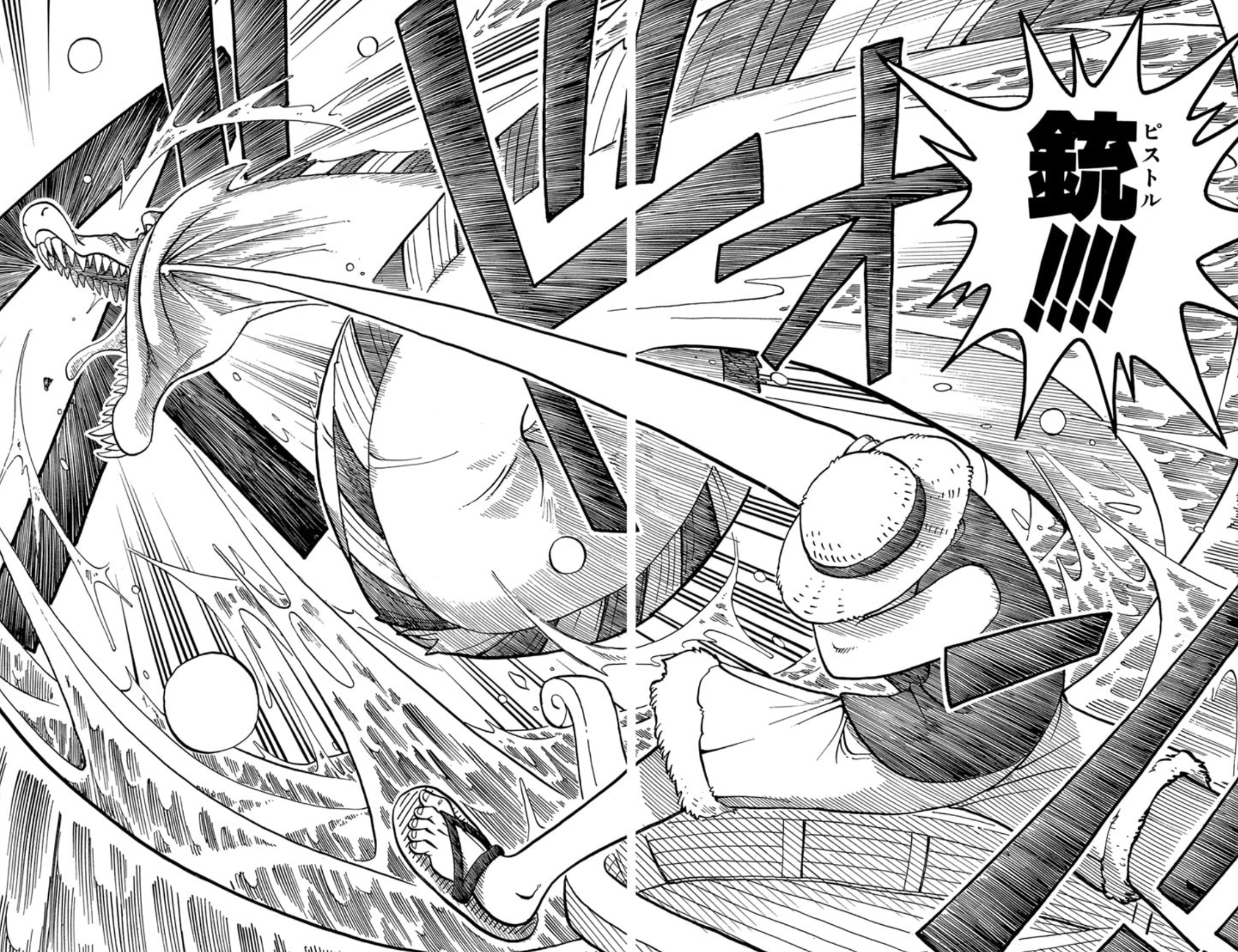
The first thing that snagged me, as a doctor, is that this body quietly bundles two separate miracles into one. “Bounces bullets” and “feels no pain.” Similar-sounding, wildly different — the doctor in me mutters.
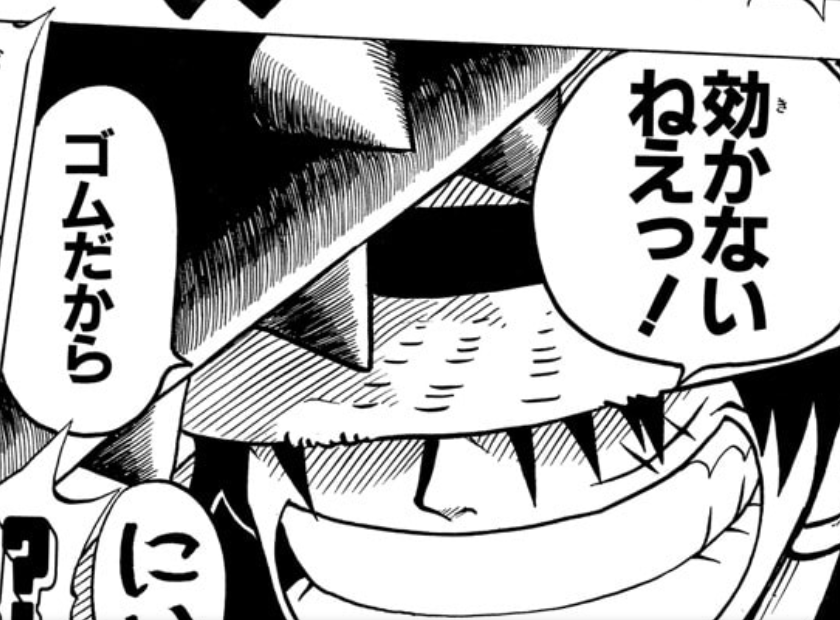
The bullet-bouncing part actually has a kernel of logic. Rubber’s elasticity spreads an impact over a wider area and stretches out the contact time, lowering the peak force — the same idea as a helmet or a car bumper (textbook materials mechanics). But hold on — reflecting a bullet is another thing entirely. No human tissue has that elastic modulus or strength. You might cushion it; bouncing it back is a different universe. Here, physics taps out first.
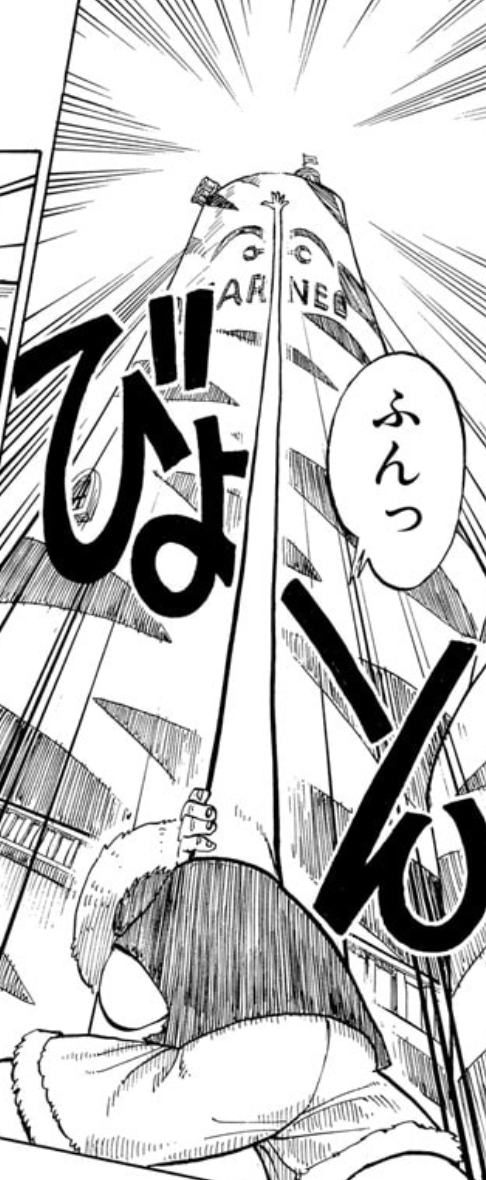
The interesting one is the “no pain” body — because that one is real. People whose pain-signaling sodium channel Nav1.7 doesn’t work (a loss-of-function in the SCN9A gene) are born unable to feel pain (Cox et al., Nature 2006). The same is true in congenital insensitivity to pain with anhidrosis (CIPA, NTRK1 mutation), where pain sensation and sweating are both absent from birth (Indo, Human Mutation 2001).
So — invincible, right? Is that a thing? — Yes. Halfway. But they don’t bounce bullets; their tissue breaks like anyone’s. Worse, because there’s no pain, they miss fractures, burns, and joints grinding themselves apart — and it costs them. Pain isn’t the enemy; it’s the alarm. Fiction’s “no pain = invincible” runs, in real life, in exactly the opposite direction. I’ll say that one with a straight face.
Verdict: ✕–△. Rubber spreading an impact is real physics, but no living body bounces bullets. A “body that feels no pain” genuinely exists — and it’s not invincibility, it’s a serious disability with the alarm cut off.
Takeaway: A body that feels no pain is real, but it’s not proof of strength — it’s a disabled warning system. Pain is a sensor that protects you; without it, you miss the damage and it shortens your life.
 Dr. Water
Read that back: “feels no pain” is a real condition — and it’s dangerous because the alarm is off. Pain isn’t the villain here; it’s the smoke detector. 🐬
▶ Related check-up: Fighting through the pain? — the flip side of this scene, where I check whether adrenaline really lets a body keep swinging through a wound instead of feeling nothing at all.
Scene 2 | The price of the Devil Fruit is losing the ability to swim — why do people float, and why do they sink?
Volume 1 establishes that whoever eats a Devil Fruit pays a price: they “can no longer swim.” The hero, too, trades his rubber powers for a body that sinks like a stone and goes limp in water. From then on, the sea = the power-user’s weakness becomes a recurring rule of the story.
Dr. Water again 🐬. The Devil Fruit’s price is “you can’t swim.” I admired the writing for a beat — then, hold on, the doctor cut in. Whether a person floats or sinks isn’t a power. It’s density.
Sink a body in water and buoyancy pushes back. Lighter than the water you displace, you float; heavier, you sink. What tips the scale is body composition. Fat has a specific gravity around 0.9 — lighter than water — while muscle and bone sit near 1.1 (textbook fact). So the human body’s average lands right around 1.0, out on the tightrope between floating and sinking.
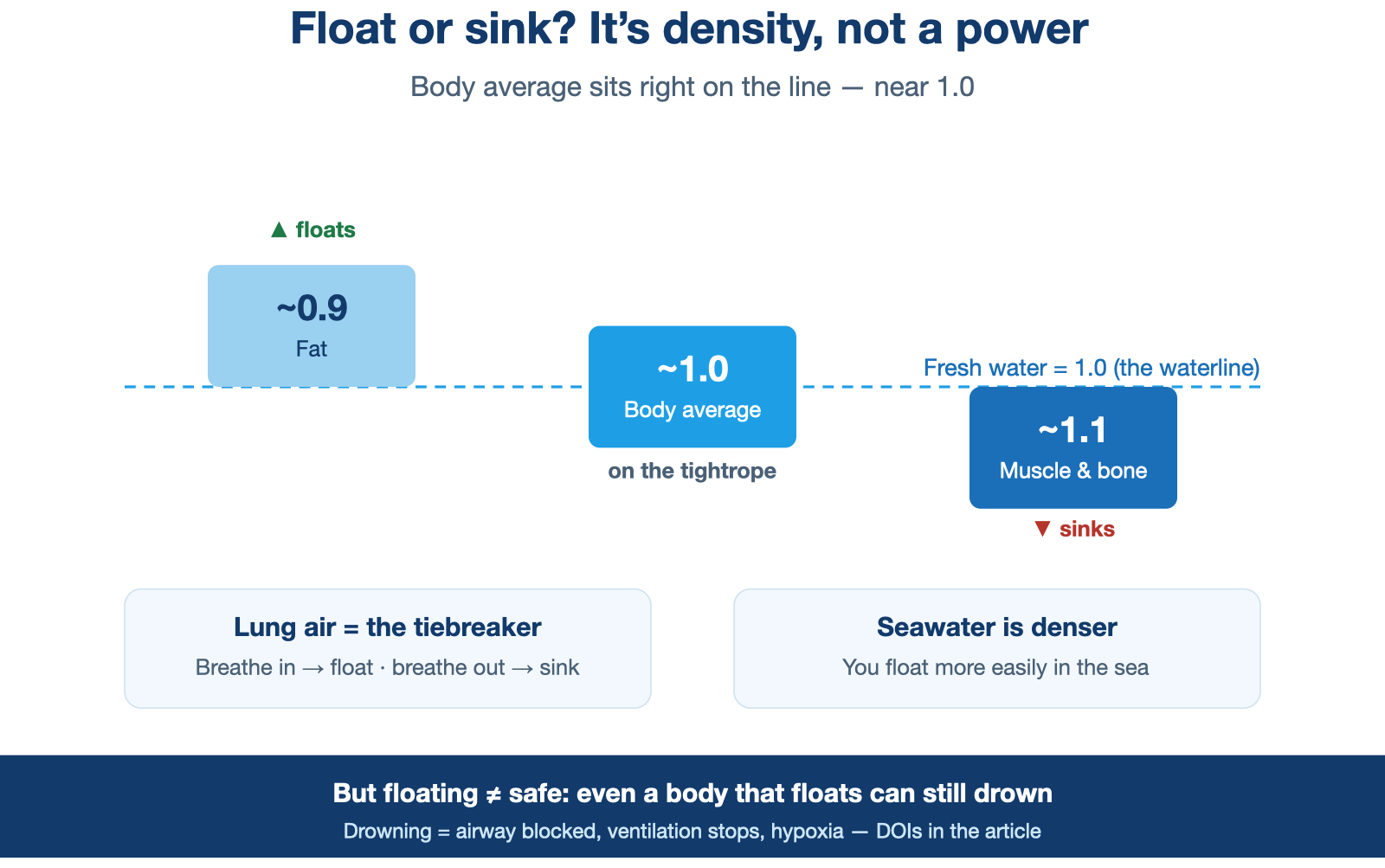
The tiebreaker is the air in your lungs. Breathe in deep and your chest becomes a life-ring and you float; breathe all the way out and you sink. And seawater is denser than fresh water, so you float more easily in it — that memory of bobbing effortlessly in the ocean but struggling in the pool isn’t your imagination.
But here’s the thing. Being able to float and being safe from drowning are two different questions. Drowning is, at its core, the airway getting blocked by water and oxygen getting cut off — and it proceeds whether your body floats or not (Szpilman et al., New England Journal of Medicine 2012; Bierens & Lunetta, Physiology 2016). Is that a thing — floaters drown? → Yes. That’s exactly right. Luffy sinking is fantasy, but “even a floating body is in danger in water” is real. Wear the life jacket. I mean it.
Verdict: ○. Human buoyancy — body composition and the air in your lungs — is real, and so is floating more easily in seawater. But “a power’s price steals your ability to swim” is fantasy. And note: even a body that floats can still drown.
Takeaway: Floating vs. sinking is set by density, not willpower — tuned by lung air and by fresh-vs-salt water. But “able to float” and “safe from drowning” are separate: even a naturally buoyant body drowns when oxygen is cut off.
Scene 3 | ⚠️ An arm bitten clean off — and he’s standing, smiling: can you survive limb loss in the sea?
(A slightly more serious stretch now. This is the scene with the most to flag today.)
The climax of Volume 1. Red-Haired Shanks shields the boy from a huge sea beast and pulls him to safety — at the cost of one arm, bitten off below the elbow. He loses the arm in the water, carries the boy back alive, and stands there afterward, bleeding from the stump, smiling. Traumatic limb amputation, major hemorrhage, a cold-water setting, and “and then he goes on living normally” — medically, this scene is a pile-up.
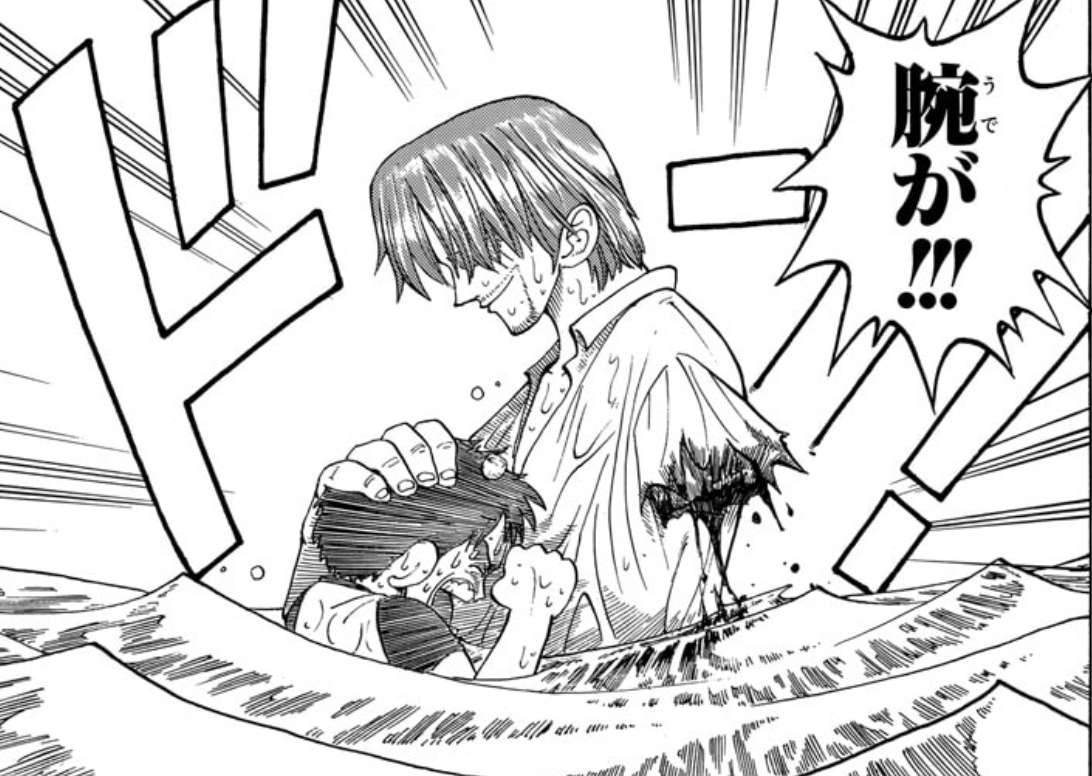
Shanks trades an arm to save the boy. It’s a landmark scene. It is — but a doctor’s eye jumps straight to the “C” of ABC (circulation). Take an arm off below the elbow and if the brachial artery is severed, untreated blood loss is measured in minutes. That is not a volume of bleeding you stand and smile through on the open sea. Hold on, the doctor mutters again.
Seawater is cold. Hypothermia slows clotting and makes bleeding worse. The trauma “lethal triad” — hypothermia, acidosis, coagulopathy — is exactly the stage set here. And in the water, direct pressure and a tourniquet are both hard to apply.
There’s one piece of medicine that stands on Shanks’s side. A large artery, cleanly cut, can retract and spasm at the stump, which in theory nudges it toward stopping itself. “Isn’t that a bit convenient?” — Yes. Halfway. But it’s not an opponent you bet on. In real severe limb hemorrhage, the person who stops it on the spot lives; the one who waits dies. Prehospital tourniquets substantially raise survival (Kragh et al., Annals of Surgery 2009) — and severe limb injuries from the sea are not hypothetical: an emergency-department case series of shark-related injuries documents exactly these bite-off-a-limb presentations (Tomberg et al., American Journal of Emergency Medicine 2018).
So this scene: emotion, full marks; survival odds, needs review. Please don’t copy it. At sea or on land, major bleeding gets stopped first. I won’t make a joke of this one.
Verdict: ⚠️ (leaning “lethal in real life”). A below-elbow traumatic amputation + immersion + cold water stacks minutes-to-exsanguination, hemorrhagic shock, and hypothermic coagulopathy — the worst possible combination. Because stump-vessel spasm plus fast hemostasis does produce real survivors, it’s not a flat ✕, but a ⚠️. The “standing and smiling right after” is fiction’s mercy.
Takeaway: Major limb bleeding — at sea or on land — follows one rule: stop it first. Fast prehospital hemostasis (pressure, tourniquet) sharply raises survival. Keep the person warm, because cold makes bleeding worse. A stump vessel spasming shut is the lucky exception, not a bet. (This is general knowledge, not diagnostic or treatment advice.)
Dr. WaterThis is the one I say with a straight face: a bitten-off arm at sea isn’t grit, it’s a clock. Major bleeding gets stopped first — pressure, tourniquet, keep them warm. 🙏
Scene 4 | A dare, a blade under his own eye — will that scar really last a lifetime?
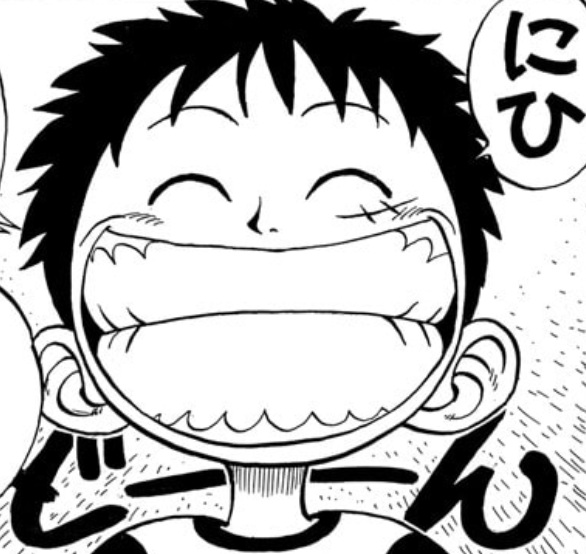
A childhood flashback in Volume 1. To prove his nerve to his friends, the boy cuts himself under the left eye with a blade. Everyone’s alarmed; Shanks and the others scramble. And that scar stays — the trademark mark under his left eye, still there years later, all grown up.
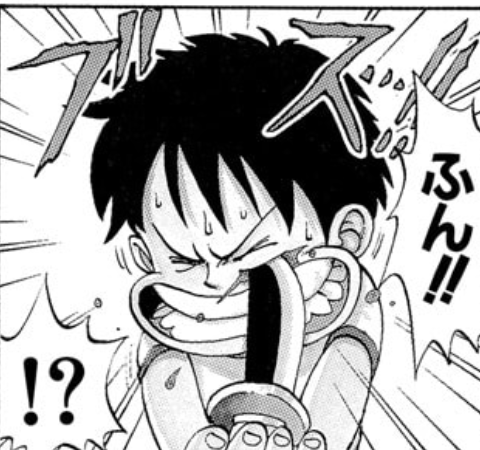
Dr. Water here. A boy cuts under his own eye with a blade to prove his nerve. The first thing that surfaced as I read was the occupational reflex: “kid, that one’s permanent.” And to cut to the verdict — it stays. That part is true.
Skin is two layers: epidermis and dermis. A shallow cut that stops in the epidermis heals with barely a trace — but reach the deep layer of the dermis (the reticular dermis) and the story changes. Cut there, and fibroblasts fill the gap with collagen, which stays behind as a permanent scar. Injuries that don’t reach the reticular dermis don’t produce hypertrophic scars or keloids, whereas deeper injuries carry chronic inflammation and scar over (Ogawa, International Journal of Molecular Sciences 2017).
Hold on — on the face, wouldn’t it stay shallow? — I thought that for a second, and it’s the opposite. Facial skin is thin, so a blade reaches the deep layer easily. That’s why the mark under the eye sticks. The logic, annoyingly, checks out.
Scar collagen is laid down in a different arrangement from normal skin, and while it can regain tensile strength, the elasticity, hair follicles, and oil glands don’t come back (Govindaraju et al., Matrix Biology 2019). So “it never fully returns to original” is the essence of a scar.
For the record: a dare that involves cutting yourself gets zero medical endorsement. That part, straight-faced.
Verdict: ○ (the scar stays = true). If a blade goes from the thin skin of the face into the deep dermis (reticular layer), a collagen scar is permanent. A mark under the eye lasting a lifetime is medically correct.
Takeaway: If a blade goes from the face’s thin skin into the deep dermis, the collagen scar is permanent — the lifelong mark is medically accurate. (Self-injury on a dare, though, is not something medicine endorses.)
Scene 5 | ⚠️ “The one who can’t swim falls into the sea” — is drowning dangerous because your strength gives out?
(This one’s about safety too. Read it calmly.)
The rule set up early on: those who ate a Devil Fruit are “hated by the sea” — in the water, their strength drains and they can’t swim. Long-voyage food-and-water shortages (fasting, dehydration, scurvy) are candidates too, but a separate article (“voyages and nutrition”) takes those head-on, so here I’ll lean on what’s specific to Volume 1: “someone who can’t swim falls into the sea = the danger of drowning.” I’ve generalized the scene into my own words.
“Eat that fruit and the sea rejects you; you can’t swim.” I started to nod — risk in exchange for power, sure — and then, hold on, the doctor in me cut in. That’s less a fantasy rule than actual drowning physiology.
What kills people in the water isn’t dramatic waves or a failure of willpower. The core of it is “the airway getting blocked by water so ventilation stops and the body goes hypoxic.” And unlike the movies, it’s usually quiet — playing out over tens of seconds to a few minutes rather than a thrashing, shouting scene (Szpilman et al., New England Journal of Medicine 2012; Bierens & Lunetta, Physiology 2016). So “falling into water in a body that can’t swim” being dangerous is, as a premise, sound.
The nastier layer is cold water. The instant you hit it, an involuntary gasp and hyperventilation fire off — and that’s what invites the first mouthful of water (Datta & Tipton, Journal of Applied Physiology 2006). “So just hold your breath?” — I wanted to push back too — but that reflex is hard to override by will.
And meanly, the parasympathetic pull of the dive response and the sympathetic surge of cold-water shock can tug against each other and trigger a fatal arrhythmia — a proposed “different way to die” in cold water (Shattock & Tipton, The Journal of Physiology 2012). The physiology of cold-water immersion itself has been reviewed experimentally (Tipton et al., Experimental Physiology 2017).
So — having nearly endorsed the whole premise (who was nodding along a second ago?) — reality’s headline is less “dangerous because your strength gives out” and more “dangerous because you can’t ventilate and go hypoxic.” That part, straight-faced. If you see someone drowning, before you jump in, call for help and get emergency services. That holds on the open sea and at your local pool. (This article is not a rescue or resuscitation manual.)
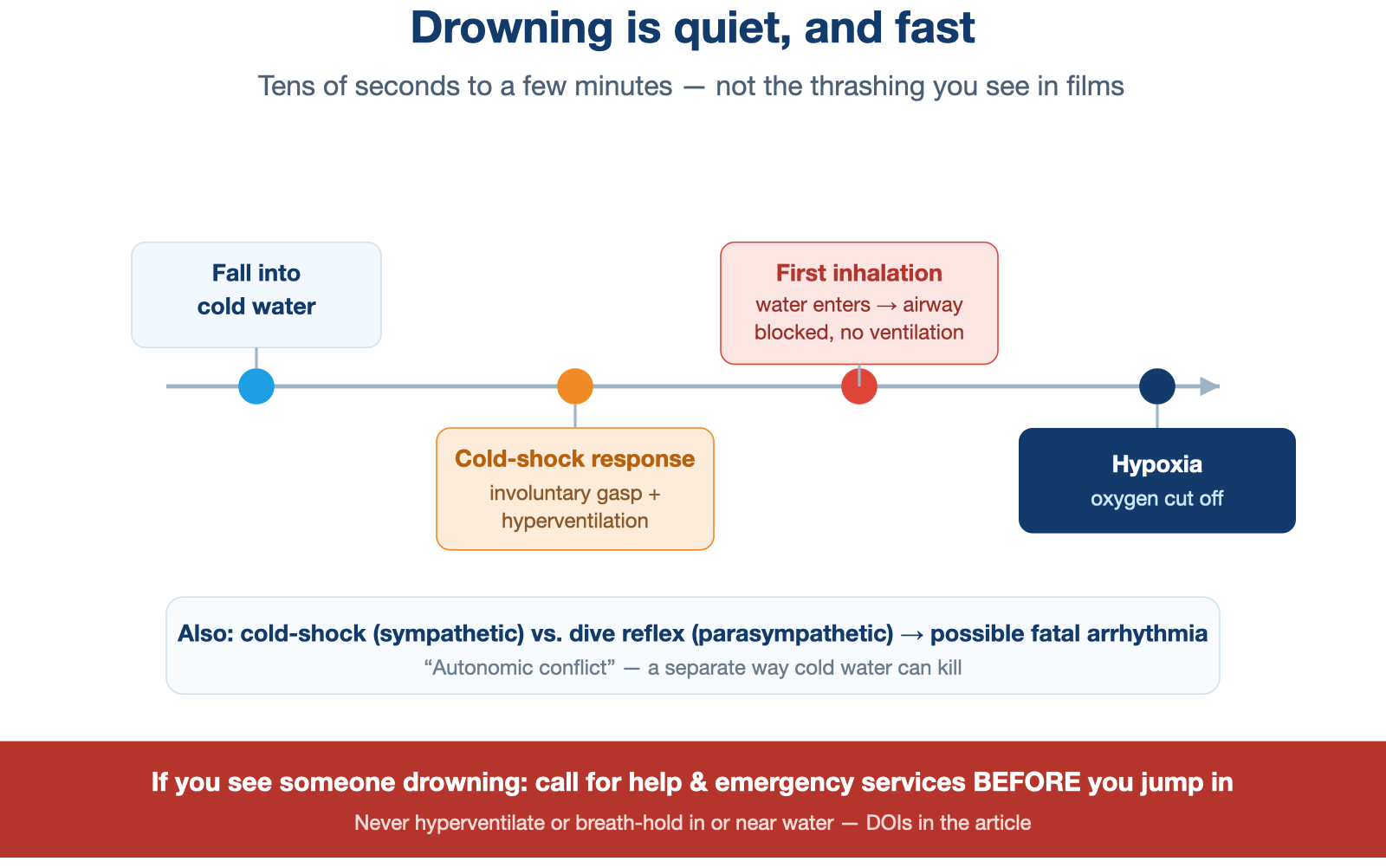
Verdict: ⚠️. The direction of the rule — being unable to move your body in the water is deadly — doesn’t contradict real drowning physiology. But the real essence isn’t “your strength gives out,” it’s “the airway is blocked, ventilation stops, and you go hypoxic” — and it comes on quietly, not with thrashing. That’s the gap between the drama and the mechanism.
Takeaway: “Falling into water in a body that can’t swim is dangerous” points the right way. But real drowning is about blocked airway → no ventilation → hypoxia, and it comes on quietly. In cold water, the moment-of-impact “cold-shock response” (involuntary gasp, hyperventilation) invites the first inhalation of water, and the autonomic tug-of-war can even cause a fatal arrhythmia. Prevention comes first: if you see someone drowning, call for help and emergency services before jumping in.
Dr. WaterThe scary part? Real drowning is quiet — no thrashing, no shouting. Seconds, not a movie scene. If you see it, call for help before you jump in. 🐬
The scorecard: Volume 1 really was all about the body
| # | Scene (Vol. 1) | Medical point | Verdict |
|---|---|---|---|
| 1 | Strange fruit → rubber body, no pain (Ch. 1) | Rubber impact-spreading / congenital pain insensitivity (SCN9A, CIPA) | ✕–△ |
| 2 | Devil Fruit’s price = can’t swim | Buoyancy, body composition, lung air / drowning is separate | ○ |
| 3 | Arm bitten off, standing and smiling (Ch. 1) | Limb amputation, major hemorrhage, cold water, lethal triad | ⚠️ lethal-leaning |
| 4 | A dare: cutting under the eye (flashback) | Wound healing, deep dermis and scarring | ○ scar stays |
| 5 | The non-swimmer falls into the sea (early rule) | Drowning pathophysiology, cold-water shock | ⚠️ dangerous |
Reading it through, here’s what struck me: ONE PIECE Volume 1 is a surprisingly honest textbook on the body. The exaggerations are exaggerations, but there’s real physiology underneath. Rubber, buoyancy, amputation, scars, drowning — all of it is, also, a story about your body.
Wrap-up
One volume, read cover to cover through a doctor’s eyes. Boiled down to three takeaways:
- Scars stay / floating vs. sinking is set by density — here the story is right. Skin and buoyancy physics are your real life.
- Bullets don’t bounce / “no pain” isn’t invincibility — “zero pain” is real, but it’s a serious disability with the alarm cut off, not proof of strength.
- And neither a bitten-off arm nor drowning is something you power through on guts. This is the one I mean straight. Major bleeding gets stopped first; for a drowning, call emergency services before you jump in.
Manga is a doorway into how strange the human body is. And the real body is far more interesting than you’d guess. From Volume 2 on, I’ll keep reading it through the “body.”
See you at the next check-up.
📚 Read today’s source the legit way on the official Manga Plus (VIZ).
📚 Following the series? This was 〈Body-Check #02〉. More anime, fact-checked by a doctor, is on the way. Get each new check-up in your inbox — subscribe free.
Dr. Water — physician; covers preventive medicine and a slightly unhealthy amount of manga.
Frequently Asked Questions
Is there a real medical condition where people can’t feel pain, like the “no pain” body in One Piece?
Yes — congenital insensitivity to pain is real, caused by mutations in genes like SCN9A (affecting a pain-signaling channel called Nav1.7) or NTRK1 (causing CIPA, congenital insensitivity to pain with anhidrosis). This isn’t a superpower, though — it’s a serious disability. Without pain as a warning signal, people with these conditions are more likely to miss fractures, burns, and joint damage, which can shorten their lives.
Does being able to float in water mean you’re safe from drowning?
No — being buoyant and being safe from drowning are two separate things. Whether a body floats or sinks depends on density (fat is lighter than water, muscle and bone heavier) plus how much air is in your lungs, and salty seawater makes floating easier than fresh water. But drowning happens when the airway gets blocked by water and oxygen is cut off, which can happen to a floating body just as it can a sinking one.
What should you actually do if someone is bleeding heavily from a limb injury, or if you see someone drowning?
For major limb bleeding, stop it first — fast pressure or a tourniquet applied before reaching a hospital sharply raises survival, and keeping the person warm matters too, since cold makes bleeding worse. For drowning, call for help and emergency services before jumping in yourself: real drowning is quiet, without the thrashing shown in fiction, and unfolds over just seconds to minutes as the airway is blocked and the body goes without oxygen.
Disclaimer 1 | Medical
This article is general, educational medical commentary sparked by a work of entertainment. It is not medical advice and not intended to diagnose or treat. Reading it creates no doctor–patient relationship. For any health decision, consult your own physician. The author is a doctor, but these views are general and personal, and the author is not your doctor. Do not imitate depicted scenes (self-injury, traumatic limb injury, hyperventilation/breath-holding in or near water, jumping into cold water). In particular, never hyperventilate or breath-hold in or near water. If you see someone drowning, call for help and emergency services before entering the water yourself (this article is not a rescue or resuscitation manual).
Disclaimer 2 | Copyright & Non-Affiliation
This site is an independent, unofficial fan commentary/criticism work. It is not affiliated with, endorsed by, or sponsored by any anime/manga studio, publisher, author, or rights holder. All titles, characters, logos, and trademarks belong to their respective owners and are referenced here solely for identification, commentary, and criticism. Manga panels are used under the fair use doctrine (17 U.S.C. §107) for criticism and commentary only, in the minimum necessary amount, each with its source cited and each because the depicted scene is itself the subject of medical analysis. Rights holders with concerns: please contact us and we will respond promptly and, if appropriate, remove the material.
🩺 Your check-up is over — but the clinic is always open
📚 This clinic has a sequel. 14 legendary monsters — vampire, zombie, werewolf and more — properly diagnosed by a real doctor. The book this blog grew into, with new write-ups added. → Get it on Amazon — $3.99 / free on Kindle Unlimited
💌 Free newsletter — new diagnoses delivered to your inbox, no appointment needed. → Subscribe on Substack
▶️ Prefer video? Watch the diagnoses on YouTube. → The Anime MD




Comments